How to Get Your First 10 Customers (B2B SaaS)
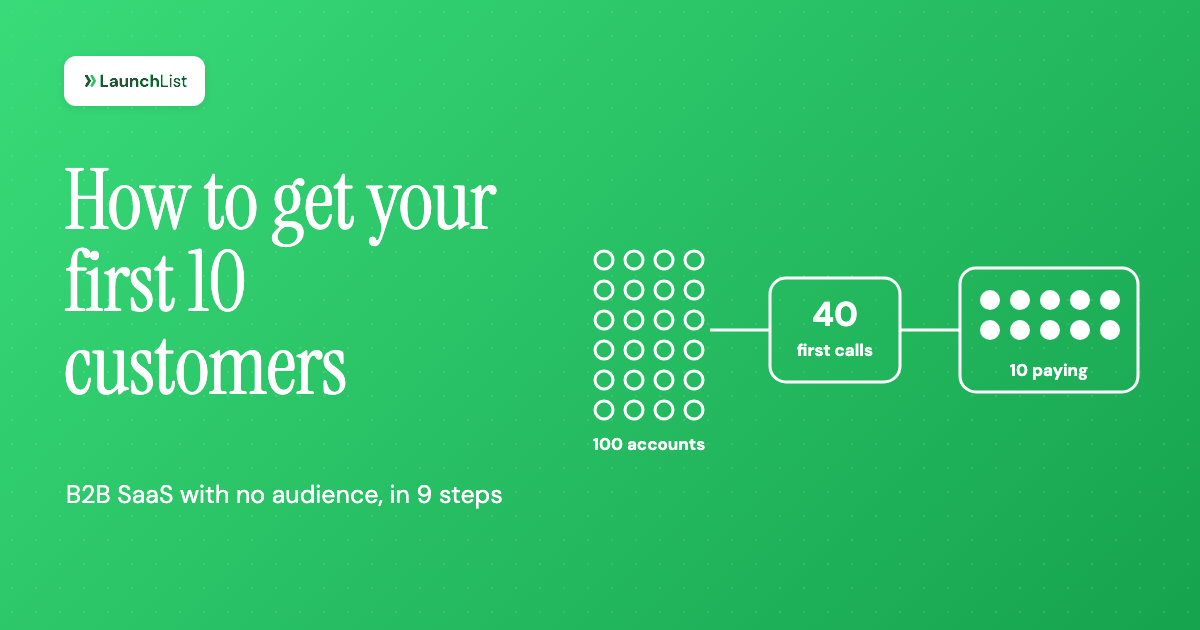
TL;DR: How to get your first 10 customers for a B2B SaaS product: finding first customers with no audience starts with people, not marketing. Choose one narrow type of company with an urgent problem, list 100 named accounts that fit, and work backwards from 10 paying customers to the number of conversations you need (about 40 first calls if one in four closes). Start with people who already trust you, then ask them for introductions, then add communities, LinkedIn, competitors' unhappy customers, partners and short, specific cold emails. Run each call on the buyer's problem, name the price before you hang up, and agree a next step with a date. For a B2B buyer, charge from the first customer, use paid pilots with written success criteria for larger buyers, and onboard every customer by hand. Below: the conversation math, 8 channels, 3 messages to copy, a call structure, pilot terms, 8 real examples and a 60-day plan.
Why the first 10 paying customers are a different problem
Your first 10 paying customers will not come from marketing. They come from you, one conversation at a time, because nobody has a reason to trust a company with no customers, no reviews and no track record. The only trust available at the start is the trust people place in you as a person.
Paul Graham put it plainly in his 2013 essay Do Things That Don't Scale: "You have to do sales yourself initially." That is founder-led sales. The founder who closes the first 10 hears every objection first-hand, can change the price or the product the same day, and learns what a repeatable sale looks like before teaching it to anyone else. The first 10 also tell you which companies buy fastest, which words they use for the problem and where onboarding breaks.
This guide is about how to get your first 10 customers as paying B2B companies found from zero, person by person. If you already have a list of interested people and are about to open the doors, how to convert a waitlist into paying customers is the better guide; if you are collecting interest from strangers, see how to get your first 100 waitlist signups. And if nothing is built yet, an idea validation landing page comes first, and idea validation tools lists the methods that work.
How to get your first 10 customers: the path in 9 steps
- Pick a narrow customer with an urgent problem and a reason to buy now.
- List 100 named accounts that fit, with the people to talk to at each.
- Do the conversation math so you know how much outreach the goal takes.
- Work the channels that find first B2B customers, and skip the ones that do not.
- Send short, specific messages written to one person at a time.
- Run a founder-led sales call on their problem, with the price and a next step.
- Use design partners and paid pilots for larger buyers.
- Charge B2B buyers from customer one with simple, written pricing.
- Onboard by hand, then ask for referrals and a short case study.
Step 1: Pick a narrow customer and a reason to buy now
Founders who struggle to find first customers are usually looking for "small businesses" or "marketing teams". You cannot list, message or find everyone. Narrow until you can.
Write one sentence: [role] at [type of company, with size] who [has this problem], usually because [trigger]. The trigger is what turns a problem they live with into a problem they will pay to fix this quarter.
| Too broad | Narrow enough to sell to |
|---|---|
| Marketing teams | Heads of marketing at 20 to 100 person B2B SaaS companies who just hired their first content writer |
| E-commerce stores | Shopify stores doing over $1M a year that sell on Amazon too and reconcile inventory in spreadsheets |
| Agencies | 5 to 30 person web agencies who bill hourly and lose track of out-of-scope requests |
| HR | Operations leads at 50 to 200 person companies hiring in more than one country for the first time |
Good triggers are visible from outside: a funding round, a new hire in the buyer's role, a job post that describes the problem, a public complaint about their current tool or a regulation with a deadline.
Two checks before you commit. Can you name 100 real companies that fit? And do they already spend money or time on the problem? A workaround (a spreadsheet, a contractor, a tool they dislike) is the best evidence that a budget exists. You can widen later: 10 similar customers teach you something, and 10 different ones mostly teach you noise.
Step 2: Build a list of 100 named accounts
A named-account list turns "find customers" into a task you can finish. Where to find the companies:
- LinkedIn search by job title, company size and industry.
- Job posts that mention the problem or the tool you replace.
- Review sites such as G2 and Capterra, where a competitor's reviews name the companies and roles that use it, and the low-star ones say what is wrong.
- Directories and member lists: industry associations, accelerator portfolios, marketplace partner directories, conference sponsor and speaker lists.
- Communities where the buyer asks for help (more in step 4).
What to record for each account:
| Column | Example |
|---|---|
| Company and size | Acme Agency, 18 people |
| Why they fit | Bills hourly, three job posts for project managers |
| Trigger | Hired a head of operations last month |
| People | The founder, the head of operations, a project manager |
| Warm path | Your former colleague worked there in 2023 |
| Status and next step | Intro asked on May 3, follow up May 10 |
List two or three people per account: the person who has the problem every day, the person who owns the budget, and someone senior enough to make the introduction. A spreadsheet is enough; a CRM can wait.
Step 3: Do the conversation math
Work backwards from 10 customers. The rates below are labelled: one is sourced, the rest are assumptions to replace with your own numbers after the first two weeks.
- Paying customers wanted: 10.
- First calls needed: 10 ÷ 25% = 40, assuming one in four first calls with a well-chosen account ends in a paid customer or paid pilot. This is an assumption; a narrow, urgent problem does better and a vague one does worse.
- Where 40 calls come from, as an example mix:
- Warm introductions: 40 intro requests, half of which become a call (assumption) = 20 calls.
- Communities and events: 10 calls from answering questions, posts and in-person meetings (assumption).
- Cold outreach: 250 people at your 100 accounts, a 5.8% reply rate, half of replies booking a call (assumption) = about 7 calls.
- Referrals from the first customers and the people who said no: 3 calls (assumption).
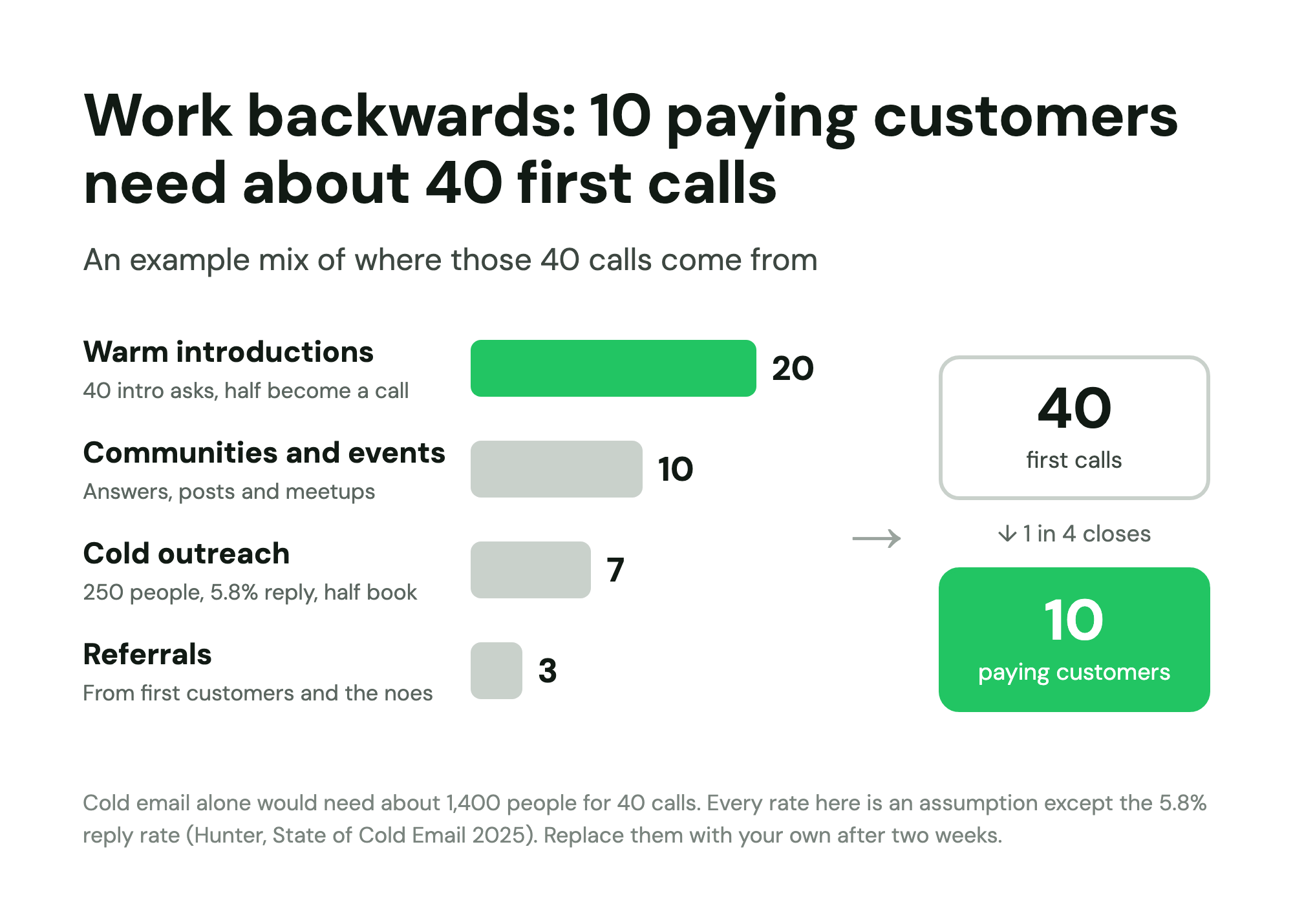
The 5.8% is the average reply rate for cold email campaigns sent to 50 people or fewer in Hunter's State of Cold Email 2025, a vendor study of 11 million cold emails.
Now the uncomfortable part: if all 40 calls had to come from cold email, you would need about 1,400 people (40 ÷ 2.9%), far more good-fit buyers than most narrow segments have. Cold outreach does not fail; it is just that no single channel gets a founder with no audience to 40 conversations, so you run several at once.
Track two numbers weekly: first calls held, and the share that moved to a paid next step. Few calls means a reach problem. Many calls and nobody paying means the customer, the problem or the price is wrong, and more outreach will not fix it.
Where first customers come from when you have no audience
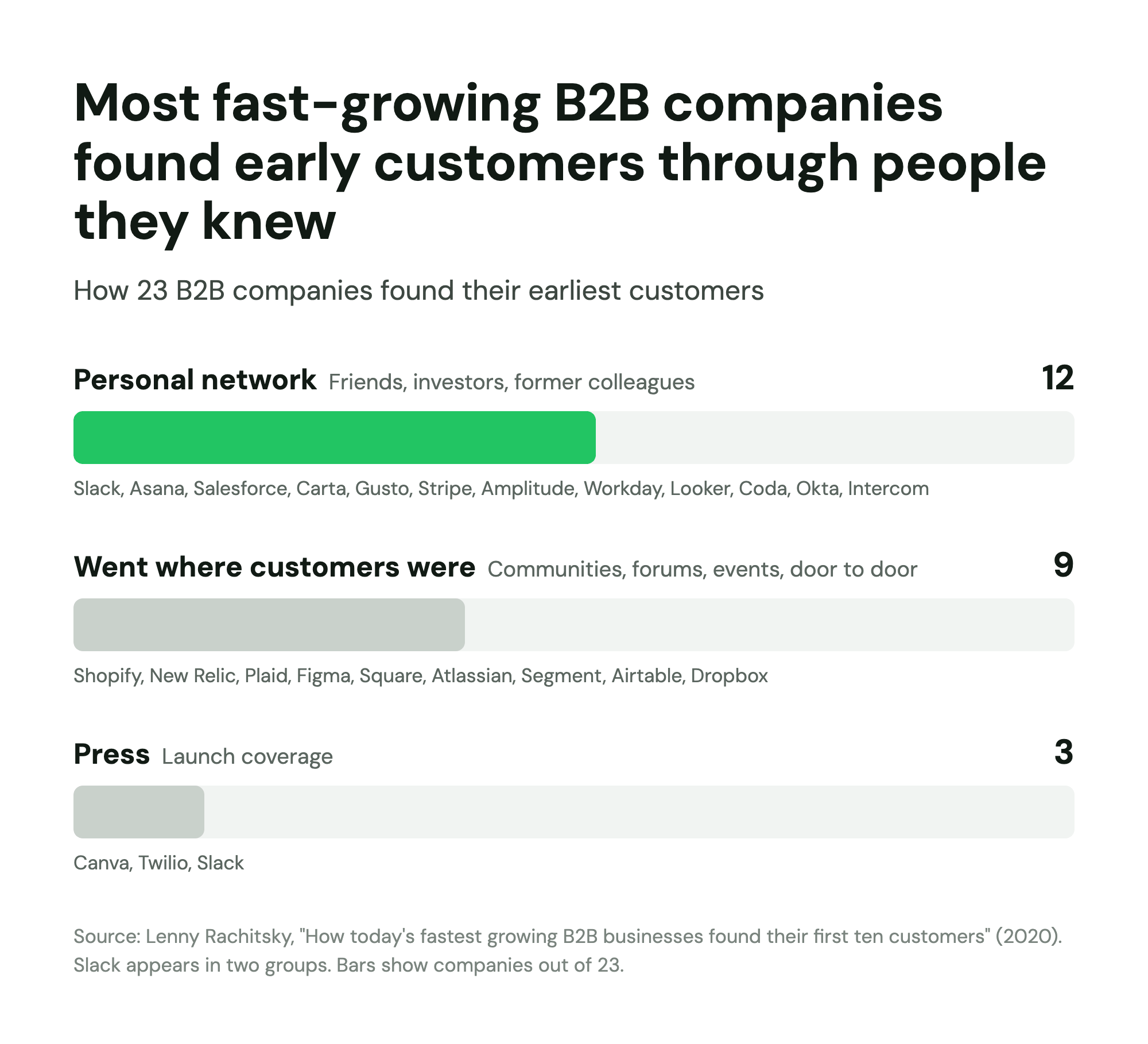
In Lenny Rachitsky's 2020 study of how 23 fast-growing B2B companies found their earliest customers, 12 tapped the founders' personal network (friends, investors, former colleagues), 9 went to where customers already were (online communities, forums, events, even door to door) and 3 got press. Slack appears in two groups. His summary: "Getting press is rarely the way to get started."
His 2023 follow-up on winning the first 10 B2B customers adds cold outreach and investors' networks. Gong's co-founder Eilon Reshef: "All of the first dozen customers were some sort of personal connection." YC visiting partner Max Kolysh gives the same order in his Startup School talk, How to Get Your First 10 Customers: exhaust your warm network first, according to a summary of the talk. Network first, then the places your buyers gather, and attention (press, launches) mostly later.
Step 4: How to get first customers for SaaS: 8 channels that work
These channels work when nobody knows you yet. Run three or four at once rather than one at a time. None of them needs an audience; each borrows trust from people and places your buyer already relies on.
1. Your own network
Start with people who already know your work: former colleagues, customers and vendors from past jobs, classmates and other founders. Mark everyone in your contacts who fits or knows someone who does, and ask directly. "I'm building X for Y; is this a problem on your team?" gets a real answer. "Let me know if you know anyone" gets a polite nothing. Okta's Frederic Kerrest described the start in Lenny's 2023 piece: "We reached out to our networks, folks we knew in IT from Salesforce and past jobs."
2. Warm introductions
Most of your network will not be buyers, but many will know one, and an introduction carries some of their trust to you. Name the exact company or role you want, and send a blurb the person can forward without editing (template 1 below). Ask investors, advisors and accelerator peers too: Vanta's Christina Cacioppo told Lenny, "We got our first 10 customers through YC. This is why we did YC."
3. Communities where buyers ask for help
Find the Slack and Discord groups, subreddits, forums and industry associations where your buyer asks for advice. Answer questions usefully for a couple of weeks before you mention what you are building. When someone describes your exact problem, reply in public with help and in private with an offer.
Zapier found its first paying customers in support forums full of integration requests.
4. LinkedIn
LinkedIn is where B2B buyers are easiest to identify by title and company size. Use it for research and short, personal messages, not automated sequences, and lead with the trigger you noticed. Zip's founders started with LinkedIn messages asking buyers for advice, not for a sale, according to Lenny's 2023 piece.
5. Cold outreach for first customers
Cold email works when it is narrow. Write to one named person about one trigger you can see, in under about 75 words (Kolysh's guideline in the talk summary above), ask one easy question and follow up once or twice. Hunter's data shows small campaigns beat large ones by nearly three to one, so 50 researched emails beat 1,000 templated ones.
Retool's first customers came from targeted cold email. David Hsu filtered Crunchbase for operations-heavy companies that were not SaaS, and emailed their CTOs and VPs of operations. His reason, quoted by Lenny: "We didn't want SaaS, because SaaS companies actually don't build that many internal tools."
The rules apply to business email too. In the US, the FTC's CAN-SPAM compliance guide says "the law makes no exception for business-to-business email": use an honest subject line, include a postal address and a way to opt out, and honor opt-outs within 10 business days. If you write to people in the EU or UK, privacy law adds its own rules, so check them before you send.
6. Competitors' unhappy customers
People who already pay for a competitor have proven the budget exists. Read low-star reviews on G2 and Capterra, complaints in community threads and replies to a competitor's price change or outage, then lead with the specific complaint, not a feature list.
7. Partners who already serve your buyer
Agencies, consultants and complementary tools already have your buyer's trust, and one of them can bring several customers at once. Offer something concrete: a referral fee, early access for their clients or an integration that makes their work easier. Partners help most once you have two or three happy customers to point to.
8. In person: events and small dinners
A trade show or meetup full of your exact buyer compresses weeks of outreach into a day: the summary of Kolysh's talk describes a founder who closed more deals in days at trade shows than in months of cold email. If no event fits, host a dinner for eight people with the same problem.
What does not work for your first 10 (yet)
Some channels are worth a lot later and very little now.
| Channel | Why it rarely works for the first 10 | When it starts to work |
|---|---|---|
| Paid ads | You do not yet know the message, buyer or price, so you pay to test all three | When you know your conversion rate and what a customer is worth |
| SEO and content | Takes months to rank and brings readers, not buyers you can talk to | Start a few pieces early; expect results after launch |
| Launch boards and press | A spike of curious visitors, few of them your narrow buyer | As a trust signal and a burst of attention once you sell reliably |
| Automated prospecting tools | They scale a pitch you have not proven yet | Kolysh's summary suggests after roughly 10 to 20 good customers |
| Building alone until it is finished | Nobody knows it exists when you are done | Never; sell while you build |
Launch boards are not useless: where to launch your startup ranks 25 of them by what they actually bring. They are just better once you already have paying customers.
Step 5: Outreach messages to copy
Three plain-text messages cover the moments that matter most: asking for an introduction, writing to a stranger and following up a good call. Replace everything in brackets and send them from your own name.
1. A forwardable introduction request
Send the ask and the blurb together, so your contact can forward it without writing anything.
Hi [First name],

Could you introduce me to [Name] at [Company]? I think they have the
problem I'm working on. A short note you can forward is below. Totally
fine to say no.

---
[Your name] is building [Product], which helps [role] at [type of
company] [result]. [Name] came to mind because [specific reason,
e.g. they just opened a second office]. [Your name] would like 20
minutes to learn how [Company] handles [problem] today.
---

Thanks, [Your name]
2. A cold email to a named account (under 75 words)
Subject: [Trigger, e.g. Your new ops hire]

Hi [First name],

Saw that [Company] [trigger: just hired / posted / launched].
Teams at that stage usually start [pain, in the buyer's words].

I'm building [Product] to [result], and I'm working closely with a
few [type of company] to get it right.

Worth a 20-minute call next week to compare notes?

[Your name], founder, [Product]
[Postal address] · Reply "no" and I won't write again.
3. The recap after a good call, with a pilot proposal
Hi [First name],

Thanks for the time today. What I heard:
- Today you [current process], which costs [time / money / risk].
- Success in 60 days would look like [metric they named].

My proposal: a 60-day paid pilot at [price], credited toward the
first year if you continue. I'll set it up with your team and
check in weekly. We decide together on [date] using the metric above.

Can we start on [date]? I'll send the agreement and invoice today.

[Your name]
For more on keeping a list of interested people warm by email, the waitlist email templates that get opened post has twelve examples.
Step 6: How to run a founder-led sales call
Founder-led sales means the founder finds, calls and closes the first customers personally, before hiring anyone to sell. A first sales call has four parts. Plan 30 minutes and protect the order.
Before the call
Spend ten minutes on the account: their size, the trigger that put them on your list, the tool they use now and the person's role. Write down the one question you most need answered.
Discovery: about two-thirds of the call
Ask how they handle the problem today, when it last went wrong and what they have already paid to fix it; past behavior is evidence, and compliments about your idea are not (the premise of Rob Fitzpatrick's The Mom Test). Then stop talking: in Gong's analysis of 326,000 sales calls, a vendor study, reps talked 60% of the time on average, and a founder in discovery should be well under that.
Demo: only on their problem
Show the one workflow that solves what they just described, in their words. Skip the feature tour. If they did not describe a problem your product solves, do not demo; ask who else might have it and move on.
Price and next step: before you hang up
Name the price on the call. "For a team your size it's [price] a month, or a 60-day pilot at [price] credited toward the first year" tells you more than any compliment, because the reaction is the signal. Then agree a next step with a date: a pilot start, a call with the budget owner, or a clear no. "Send me some info" with no date is a polite no.
Send the recap (template 3) the same day. After ten calls, read your notes side by side: the repeated objection is your next product or pricing change.
Step 7: Design partners and paid pilots
Larger buyers rarely sign a subscription for an unfinished product on the first call. A design partner arrangement or a paid pilot gives them a smaller, safer yes, and it is often the fastest way to get first paying customers who are bigger than a startup.
Design partners
A design partner is an early customer who uses the unfinished product on a real problem and meets with you regularly to shape it, usually for a lower price and direct access to the founders. Three to five who look alike is a manageable number for a small team.
The venture firm Unusual Ventures, in its field guide on working with design partners, suggests qualifying hard: will they commit to 30 to 45 minute feedback calls every two weeks, and have they already spent money trying to solve the problem and failed? It also recommends fast-moving "challengers, not giants", and agreeing up front the success metrics a partner must hit before moving to a purchase.
Paid pilots
A pilot should never be free. Money makes it a buying decision instead of a favor, and a budget owner approving even a small amount tells you more than a dozen enthusiastic users.
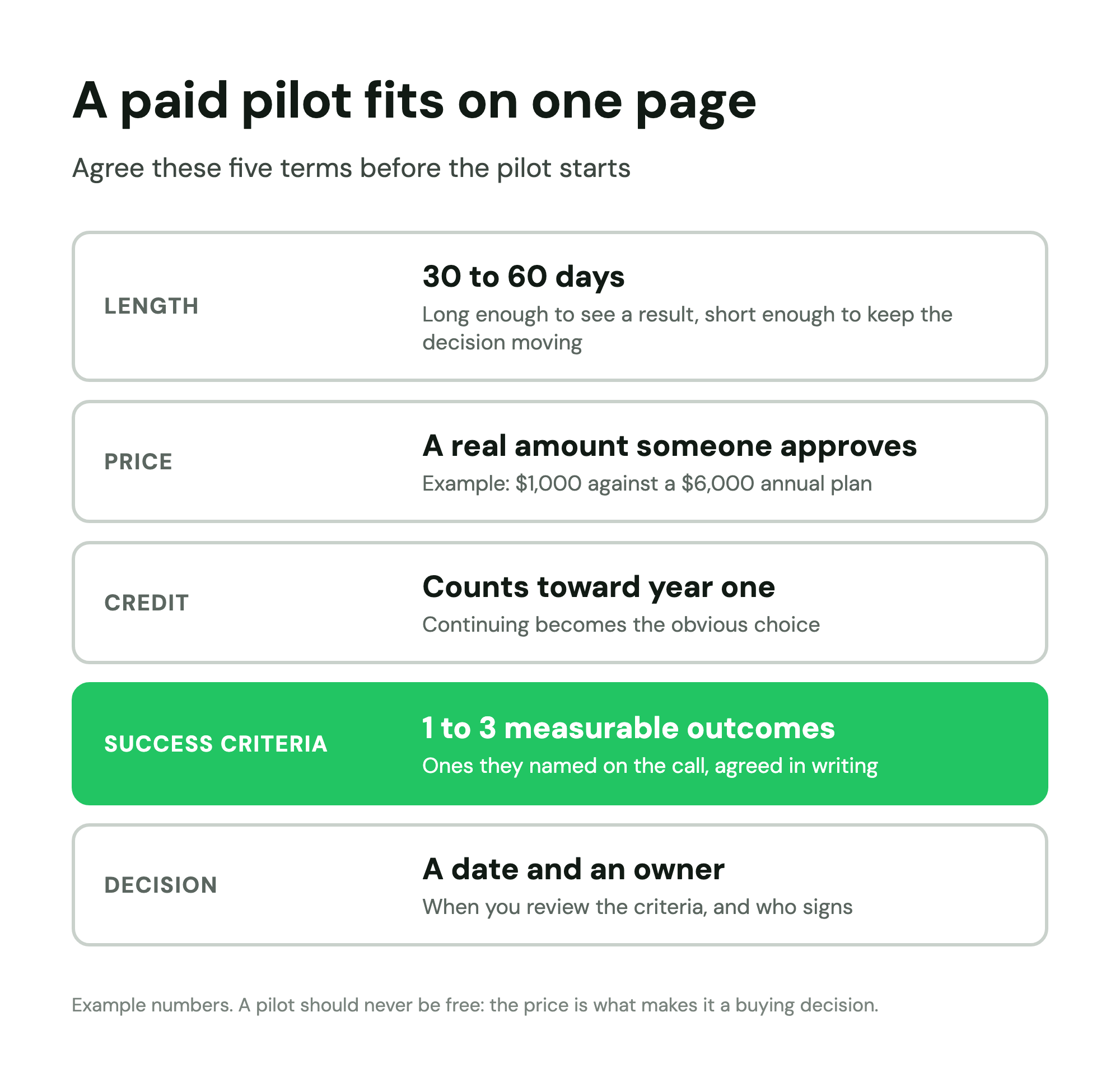
Put five things on one page:
- Length: 30 to 60 days is enough to see a result without stalling the decision.
- Price: a real amount that needs approval, often a share of your planned annual price. For example, a $1,000 pilot against a $6,000 annual plan.
- Credit: the pilot fee counts toward the first year if they continue, so continuing feels like the obvious choice.
- Success criteria: one to three measurable outcomes they named on the call, such as "invoices reconciled in under a day" or "two hours a week saved per project manager".
- Decision date and owner: the date you review the criteria together, and the person who signs.
Then do your part: set the product up for them, check in weekly and fix what blocks the success criteria first. A pilot is a small, private beta launch with a price attached, and if you later let several waves of companies in, how to run an early access program covers sizing and pacing them.
Step 8: Pricing your first customers
For a B2B buyer, charge from the first customer. A free user tells you the product is interesting; a paying customer tells you it is worth money, and that is the thing you are trying to learn. Zip's Rujul Zaparde, quoted by Lenny, put it plainly: "They should buy it because they see value in it, and that's how we'll know it's a good idea."
Zapier charged its first customer $100 for beta access before it had a bank account.
Four rules for early pricing:
- Keep it simple. One plan, or two at most, priced per company or team. Offer annual payment with a discount; a year paid up front helps you more than the discount costs.
- Write down any early discount. A founding-customer price (for example, 30% off for the first year) rewards risk, but put the amount and the end date in writing, or it becomes an awkward conversation a year later.
- Avoid lifetime deals. They turn your best early customers into people who never pay again.
- Raise the price when nobody objects. If every buyer says yes without a pause, you are too cheap. Raise it for the next one.
A paid pre-order before the product exists is a strong signal; a letter of intent (LOI) is only a promise, so treat it as the start of a sale. To see what early prices add up to over time, the pre-launch MRR calculator turns a list size and a price into a revenue range.
Step 9: Closing and onboarding by hand
When someone says yes, make paying easy the same day: send an invoice or a payment link, and a one-page agreement for pilots. Then onboard every one of the first 10 customers yourself.
- Run a kickoff call within a few days of payment, with everyone who will use the product.
- Set it up for them. Import their data, configure the first workflow and get them to the result they bought.
- Open a shared channel (Slack, Teams or email) where they can reach you directly.
- Check in weekly for the first month, and fix what blocks them first.
- Write down every question they ask. It becomes your onboarding and your help docs.
Graham again: "Your first users should feel that signing up with you was one of the best choices they ever made." Note when each customer first gets the result they paid for and how often they come back to it; that is a better early measure than revenue.
Asking for referrals and case studies
Ask for a referral once a customer has seen the result, not on day one. Be specific: "Who else do you know who runs a 10 to 30 person agency and bills hourly?" gets names; "Know anyone who'd like this?" does not. Ask the people who said no as well.
A short case study needs four things: who they are, what they did before, what changed (with a number) and a quote you write together and they approve. Three from similar companies make every later sales call easier, and they are what partners and launch audiences want to see.
Real examples: how 8 B2B companies got their first customers
These are the cases you can verify, from the companies' own posts or interviews with their founders.
| Company | How the first customers came | Source |
|---|---|---|
| Zapier | Searched support forums for integration requests, emailed the askers, charged $100 for beta access | Zapier blog |
| Vanta | First 10 customers through the YC network | Lenny's Newsletter, 2023 |
| Retool | Filtered Crunchbase for operations-heavy companies and cold emailed their CTOs | Lenny's Newsletter, 2023 |
| Figma | Founders' friends and friends of friends, then cold messages to influential designers | Lenny's Newsletter, 2023 |
| Gong | The first dozen customers were all personal connections | Lenny's Newsletter, 2023 |
| Okta | Founders' IT contacts from Salesforce and earlier jobs | Lenny's Newsletter, 2023 |
| Zip | LinkedIn messages asking buyers for advice first | Lenny's Newsletter, 2023 |
| Gleap | Word of mouth among agencies in the founders' network | Gleap blog |
Vanta's network reach included posts in YC's internal forum that mentioned compliance, and Figma used a script to find influential designers on Twitter before messaging them, both according to Lenny's 2023 piece. Gleap, a bug-reporting tool that began as BugBattle, got its first 10 customers mostly through word of mouth among agencies the founders knew, then had to work out how to reach people outside that circle. That is the usual second problem: the network gets you started, and steps 2 to 5 get you past it.
One counterpoint: Amplitude's Spenser Skates told Lenny, "One mistake that YC companies make is trying to sell to other people in their batch." A friendly network is a start, not proof. Keep asking whether your early customers are the buyers you want more of.
A 60-day plan for your first 10 paying customers
Weekly numbers keep the outreach honest. Adjust them once you know your own rates.
| When | Do | Target by the end |
|---|---|---|
| Week 1 | Write the customer sentence, build the 100-account list, list everyone you know who fits or knows someone who does | 100 accounts, 50 network contacts marked |
| Week 2 | Send direct asks to your network and 20 intro requests; join 3 communities and start answering | 8 first calls booked |
| Weeks 3 and 4 | Send 50 researched cold emails a week with follow-ups; keep answering in communities; hold calls and name the price on each | 20 first calls held, 2 to 3 pilot proposals out |
| Weeks 5 and 6 | Close the first paid pilots or subscriptions; onboard each by hand; ask every call for one introduction | First 2 to 4 paying customers |
| Weeks 7 and 8 | Keep 10 first calls a week; add a partner or an event; ask the first customers for referrals and a case study | 40 first calls in total, 5 to 10 paying customers |
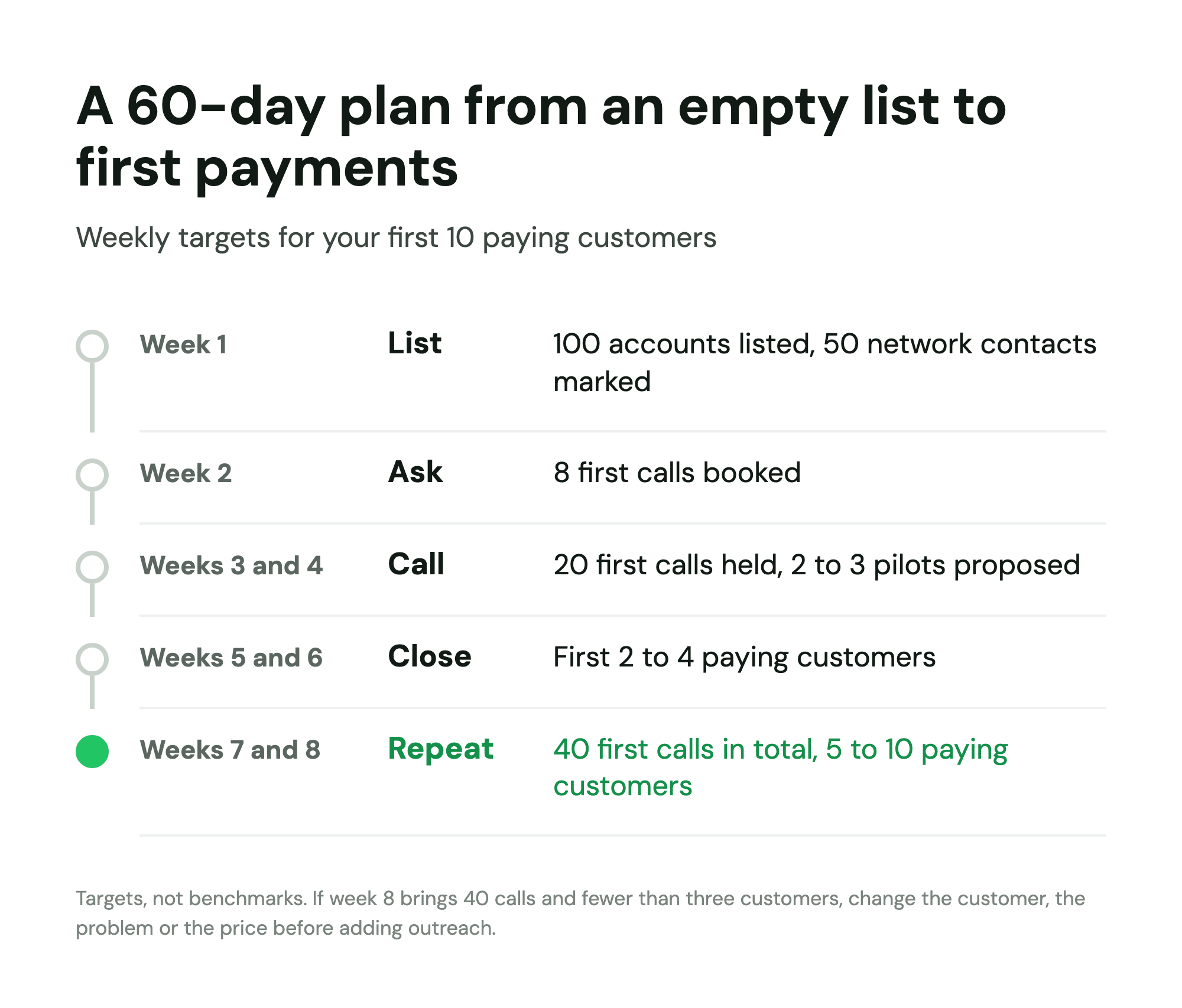
If you reach week 8 with 40 calls and fewer than three paying customers, stop adding outreach and reread your call notes. The customer, the problem or the price needs to change, and more volume will only confirm it.
For the wider set of launch tasks around this, the SaaS launch checklist covers the rest of the run-up to launch, the SaaS pre-launch marketing playbook covers building an audience in parallel, and the startup launch stack lists tools by stage once you outgrow a spreadsheet.
Common mistakes with first B2B customers
- Building for months before talking to a buyer. A conversation in week 2 can save a feature you would have spent week 10 on.
- A customer sentence that fits everyone. If you cannot list 100 companies, you cannot find them either.
- Ending a call without a price or a date. Avoiding both only delays a no.
- Mass, automated outreach. It burns a narrow list fast and teaches you less than 50 personal emails.
- Counting compliments. "I'd definitely use this" is not a customer. A paid pilot is.
- Hiring a salesperson for the first 10. Nobody can sell a product whose buyer and pitch the founder has not figured out yet.
Keeping interested companies warm with LaunchList
Most companies you talk to will not buy in the first conversation. Some are interested but not ready: no budget until next quarter, a competitor's contract that ends in spring, or one missing feature. They are your next customers, if you keep track of them and come back at the right moment.
LaunchList is pre-launch waitlist software for founders, and that is the part it can help with. It does not do sales: it has no deal pipeline or CRM, it does not find customers and it does not take payments. Your calls, pilot agreements and invoices live elsewhere.
What it does:
- One page for companies that are interested but not ready. A hosted page written from one sentence and edited block by block in the AI waitlist page editor, or a form embedded on your own site. Add qualifying questions to the waitlist signup form on every plan: company size, the tool they use now, and when they expect to buy, as dropdowns or multiple choice. Put the link in your email signature and at the end of every call recap, so a "not yet" still leaves a record.
- Find the hottest accounts. Tags are on every plan, so you can mark who came from a call, a partner or a community. On the Launch plan and the Grow plan you can build your own segments, for example companies with 50 or more people who expect to buy this quarter. The waitlist management view shows them all in one place.
- Tell them when pilots open. From the Collect plan you can email your waitlist, for example to announce that you are taking three new paid pilots this month, or that the feature they were waiting for has shipped.
- Let design partners in with a personal code. Personal invites are on every plan (the Free plan includes a fixed number; pricing has the details). Each person gets an email linking to their own waitlist status page with their code and a "Claim access" button, and codes expire after 14 days unless you set otherwise. Early access invite codes explains the details.
If your product is not ready for anyone yet, the SaaS waitlist software page shows how founders use a page like this before launch, and what a pre-launch waitlist is covers the basics.
First 10 customers FAQ
How do I get my first 10 customers with no audience?
Sell to them one at a time. Pick a narrow type of company with an urgent problem, write down 100 named accounts that fit, and start conversations through the people you already know, introductions from them, communities where those buyers ask for help, and short, specific cold messages. Aim for about 40 real first calls, charge B2B buyers from the first customer, and onboard each one by hand. An audience helps later; it is not required for the first 10.
How long does it take to get the first 10 paying customers?
There is no reliable benchmark, because it depends on the buyer and the price. The plan in this guide aims for the first payments around week 6 and 5 to 10 paying customers by week 8, with daily outreach to small and mid-sized companies; larger companies with procurement take longer. The number that predicts your timeline is how many real first calls you hold each week, not how long you have been building.
Should my first B2B customers get the product for free?
Not for a B2B product. A free user tells you the product is interesting; a paying customer tells you it is worth money, which is the thing you need to learn. Charge a real price from the first customer, even if it is discounted for being early, and put the discount and its end date in writing. A paid pilot is a good middle ground for larger buyers.
How many people do I need to contact to get 10 customers?
Work backwards. If about one in four first calls ends in a paid customer (an assumption; track your own rate), 10 customers need about 40 first calls. Through cold email alone, at Hunter's 5.8% reply rate for small campaigns and assuming half of replies book a call, that is about 1,400 people. Warm introductions, communities and referrals cut that number sharply, which is why you run several channels at once.
What is founder-led sales?
Founder-led sales means the founder finds, calls and closes the first customers personally, before hiring anyone to sell. It is slower than a sales team would be, but the founder hears every objection first-hand, can change the product or the price on the spot, and learns what a repeatable sale looks like before trying to teach it to someone else.
Does cold email work for B2B SaaS first customers?
It works when it is narrow and personal, and poorly when it is not. Hunter's State of Cold Email 2025, a vendor study of 11 million emails, found a 4.1% average reply rate, 5.8% for campaigns sent to 50 people or fewer and 2.1% for campaigns sent to 1,000 or more. Write each message to one named person about one specific trigger, keep it under about 75 words and follow up once or twice.
What is a design partner?
A design partner is an early customer who agrees to use an unfinished product on a real problem and meet with you regularly to shape it, usually in return for a lower price and direct access to the founders. Three to five design partners who look alike (same company size, same buyer, same problem) teach you more than ten who do not.
How much should I charge for a paid pilot?
Enough that someone with a budget has to approve it. A common structure is a 30 to 60 day pilot priced at a share of your planned annual price, credited toward the first year if they continue, with one to three success criteria agreed in writing and a decision date. The price matters less than the fact that money changed hands.
Should I offer lifetime deals to get my first customers?
Usually not for B2B SaaS. A lifetime deal turns your most engaged early customers into people who will never pay again, attracts buyers who are shopping for a bargain rather than solving your problem, and leaves you supporting them for as long as the product exists. A written founding-customer discount with an end date rewards early risk without those costs.
Do Product Hunt or ads help with the first 10 B2B customers?
Rarely. A launch board can bring a spike of curious visitors, but few of them match a narrow B2B buyer, and ads need a message and a price you have already proven to be worth the spend. Both are better after your first 10 customers have taught you who buys and why. Before that, the same hours spent on direct conversations go further.