Daniel Priestley Waitlist Strategy: Build Demand Before You Sell
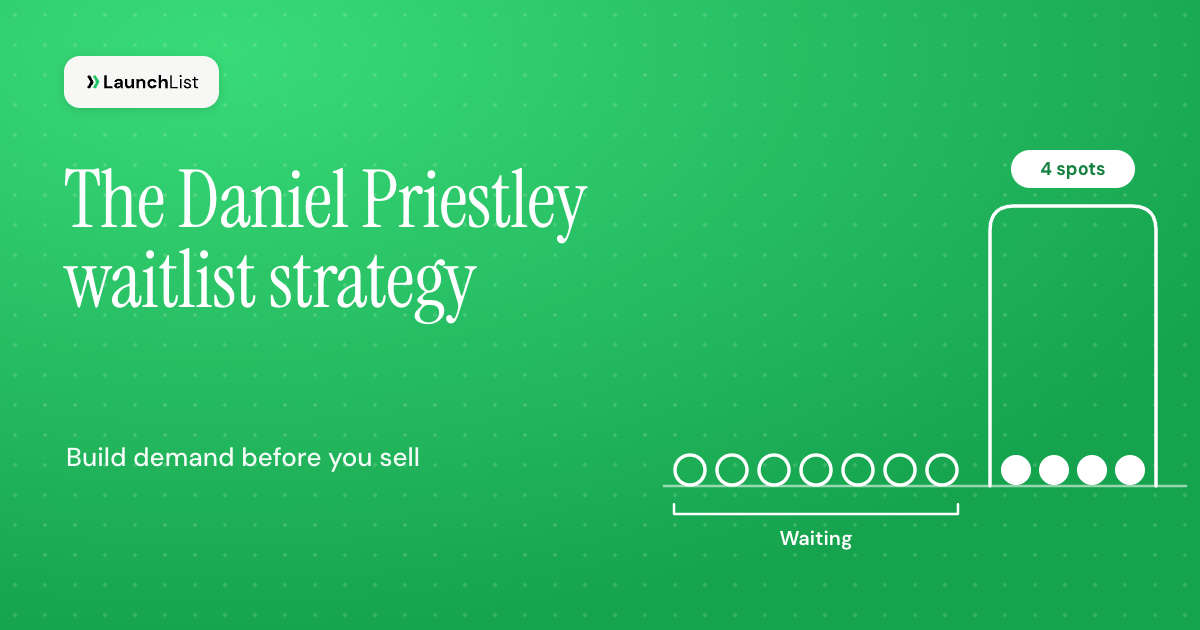
TL;DR: Daniel Priestley's waitlist strategy comes from his book Oversubscribed: become a business where more people want what you sell than you can deliver, and build that demand before you sell. He asks for a signal first, usually joining a waiting list, and makes the sale later, to the people who raised their hand. Applied to a launch, that comes down to five moves:
- Write down your real capacity first. How many people you can serve well in the first release, who they are and when.
- Collect signals, not sales. Joining a waiting list takes far less certainty than buying, so more of the right people say yes.
- Ask questions on the way in. Priestley asks what people want, what is in their way and what they would pay.
- Warm the list up. Send updates, demos and useful content before you ask anyone to commit.
- Release when demand is bigger than capacity, and say so: how many people asked, how many spots there are and when the window closes.
Below is the idea in Priestley's own words, from the publisher's previews of Oversubscribed, his interviews on The Diary of a CEO and videos he recorded for ScoreApp, the software company he co-founded. Then comes how to run it for a SaaS product, an app, a course or a service, and what does not carry over. We are not affiliated with Priestley, and nothing here is endorsed by him. Sources were checked on November 9, 2026.
Who Daniel Priestley is
Daniel Priestley is an entrepreneur and author based in London. His own site describes him as the co-founder of Dent Global and ScoreApp, and his books page lists four titles, among them Key Person of Influence and Oversubscribed. Capstone first published Oversubscribed in 2015, and The Irish Times reviewed it that April, noting that he had arrived in London from Australia in 2006 "with just a suitcase and a credit card." A second edition followed in February 2020. At the time of writing, his site also asks visitors to join the waitlist for AwardsApp, a product of his that has not launched yet.
The core idea: more demand than you can supply
Priestley starts from basic economics: demand and supply set the price, and with it the profit. In a 2023 video for ScoreApp, he put it bluntly: "demand and supply tension is absolutely everything." The first principle of Oversubscribed is that only oversubscribed businesses make a profit, and its opening chapter argues that you do not have to take the market's forces as given: "you can make your own market forces."
Oversubscribed means more people want what you offer than you can deliver. The chapter on releasing defines it: "you become oversubscribed when more people want your capacity than you can possibly deliver to." The introduction lists the businesses he means, from restaurants people line up for to consultants booked six months ahead, and sums them up in two sentences: "There are people who don't chase clients. Clients chase them."
The number does not have to be big. One section of the first chapter is titled "You only need two bidders," and The Irish Times review put the book's lesson as "you don't need a large number of customers to make a handsome living." For a coach with eight client spots, twelve serious inquiries is oversubscribed. For a SaaS product that can onboard 50 teams by hand, a few hundred of the right signups is.
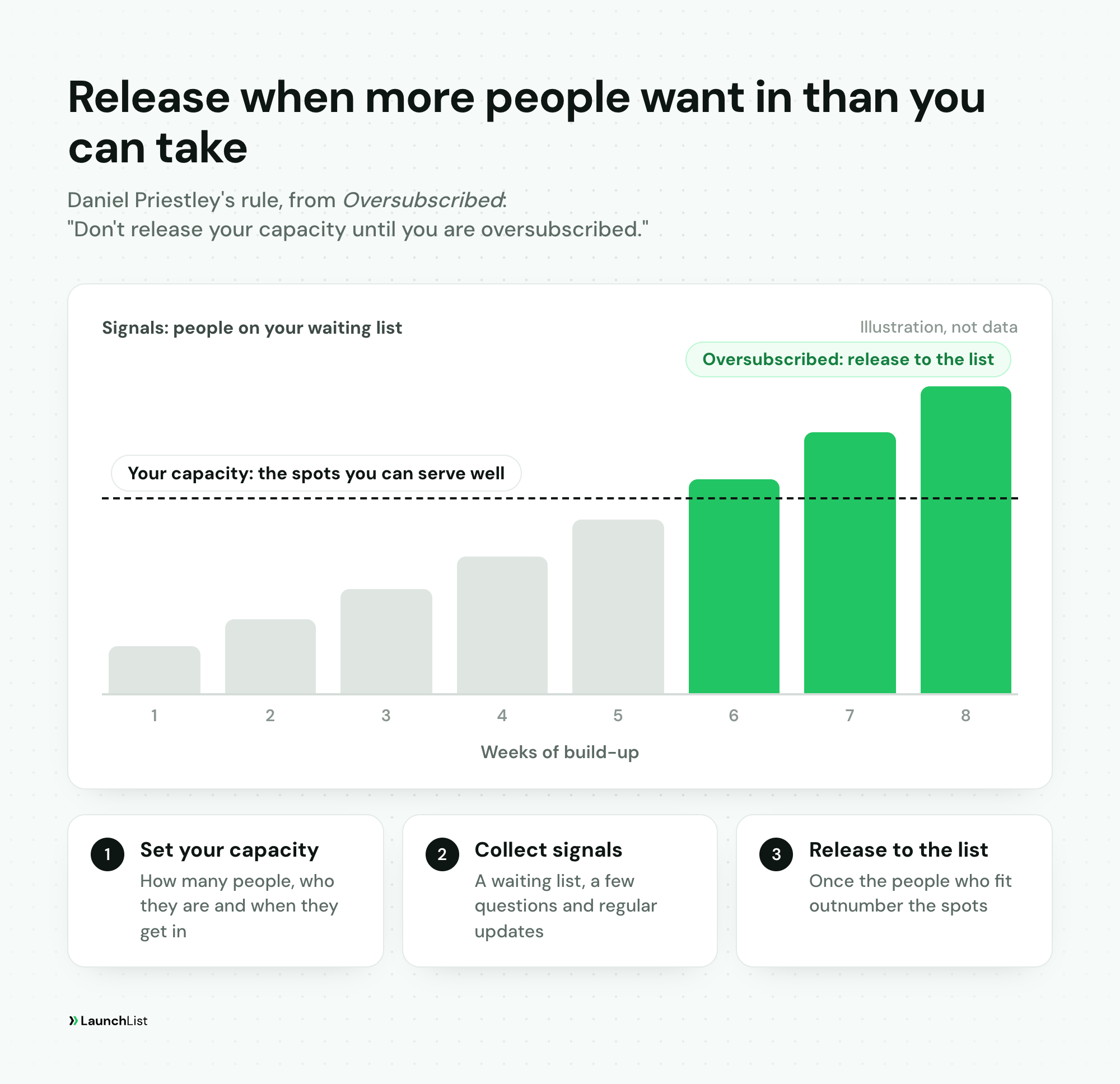
A waiting list is where that demand collects and becomes visible, to you and to the people on it. In the same 2023 video, Priestley points to the Glastonbury festival, where people register their interest first and only later get a chance to buy a ticket. Most of his examples work that way: the place in line comes before the sale.
The parts of his approach that matter for a waitlist
Oversubscribed has eight principles and a five-phase campaign method. These five ideas are the ones a founder with a waitlist can use directly.
1. Signals first, then sales
"We market for signals first and then sales," Priestley says in the ScoreApp video. Instead of asking strangers to buy, "we first ask for them to signal their interest." The book's build-up phase is titled "warming up the market while sending and collecting signals," and its preview explains why: "People take time to warm up to a buying decision." The third principle adds who you sell to when the time comes: "Successfully oversubscribed businesses launch products and services only to those who have expressed interest."
Joining a waiting list is the signal he recommends most often, and he explained why on The Diary of a CEO in February 2024. To buy something, he said, a person has to be about 100% certain. To join a waiting list, they need to be only 5 to 10% certain. Joining is "a micro commitment," and it leaves people wanting to know whether they will get in.
The same interview shows the other use: testing an idea. When someone has an idea, he tells them to set up "a very simple waiting list landing page" and see who joins. Hundreds of people joining is "a pretty good indication" the idea is good. Messaging 3,000 people and getting no one tells you to try another idea. Our guide to what to do once you have an app idea runs that test with a number set in advance.
2. A real capacity, decided first
Phase 1 of his campaign method is titled "Campaign planning: know your capacity, who it's for and when you can deliver it." Its preview is direct about software: "The truth is your capacity is limited. Even software is limited by the market size, the number of supporting devices and the supporting infrastructure." And it warns what happens if you pretend otherwise: "Truly unlimited capacity to deliver a remarkable result forces the price to zero."
This is the step founders skip. A waiting list with no number behind it has nothing to be oversubscribed against. Before you open it, decide how many people the first release can take, who they should be and when they get in.
3. Questions on the way in
Priestley does not collect only an email. In the 2024 interview, he described a waiting list where people give a name and email and answer five questions, such as "how much are you willing to pay," "what are you trying to achieve" and "what would you try if this didn't exist."
In a January 2025 episode, he gave the structure behind the questions. Four ask where the person is now, the outcome they want, what is in their way and what they are considering instead. Then come price questions: what price would be fair, what price would be so cheap it would make them doubt the quality, and what price would be so expensive they could no longer afford it.
The answers matter as much as the count: they tell you who you can help, what to build first and what to charge. On his own software launch, described below, the answers showed that 40% of one list were people "we couldn't actually help."
Every question also costs you some signups, so ask on the form only what decides who gets in, and ask the rest once people have joined. Our waitlist marketing strategy guide covers that trade-off.
4. A warm-up before you ask
The build-up phase exists because people need time. In the January 2025 episode, Priestley described what he calls 7-11-4: 7 hours, 11 interactions, on four platforms, which he says is what it takes for people to remember you. He attributes the numbers to research he does not name, so treat them as his rule of thumb rather than a measured result.
For a waitlist, the warm-up is what you send between the signup and the release: progress updates, a demo, a short video, a question that asks for a reply. Our waitlist campaign guide gives a week-by-week plan for it.
5. A release in the open, with a start and an end
Phase 3 is the oversubscribed release: "communicating demand and supply tension before allowing people to buy." Its rule is short: "Don't release your capacity until you are oversubscribed."
In the 2023 video, Priestley calls this "transparency of demand and supply tension" and explains it with an ice cream truck on a hot day: nobody at the front of a long line asks for a discount, because everyone can see the line. Most businesses do the opposite, he says, and chase each customer one at a time.
The release is also a campaign, not an always-open shop. After it come two more phases: sales follow-through, because, as the preview says, "more than half the people who will buy from you want to talk to someone first," and then "celebrate and innovate," which the book describes as "publicly sharing the success of your campaigns, rewarding the people who made it all possible." Then the next campaign starts.
How Priestley ran it on his own software launch
In a video on ScoreApp's YouTube channel published in March 2026, Priestley tells how he launched Vidonary, video software for businesses. By his account, every phase of the method is in it:
- Two ideas, two waiting lists. About 750 people joined the list for his favorite idea, and about 4,500 joined the list for the other, with the same effort behind both. On the first list, 40% of the people were ones the team could not help. He built the second idea.
- A real capacity. By launch, more than 5,000 people were on the waiting list for 1,000 beta spots.
- A warm-up. While the product was built, the team kept sending the list updates and videos.
- A release in the open. The team told the list that "only a thousand people can get access to the product in version one." Within three days it had 1,000 paying customers, and he says the launch brought in $300,000 in sales.
- The next campaign. People who missed out were invited to join a waiting list for version two.
These are his own figures, in a video published by his own company, so read them as one founder's account, not a benchmark. The shape is the useful part: two lists to choose the idea, a number of spots fixed in advance, and a release that told people the truth about both.
How to run it with a waitlist, step by step
The phases are Priestley's; the waitlist steps are ours.
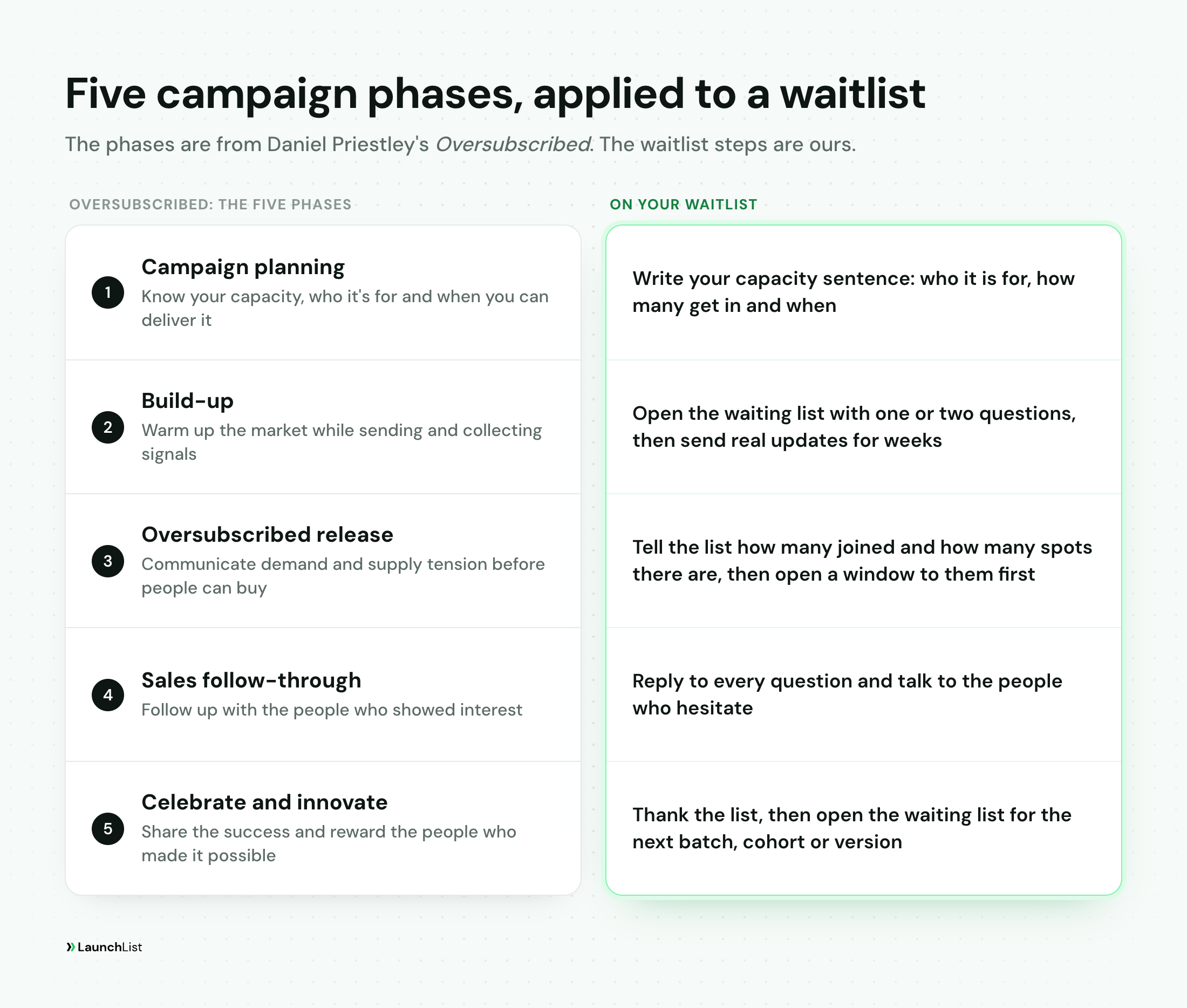
1. Write your capacity sentence. One line, on the page: who it is for, how many get in and why that many. "We're letting in 50 teams in March so we can set each one up by hand." What counts as capacity depends on what you sell:
| What you launch | A real limit | A release with a start and an end |
|---|---|---|
| SaaS product | Teams you can onboard and support well | A beta batch on a set date |
| App | Testers whose feedback you can read, or what your servers can carry | A test build sent to one batch at a time |
| Online course | Seats in a cohort you can teach and give feedback to | Enrollment open to the list for a week before the cohort starts |
| Service or coaching | Client spots per month | A booking window for next quarter's spots |
If you sell a course, our page on waitlists for online courses covers the cohort setup.
2. Open the waiting list before you sell. Say what it is, who it is for, roughly when, and your capacity sentence. Ask for an email and one or two questions that decide who gets in first. The rest of Priestley's questions (situation, outcome, obstacle, price) can come after people join.
3. Warm the list up. Write every week or two with something real: what you built, a demo, a decision you made, a question. Count replies, not just opens.
4. Watch two numbers. Signups against capacity, and how many of those signups match who you are building for. Following Priestley's rule, do not release until the people who match clearly outnumber the spots. If they never do, the list has told you something about the offer, which is the test working.
5. Release to the list first, in the open. Tell people how many joined, how many spots there are, how you will choose and when the window closes. Admit them in batches you can handle, as our guide to running an early access program explains. If you are taking money before the product is finished, how to pre-sell a SaaS covers deposits, refunds and what to promise.
6. Follow through. Reply to everyone who asks a question, and talk to the people who hesitate. That matters more for a $3,000 program than a $30 app, but it matters for every first batch.
7. Celebrate, then open the next list. Tell the list what happened and thank the people who made it happen. Then open the waiting list for the next batch, cohort or version, as Priestley did for Vidonary's version two.
What does not carry over, and where to be careful
The limit has to be real. Priestley's Phase 1 is an argument that capacity is limited, not an invitation to invent a limit. Software can eventually serve everyone, so for a software launch the honest limits are your time, your onboarding and your support. Name the one you have. "Only 100 spots left" on a page that has said it for months undoes the whole method.
Show true numbers. Transparency of demand only works when the numbers are true. If 140 people have joined, say 140, or wait until the number helps you. Never round up, and never seed a counter.
Say plainly what does not exist yet. In the January 2025 episode, Priestley described test ads whose link says the product "is not yet available in your area", with a waiting list to join. If the product is not available anywhere because it is not built, say that instead: "We're building this. Join the waiting list and we'll tell you first." The signal you collect is just as useful, and nobody feels misled later.
A signup is a signal, not a sale. Priestley's method has a follow-through phase for a reason. By his account, his 1,000 paying customers came from a list of more than 5,000, and your ratio will be your own. Measure it with your first batch before you plan around it, and see how to convert a waitlist into paying customers for the steps.
Don't keep people waiting with no release in sight. A campaign has an end. A list that grows for a year with nobody let in is not oversubscribed, it is stalled.
Referrals are a different model. Priestley's approach, as his material describes it, rests on signals, capacity and a release. It does not depend on people moving up a line by sharing. That is Robinhood's waitlist strategy, and you can combine the two, as long as the line and the capacity are both honest.
Running the approach in LaunchList
Disclosure: LaunchList is our product. It is pre-launch waitlist software for founders, and each phase above has a place in it.
- The waiting list. Publish a launch page we host at a launchlist.page address if you have no website, or put the signup form on your own site.
- Questions on the way in. A new signup form has one field, email, by default. Add an optional question to the form, and put a survey on each signup's status page for the rest, so people answer after they join. Priestley's situation, outcome and price questions fit there.
- Real signups. Ask people to verify their email is a switch on the form, on by default for a new signup form. Everyone who signs up is on the list either way.
- Demand in the open. A signup counter, a milestone bar and a countdown to your release date can go on your launch page or be embedded on your own site, on every plan.
- The release. Under Audience → Invites, enter a number and LaunchList invites that many people, most referrals first and signup order for ties. Or choose people yourself, for example the ones whose answers match who you are building for. A batch holds up to 1,000 people.
- Sharing, if you want it. Every signup gets a personal referral link and a live place in line on their status page. Rewards for the number of friends who joined are on the Collect plan and up.
The Free plan holds 100 contacts, and broadcasts, the emails you send the list during the warm-up, start on the Collect plan. To run your first campaign, create a waitlist, write your capacity sentence at the top of the page and open the list before you sell anything.
Daniel Priestley waitlist FAQ
What is Daniel Priestley's waitlist strategy?
It is the campaign method from his book Oversubscribed, run with a waiting list. Decide your real capacity first, collect signals of interest before you sell anything (joining a waiting list is the main one), ask a few questions as people join, warm the list up, and release only when more people want in than you can take. In his words, you 'market for signals first and then sales.'
What does oversubscribed mean in Daniel Priestley's book?
That more people want what you offer than you can deliver. The book puts it as 'when more people want your capacity than you can possibly deliver to.' It does not take a huge number: one section of the book is called 'You only need two bidders.' A coach with eight client spots and twelve serious inquiries is oversubscribed.
What questions does Daniel Priestley ask on a waiting list?
In his interviews he asks where the person is now, the outcome they want, what is in their way and what else they are considering. Then he asks about price: what would be fair, what would be so cheap they would doubt the quality, and what would be so expensive they could no longer afford it. In another interview he suggested asking 'how much are you willing to pay' and 'what are you trying to achieve.'
Does the Oversubscribed approach work for software?
Yes, with an honest limit. Priestley writes that 'even software is limited' by market size and infrastructure. For an early product the real limit is usually how many people you can onboard and support well, so open in batches you can handle and say why. By his account, his own software launch let in 1,000 beta users from a list of more than 5,000.
Isn't a waiting list just fake scarcity?
Only when the limit is invented. Priestley's method starts from real capacity, and his release step communicates real demand against real supply. A cap that never fills, a padded counter or a countdown that resets is the opposite of that, and people notice. Put the limit and the reason for it on the page.
Does this work for online courses and coaching?
It fits them well, because capacity is easy to name: seats in a cohort or client spots in a month. Open a waiting list for the next cohort, ask what people want to achieve, send a few useful emails, then open enrollment to the list first for a set window. When it fills, start the list for the cohort after.