Customer Discovery Interview Questions (2026)
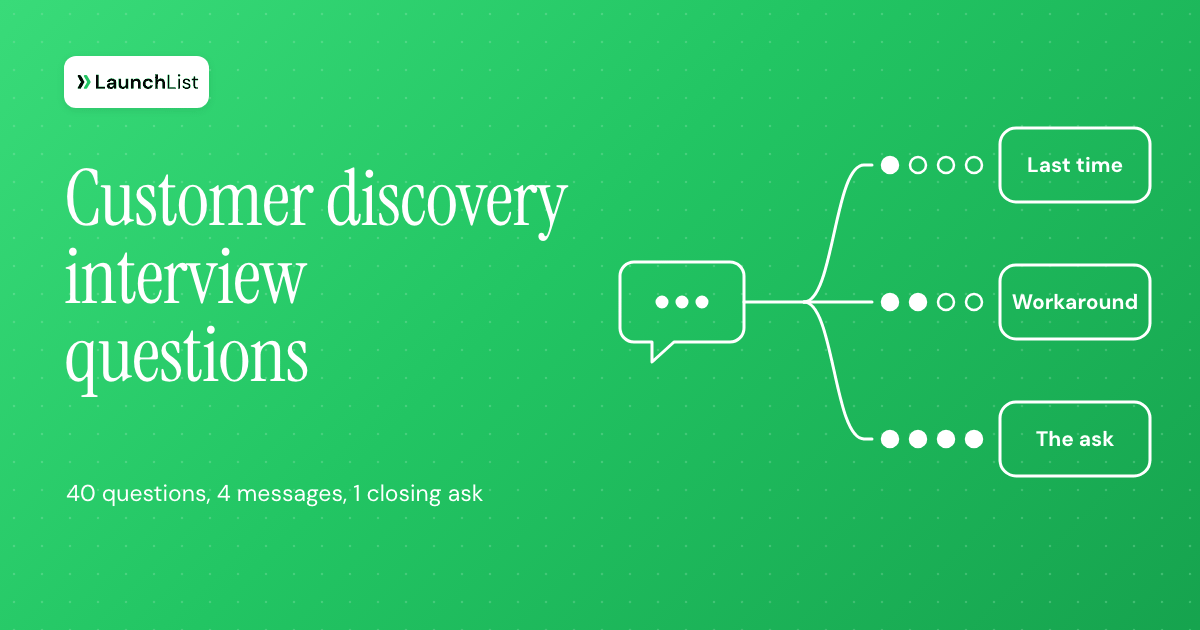
TL;DR: Customer discovery interview questions work when they ask about the person's past, not your idea's future. Ask "When did this last happen?", "What did you do about it?" and "What does it cost you today?", never "Would you use this?". Run 20-minute calls with people who have the problem now, and end every call with a concrete ask: an introduction, a second call, a pilot, a letter of intent or a pre-order. What people agree to do is the signal; compliments are not. Most themes show up within 6 to 12 interviews with similar people (Guest, Bunce and Johnson, 2006), so plan 10 to 15 per customer segment. Below: 40 questions by stage, 10 bad questions rewritten, a commitment ladder, four outreach messages, the math for booking calls, a 20-minute script, a note template and a scoring grid.
What a customer discovery interview is
Customer discovery is the first of four steps in Steve Blank's customer development method: before you build or sell anything at scale, you turn your guesses about who has a problem, how badly and what they do about it into facts. The interview is the main tool. It is a conversation of 20 to 45 minutes with one person who might have the problem, where you learn about their life and say very little about your idea. Customer discovery questions are the prompts you use in that conversation to learn what the person did, what it cost and what they use now.
It gets confused with three other conversations, and mixing them up is how founders come back with nothing:
| Discovery interview | Survey | Sales call | Usability test | |
|---|---|---|---|---|
| Goal | Learn if a problem is real and how it is handled today | Count how common an answer is | Get a yes | Find where a design confuses people |
| What you show | Nothing, or almost nothing | A list of questions | Your product | A prototype or the product |
| Who talks most | They do | They write | Often you | They narrate while they use it |
| What you leave with | Facts about past behavior and a next step | Numbers without the "why" | A deal or a no | A list of usability problems |
Interviews tell you which questions matter and what words people use; a survey later tells you how many people would answer the same way. The questions below are for a live conversation.
Customer discovery vs customer validation vs user research
The three get used as if they meant the same thing. They answer different questions at different times:
- Customer discovery comes first: is the problem real, who has it, and what do they do about it today? Mostly interviews, before you build.
- Customer validation comes next in Blank's method: will people actually buy, again and again? Pre-orders, pilots, letters of intent and early sales.
- User research is the wider practice of studying how people use a product, including usability tests of something that already exists. Most of it assumes you already have a product to study.
Three rules for questions that get honest answers
People are kind to founders. Ask whether your idea is good and most will say yes, because a no costs them an awkward moment and a yes costs them nothing. Rob Fitzpatrick's book The Mom Test is built on that problem: a good question gets a truthful answer even from your mom, who wants to protect your feelings. Its three rules, as summarized in Michael Lynch's book report:
- Talk about their life instead of your idea.
- Ask about specifics in the past instead of generics or opinions about the future.
- Talk less and listen more.
Eric Migicovsky, the founder of Pebble, teaches the same three as mistakes to avoid in his Y Combinator lecture How to Talk to Users: pitching your idea, asking hypotheticals and talking too much.
In practice, that turns into six habits:
- Past over future. "What did you do last time?" beats "What would you do?". People predict their own behavior badly and describe it well.
- Specific over general. "Tell me about last Tuesday" beats "How do you usually handle it?". "Usually" gets you the tidy version of their week.
- Their words, not yours. Do not name the problem for them. If they never bring it up, that is data too.
- No pitch until the end. Once you describe your idea, they start reviewing it instead of describing their life. Save any demo for the last few minutes or a second call.
- Money in the past tense. Ask what they spend now, in money or hours, never what they would pay.
- Look for evidence against your idea. You will hear what you hope to hear and forget the rest. Before each call, write down which answer would prove you wrong, then ask the question that could produce it.
The book also names three kinds of answer to throw away: compliments ("That sounds great"), fluff (generic, future and hypothetical statements: "I usually", "I would", "I might") and feature ideas taken at face value. When you hear fluff, steer back to a real event: "When did that last happen?". When you hear a feature request, ask what it would let them do that they cannot do now.
Customer discovery interview questions by stage
These customer discovery interview questions are grouped by what you are trying to learn. Pick 6 to 10 per call, not all 40: the follow-ups matter more than the list. They work as customer interview questions for startups selling to businesses or to consumers; the budget section is mostly for B2B.
| Stage | What you are learning | The one question to keep | A strong answer sounds like |
|---|---|---|---|
| Problem | Is it real, recent and frequent? | "Tell me about the last time that happened." | A date and a story with details |
| Current workaround | What they do now and what it costs | "What do you use for this today?" | A named tool, a spreadsheet they maintain, a person they pay |
| Budget and buying (B2B) | Who pays, from which budget, through what process | "How did you buy the tool you use now?" | Names, a budget line, a sequence of steps |
| Commitment | Whether they will act, not just talk | "Who else should I talk to? Could you introduce me?" | Yes, with a name and a date |
Problem questions
- What is the hardest part about [doing the job]?
- Tell me about the last time that happened.
- Why was that hard?
- How often does it come up? When was the time before that?
- What happened as a result? Did it cost you time, money or a customer?
- Who else was involved?
- Where does this rank among the things you are dealing with this month?
- What were you doing just before it came up?
- Was there a time it went well? What was different?
- What happens if you just leave it?
Questions 1 to 3 are Migicovsky's. Question 7 is the most underrated: a real problem that ranks ninth on someone's list rarely gets money or time.
Current workaround questions
- What, if anything, have you done to try to solve this?
- What do you use today? Could you show me on your screen?
- What don't you love about the solutions you have tried?
- How much time does it take you in a normal week?
- What do you pay for it now, in money or in hours?
- Have you looked for something better? Where did you look, and what did you find?
- Why did you stay with what you have (or why did you switch)?
- If you built something yourself, how long did it take, and who keeps it working?
- What was the last thing that made you think about changing it?
- Do you know anyone who handles this differently?
A homemade spreadsheet, a script or a hired assistant is the best sign here: someone who already spends effort on a problem knows exactly whether something saves it.
Budget and buying process questions
- How did you buy the tool you use now? Walk me through it.
- Who else had to say yes?
- Whose budget did it come from?
- How long did it take from first look to paying?
- What almost stopped the purchase?
- What did you have to show to get it approved?
- Is there money set aside this year for this problem?
- What else competes for that budget?
- When does your current contract renew?
- Who would be upset if you replaced it?
For a consumer product, shrink this to two questions: "How did you pay for the thing you use now?" and "Who else in the household had a say?".
Commitment questions
- Who else should I talk to? Could you introduce me?
- Is there anything I should have asked and didn't?
- Can we talk again in two weeks, when I have something to show you?
- Would you try an early version with your real data, if I set it up with you?
- Could I show this to the person who would approve buying it?
- Would you sign a letter of intent, or pre-order at [price], to be first in line?
Questions 31 and 32 come from The Mom Test and end every call. Questions 33 to 36 are a ladder, explained in the next section.
Follow-up probes that work at any stage
- Tell me more about that.
- Can you give me an example?
- Why does that matter to you?
- What did you do next?
Mom Test questions: 10 bad questions and better ones
These Mom Test questions show the most common flaw in interview questions: asking the person to predict, imagine or approve. Here are ten common ones, why they fail and what to ask instead.
| Don't ask | Why it fails | Ask instead |
|---|---|---|
| "Would you use a product that does X?" | A hypothetical; saying yes is free | "When did you last need to do X? What did you use?" |
| "Do you think this is a good idea?" | It asks for a compliment | "What do you do about this today?" |
| "How much would you pay for this?" | A prediction about money, anchored on your idea | "What do you spend on this now, in money or time?" |
| "Would you buy it if it had feature Y?" | Two hypotheticals stacked | "What made you pick the tool you use now?" |
| "Do you have problem X?" | Names the problem for them | "What is the hardest part about [the job]?" |
| "How often do you usually do this?" | "Usually" gets the ideal week | "When was the last time? And the time before that?" |
| "Don't you hate it when [X] happens?" | Leading; puts words in their mouth | "Tell me about the last time [the task] went badly." |
| "What features would you want?" | They design, and you lose the reason | "What would that let you do that you can't do now?" |
| "Would your team use this?" | They are guessing about other people | "Who else touches this? Could I talk to them?" |
| "Can I tell you about my idea?" (early on) | Turns the interview into a pitch | Hold it for the last five minutes, or a second call |
The closing ask: turn a good conversation into a signal
Almost every interview ends with "Sounds great, keep me posted". That line is not a result. The only reliable difference between a good meeting and a polite one is what the person agrees to do next.
The Mom Test calls this commitment and advancement: the person gives up something they value (time, reputation or money), and the relationship moves to the next real step. If you leave a call without knowing what happens next, it did not work.
Decide which ask you will make before the call, and make the biggest one that fits where you are. Before you have anything to show, ask for introductions and a second call. With a prototype, ask for a pilot. With a price, ask for a letter of intent or a pre-order.
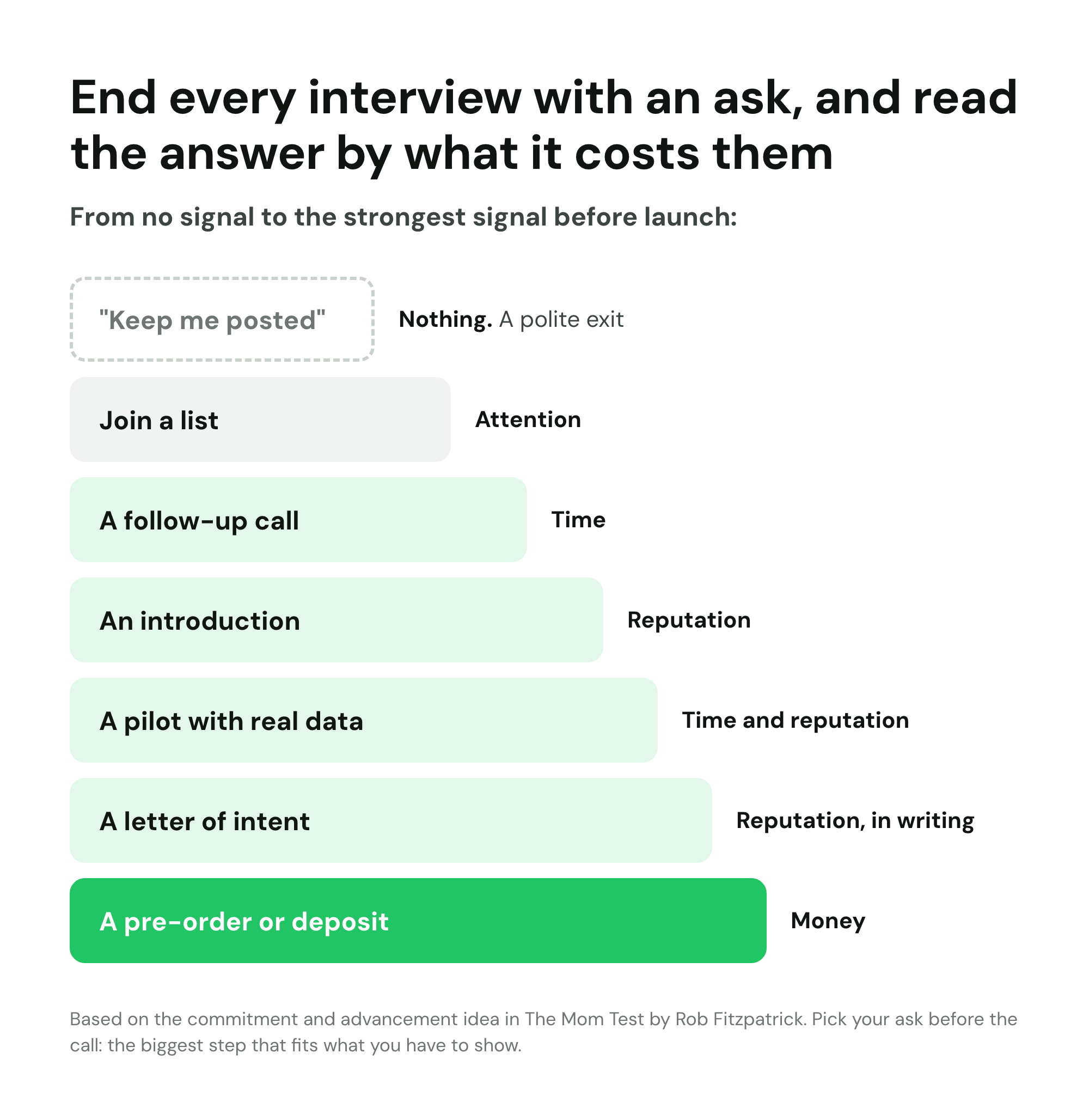
| The ask | What they give up | What a yes tells you |
|---|---|---|
| "Keep me posted" (no ask) | Nothing | Nothing. It is a polite exit |
| Join a list for an early version | A little attention | They want to hear more. The weakest real signal |
| A follow-up call on a set date | Time | The problem matters enough for another 20 minutes; strongest when they pick the date |
| An introduction to a colleague or the buyer | Reputation | They will put their name behind you; an intro to the buyer beats a second call with someone who cannot buy |
| A pilot with their real data | Time, reputation and some risk | The problem is bad enough to change how they work |
| A letter of intent | Reputation, in writing | A company states it intends to buy on stated terms |
| A pre-order or deposit | Money | The strongest signal you can get before launch |
Two details the table cannot hold. A pilot needs their real data, a fixed length such as two weeks and one agreed measure of success: a pilot on fake data is a demo. A letter of intent is usually not binding, but someone has to sign it and often show it to a boss, which is why it counts. If you take pre-orders, use a payment tool you trust, say when you will deliver and refund if you don't; our guide on how to convert a waitlist into paying customers covers what comes after.
The warning signs are the opposite: "That's cool, I like it", "Looks interesting, keep me in the loop", and silence after you send the follow-up you promised.
How to find people to interview for customer discovery
Finding people to interview with no network is where most founders stall, and where the advice online is weakest. The fix is a short list, several channels at once and one habit at the end of every call.
Write a who-where sentence first
Before you contact anyone, write one sentence: "[Role] at [kind of company] who [did the job] in the last month, and they gather at [places]." For example: "Freelance bookkeepers with 5 to 20 clients who chased a late invoice this month, and they gather in two subreddits, a Facebook group and one paid Slack." Interview only people who fit it. Jason Cohen, the founder of WP Engine, is blunt about this in his guide to finding customers to interview: friends and family cannot tell you whether real customers will pay.
Where to look
| Channel | Speed | Fit | What makes it work |
|---|---|---|---|
| Introductions from people you know | Days | High | Ask for a specific person, not "anyone" |
| Existing customers, your sales team and support inbox | Days | High | For a previous or live product: the people in tickets and sales notes already named the problem |
| LinkedIn search by job title | Days | High (B2B) | A personal note and a clear reason you picked them |
| Communities where they ask for help | 1 to 3 weeks | High | Contribute first; ask one clear question |
| Public complaints about a competitor | Days | High | Help with the complaint first, then ask for a call |
| Job postings for the job you automate | Days | Medium | A company paying a person to do it has the problem |
| Your own signup page | Ongoing | High | Ask "Would you do a 15-minute call?" on the form |
| Building in public | Months | High | Start well before you need interviews |
| Paid research panels | Hours | Medium | A strict screener; pay what the panel suggests |
A few details that matter:
- Introductions. Ask each friend one question: "Who do you know who [has the problem] and would give me 20 minutes?". Cohen's line for the ask is a good one: "I'm trying to have 20 conversations like this, to give this product a real shot."
- LinkedIn. Cohen reports that when he did this for WP Engine, 40 of 50 people agreed to talk and 30 eventually became customers. He offered "any fee you feel is fair for an hour of your time", and only one of the 40 asked to be paid. One founder's result, but it shows how far a personal, advice-seeking message goes.
- Communities. Find the subreddit, Slack, Discord or forum where your people ask for help. Read the rules, answer questions for a week, then ask one specific question. For a wider list of where founders can post, see these places to promote your startup for free.
- Your own page. A simple idea validation landing page with one screening question and "Would you do a 15-minute call?" lets the people who care raise their hand. If you already run a waitlist landing page, your existing signups are the easiest interviews you will ever book.
- Building in public. A public build in public changelog gives weekly posts about the problem somewhere to point.
- Paid panels. Product Talk describes a founder who wrote a screener on User Interviews, saw 50 responses scored against her criteria and booked three interviews with no no-shows (Product Talk). Good for hard-to-reach professionals, poor for finding your first customers.
The same piece has the counterexample: one founder's post to her own network drew engagement, but only four people agreed to talk and none fit her criteria. Reach is not fit.
Finally, end every interview by asking who else you should talk to, and ask for two names. That one habit is how a list of five becomes a list of fifty.
Outreach messages to copy
Four plain-text messages cover most of it. Ask for advice, not a sale; say how long it takes; say why you picked them; and never attach a deck.
1. A personal message to someone you found
Subject: Quick question about [their problem]

Hi [First name],

I saw your [post / review / comment] about [specific problem].
I'm researching how [type of person] handle [the job] before I
build anything, and I'd love to hear how you do it today.

Would you give me 20 minutes this week or next? I'm not selling
anything; I'll share what I learn from about 15 conversations
if that's useful to you.

[Booking link]

Thanks,
[Your name]
[One line on who you are]
2. An introduction request a friend can forward
Hi [Friend],

Small favor: I'm talking to [role] who [did the job] recently,
before I build anything. Do you know one or two people like that?

Here's a note you can forward as is:

"[Your name] is researching how [role] handle [the job]. No pitch,
just 20 minutes of questions about how you do it today. If you're
open to it, here's a link to pick a time: [booking link]"

Thank you!
[Your name]
3. A post in a community where your people ask for help
Title: How do you handle [specific problem]? (founder, researching)

I'm a founder looking into how [role] deal with [problem]. I'm not
selling anything yet and won't post a link to a product.

Two questions for anyone who's dealt with this recently:
1. What did you do the last time it happened?
2. What do you use for it today?

If you'd be up for a 15-minute call, reply or message me and I'll
send a time. I'll post a summary of what I learn here.
4. One follow-up, five days later, as a reply in the same thread: "Bumping this once in case it got buried. If now is a bad time, no reply needed and I won't follow up again."
For the emails that come later, when those people are on your list, these waitlist email templates pick up where these messages stop.
How many people to contact for 10 completed interviews
Work backwards. Here is the math for 10 completed calls from cold outreach, with every rate labeled:
- Completed interviews wanted: 10.
- Booked calls needed: about 13. MeasuringU's analysis of more than 14,000 moderated studies found an average no-show rate of about 8%, and suggests planning for 10%. Those participants were paid; strangers doing you a favor owe you less, so this example assumes 20%.
- Yes replies needed: about 18, assuming a quarter of the people who say yes never pick a time. This is an assumption; replace it with your own.
- Messages to send: about 180, at a 10% yes rate. Cohen calls a 10% response rate to cold requests "fantastic", so treat this as a good outcome, not a floor.
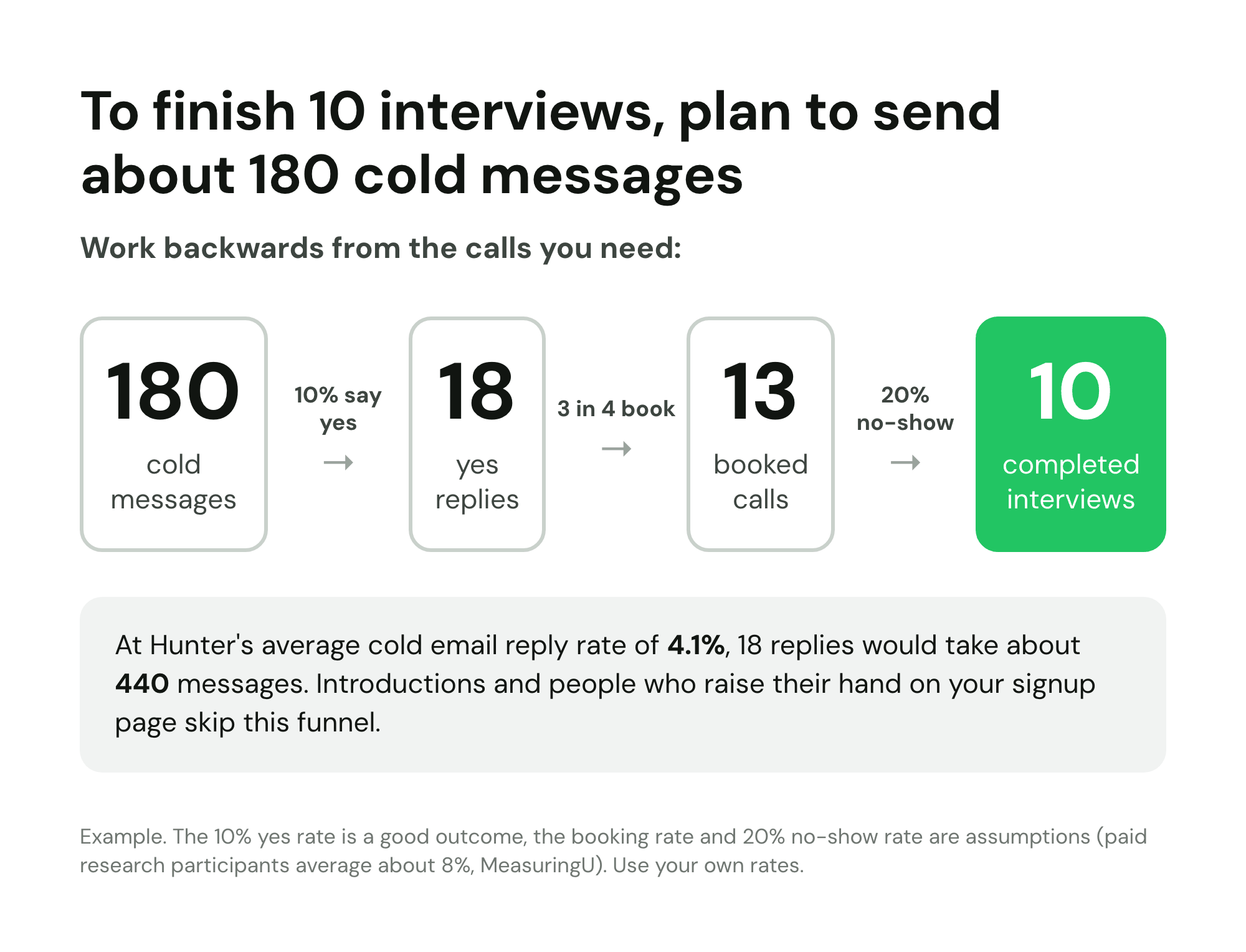
For comparison, Hunter's State of Cold Email 2025, which analyzed 11 million cold emails sent in 2024, found an average reply rate of 4.1%, and 5.8% for campaigns sent to 50 people or fewer: roughly 310 to 440 messages for 18 replies. That is why introductions and the people who raise their hand on your signup page come first; they skip this funnel.
How many customer interviews you need
The honest answer is "until you stop learning anything new", which is called saturation. It is less vague than it sounds, because researchers have measured it:
| Source | What it is | What it found |
|---|---|---|
| Guest, Bunce and Johnson, 2006 (Field Methods) | Academic study: 60 interviews, analyzed in sets of 6 | Of 36 common themes, 34 had appeared after 6 interviews and 35 after 12; saturation by 12 |
| Griffin and Hauser, 1993 (Marketing Science) | Academic study of customer needs for one product type | 20 to 30 interviews uncovered an estimated 90 to 95% of needs |
| Nielsen Norman Group, 2021 | UX research firm, practitioner guidance | Start with 5 or 6, analyze as you go; 5 is often too few for exploratory research |
The two studies are summarized in Nielsen Norman Group's article on interview sample size; the University of Cambridge's user and customer interviews guidance repeats the 20 to 30 rule of thumb and adds a plain stopping rule: stop when no new needs are being found.
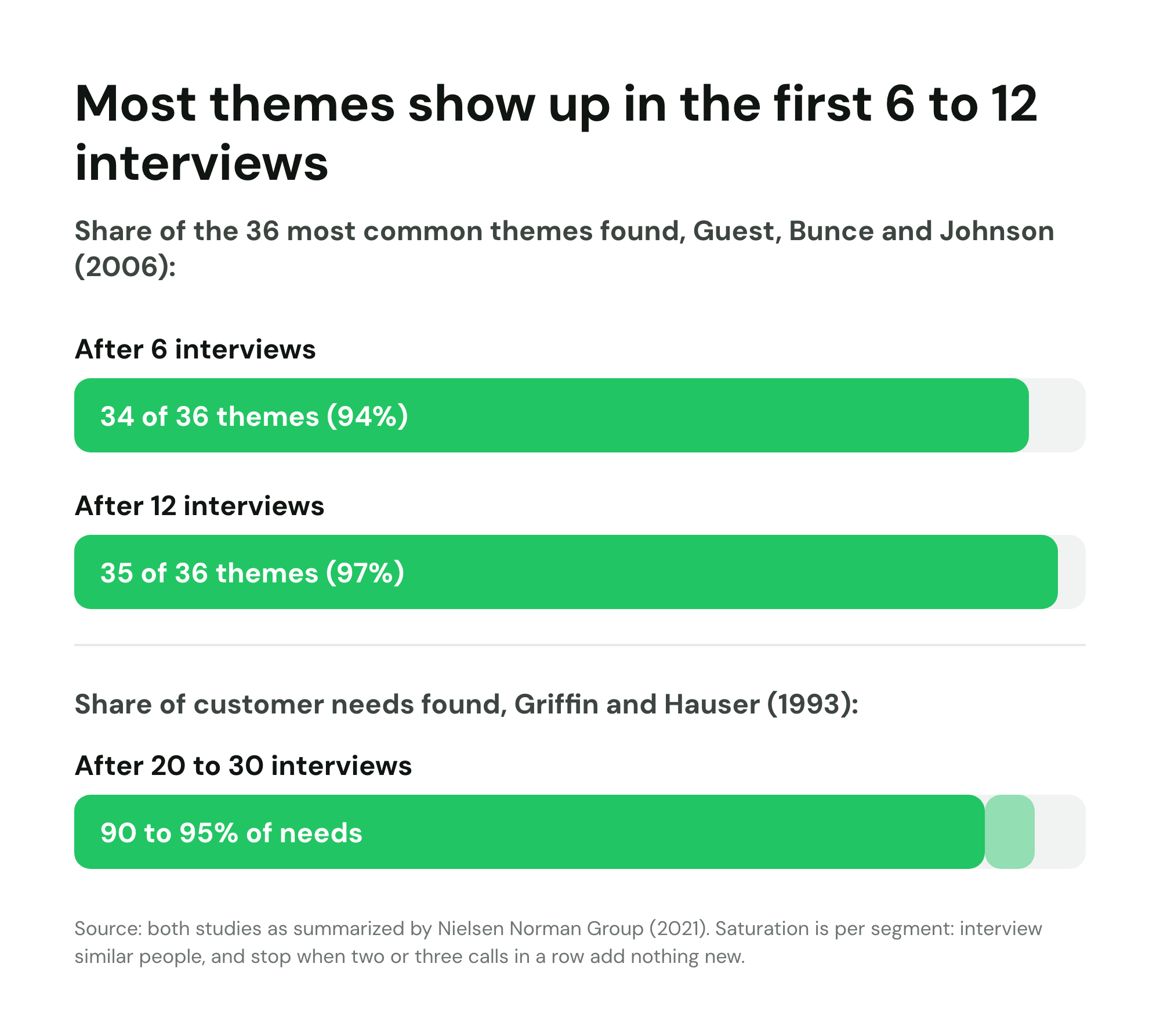
Two cautions before you stop at six. Those studies used similar people, fixed questions and experienced researchers; your first few calls are practice. And saturation is per segment: five freelancers and five agency owners are two groups of five, not one group of ten.
A practical plan:
- Do 5 interviews with one segment, then stop and review. Rewrite questions that got fluff.
- Plan 10 to 15 per segment. If you are testing two segments, that is 20 to 30 calls.
- Stop a segment when two or three interviews in a row add nothing new to your notes: no new trigger, no new workaround, no new objection.
Running the call: a 20-minute problem interview script
Twenty minutes is enough for a first problem interview: easier to book, harder to drift into a pitch, and it leaves room for a longer second call with the best people.
Before the call
- Write your three big questions. The Mom Test suggests deciding with your cofounders the three things you most need to learn, and the commitment you want to ask for.
- Do your desk research. Drop any question you could answer by reading their LinkedIn profile or company site.
- Pick 6 to 10 questions from the bank above, with the "last time" story in the middle.
- Book with a link, within a week. Offer 20-minute slots with one screening question on the booking form ("When did you last [do the job]?"), and send a reminder the day before with the call link.
- Bring a note-taker if you can. Cambridge's guidance recommends that interviewing and note-taking be done by different people where possible.
The script
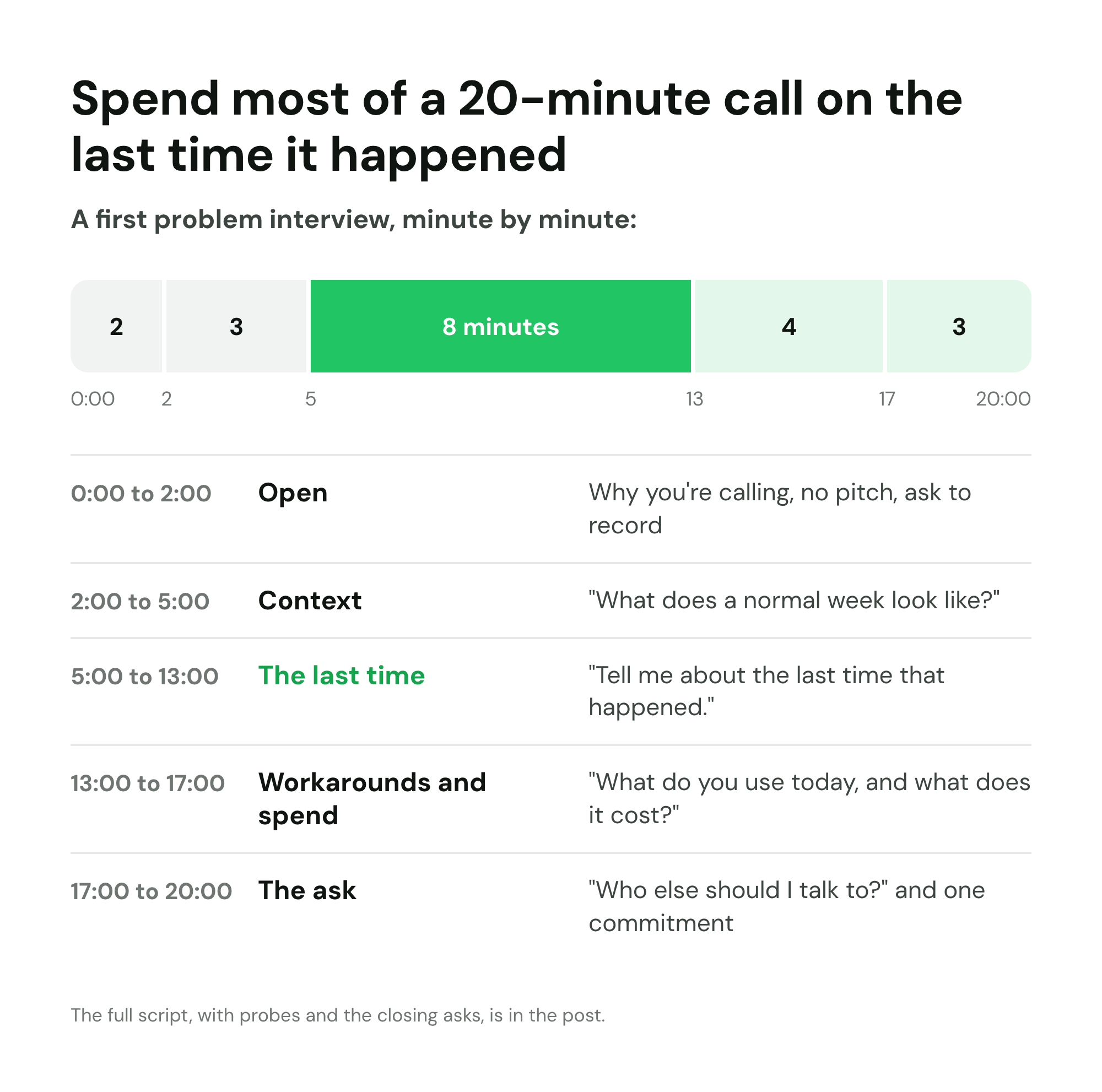
0:00 to 2:00  OPEN
"Thanks for making time. I'm researching how [role] handle [the job]
before I build anything, so there are no right answers and nothing to
sell you. Is it OK if I record this for my notes only? I'll delete it
whenever you ask." [Wait for a clear yes before recording.]
"We'll finish in 20 minutes."

2:00 to 5:00  CONTEXT
"Tell me a bit about your role and what a normal week looks like."
"Where does [the job] fit into that?"

5:00 to 13:00  THE LAST TIME
"What's the hardest part about [the job]?"
"Tell me about the last time that happened. Start from the beginning."
  Probe: "Then what?" / "Why was that hard?" / "Who else was involved?"
  Probe: "What did it cost you: time, money, a customer?"
"How often does that happen? When was the time before?"

13:00 to 17:00  WORKAROUNDS AND SPEND
"What do you use for this today? Could you show me?"
"What don't you love about it?"
"What do you spend on it now, in money or hours a week?"
"Have you looked for something better? What did you find?"
[B2B: "How did you buy what you use now? Who had to say yes?"]

17:00 to 20:00  CLOSE AND ASK
"Is there anything I should have asked and didn't?"
"Who else should I talk to? Could you introduce me?"
[Your ask, chosen before the call:]
  "Could we talk again in two weeks when I have something to show?"
  "Would you try an early version with your real data?"
  "Could I show this to the person who would approve it?"
"Thank you. I'll send you [what you promised] by [day]."
If they ask what you are building, give one sentence and offer to show it at the end or on a second call. If a great story runs over, let it run.
Ask to record on the recording itself, so the consent is saved with it. According to the Digital Media Law Project's guide to recording phone calls and conversations, US federal law and 38 states plus Washington, D.C. allow recording when one party consents, but eleven states require everyone's consent, among them California, Florida, Illinois, Maryland, Massachusetts, Pennsylvania and Washington; when people are in different states, get everyone's consent. Rules differ again outside the US. This is not legal advice: ask first, say what the recording is for, and delete it when asked.
Note template
Fill one in within 10 minutes of hanging up. Write their exact words in quotes; your paraphrase will drift toward what you hoped to hear.
INTERVIEW #[n]  |  [Date]  |  [Name, role, company size]
Segment: [which group]      Source: [intro / LinkedIn / community / signup page]

THE LAST TIME (their story, in order)
- When:
- What triggered it:
- What they did:
- What it cost (time / money / customers):

CURRENT WORKAROUND
- Tool or process:
- Spend (money / hours a week):
- What they dislike about it:
- Looked for alternatives? Found:

BUYING (B2B)
- Who decides / whose budget:
- How they bought the current tool:

EXACT QUOTES WORTH KEEPING
- "[their exact words]"

COMMITMENT
- Asked for: [intro / second call / pilot / LOI / pre-order]
- Got: [what they agreed to, with a date]
- Introductions offered: [names]

SCORE (0 to 2 each): Recency _ Cost _ Workaround _ Budget _ Commitment _  = _/10
SURPRISES / WHAT TO ASK NEXT TIME:
Synthesizing: a scoring grid and when to stop or pivot
Interviews only help if you compare them. Score each one the same day, from 0 to 2 on five criteria:
| Criterion | 0 points | 1 point | 2 points |
|---|---|---|---|
| Recency | Can't recall a specific time | In the last six months | In the last month |
| Cost | A shrug | Annoying, no number | They named a cost in money, hours or customers |
| Workaround | Nothing | Something informal | A paid tool, something they built, or a person they pay |
| Budget | No budget or no say | Unclear | They control money that already pays for this |
| Commitment | "Keep me posted" | Time (a second call, joined a list) | Reputation or money (an intro, a pilot, an LOI, a pre-order) |
A score of 7 or more out of 10 is a strong interview, 4 to 6 is mixed, and below 4 is weak. These thresholds are a starting rule, not research; adjust them after your first ten calls. For a consumer product, replace "Budget" with "Spends money on it today".
Patterns across interviews
Keep one spreadsheet row per call (segment, source, the five scores, trigger, workaround, best quote) and sort by segment and score after every five calls. Look for three things:
- One segment that scores higher than the rest. That is usually your first customer, even if it is not the one you planned for.
- The same trigger and the same workaround from different people. One person's story is an anecdote; five people describing the same Tuesday-afternoon spreadsheet is a market.
- The words they use. Their phrases make better headlines than yours. When you write your page, start from those quotes and one of these waitlist landing page templates.
If the strong interviews include real spend, you can also rough out what a paying base might look like with a pre-launch MRR calculator, as long as you treat the result as a guess.
When to stop, pivot or keep going
| What you see after 10 to 15 interviews in a segment | What to do |
|---|---|
| Most score 7 or more, and several gave an intro, a pilot or money | Keep going: build the smallest version and test demand in public |
| One segment scores high, the others low | Narrow to that segment and drop the rest |
| People score high on a different problem than yours | Follow their problem; it is the one they will pay for |
| Mostly below 4, and nobody takes a next step | Stop, and go back to who and what before writing code |
After strong interviews, the next step is usually a public test: a page that states the problem in their words and asks for a signup. These idea validation tools cover the rest of that ladder, from search demand to pre-sales. And later, once you have users, the Sean Ellis question ("How would you feel if you could no longer use this product?") tells you whether you are close to product-market fit; our guide on how to run an early access program explains how to use it.
How phone calls changed Intuit's product
Intuit's surveys of Quicken users, a personal finance product, kept showing that about half of them were businesses. Scott Cook told CPA Practice Advisor in 2014 that his first reaction was "that must be a mistake". Years later the team called some of those users and found that they were running their company's books on the home product, because business accounting software assumed they knew debits, credits and ledgers. That discovery shaped QuickBooks. The survey showed what was happening; only the conversations showed why.
Buffer is the small-scale version. Joel Gascoigne wrote in Idea to Paying Customers in 7 Weeks that customer development taught him to "take advantage of those emails coming in by asking people questions": every signup is a person you can ask for 15 minutes.
Running discovery interviews from a waitlist with LaunchList
LaunchList does not run, record or transcribe interviews, and it does not find people for you. It is pre-launch waitlist software for founders, and it helps at one point: getting the right people to raise their hand, and keeping track of who you talked to. New to the idea? Here is what a pre-launch waitlist is.
- A page that asks the screening question. Write a hosted page from one sentence, then edit it block by block in the waitlist page editor, or embed the form on your own site. A waitlist signup form can ask screening questions on every plan: a dropdown for role, a single choice for "When did you last [do the job]?", and a yes or no for "Would you do a 15-minute call?". The people who say yes have picked themselves.
- Know where each person came from. A hidden field records a URL parameter on every plan: give it the key
source, and a link ending in?source=redditfills it in. Put a different link in each post and message, and each person's source is saved with their answers. On the Grow plan, waitlist analytics also breaks signups down by channel and referring site. - Tag who you interviewed. Tags are on every plan, so you can mark "interviewed", "strong" or "sent intro" on each contact, and waitlist management shows everyone with their answers in one place.
- Find everyone who said yes to a call. Building your own segments, such as "said yes to a call and last did the job this month", is on the Launch plan and the Grow plan.
- Ask for calls by email. From the Collect plan you can email your waitlist: send your booking link to the people who said yes, then send updates to everyone as you learn. Plan details are on the pricing page.
Two related reads: getting the list started with your first 100 waitlist signups, and the wider SaaS pre-launch marketing playbook. If you already have signups and they are not turning into users, interviewing ten of them is the fastest way to find out why your waitlist is not converting.
Customer discovery interview FAQ
What are the best customer discovery interview questions?
The best ones ask about something that already happened. Eric Migicovsky's five from Y Combinator's Startup School are a good core: What is the hardest part about doing the thing you're trying to solve? Tell me about the last time you encountered this problem. Why was this hard? What, if anything, have you done to try to solve it? What don't you love about the solutions you've tried? Add what it costs them today, and end with a concrete next step.
What questions should you not ask in a customer interview?
Avoid anything hypothetical or flattering: 'Would you use this?', 'Do you think this is a good idea?', 'How much would you pay?' and 'What features would you want?'. Each one gets a polite answer that costs the person nothing and predicts nothing. Ask instead when the problem last happened, what they did about it and what they spend on it now.
What is the Mom Test?
The Mom Test is a book by Rob Fitzpatrick about asking questions that get honest answers even from people who want to be nice to you. Its three rules are to talk about their life instead of your idea, to ask about specifics in the past instead of opinions about the future, and to talk less and listen more.
How many customer discovery interviews should I do?
Plan 10 to 15 per customer segment, review after the first five, and stop when two or three interviews in a row teach you nothing new. In a well-known study, Guest, Bunce and Johnson (2006) found that 34 of 36 common themes appeared within 6 interviews and 35 within 12. Griffin and Hauser (1993) estimated that 20 to 30 interviews uncover 90 to 95% of customer needs.
How long should a customer discovery interview be?
Twenty minutes is enough for a first problem interview and much easier to book than an hour. Spend about three minutes on context, eight on the story of the last time the problem happened, four on workarounds and spend, and the final three on the closing ask. Book a longer second call with the people who score highest.
How do I find people to interview if I have no network?
Write one sentence describing who you need and where they gather, then use several channels at once: introductions from anyone you know, LinkedIn search by job title with a personal note, communities where those people ask for help, people who publicly complain about a competitor, and a signup page that asks 'Would you do a 15-minute call?'. End every interview by asking who else you should talk to.
Should I pay people for customer discovery interviews?
Usually you don't need to. Jason Cohen, founder of WP Engine, offered 'any fee you feel is fair for an hour of your time' and only one of 40 people asked to be paid. Offering a thank-you, such as a donation or a gift card, is fine. For hard-to-reach professionals or a fixed number of calls by a date, a paid research panel is the honest option.
What should I ask at the end of a customer interview?
Ask 'Who else should I talk to?', 'Is there anything I should have asked?', and then for one concrete commitment that fits your stage: a second call on a set date, an introduction to a colleague or the buyer, a pilot with their real data, a letter of intent or a pre-order. A vague 'keep me posted' is not a yes.
Can I record a customer discovery call?
Ask first, every time. US federal law allows recording with one party's consent, but according to the Digital Media Law Project eleven states require everyone on the call to agree, including California, Florida, Illinois, Pennsylvania and Washington, and calls across states are safest with everyone's consent. This is not legal advice; ask at the start of the recording and offer to delete it afterward.
What is the difference between customer discovery and customer validation?
In Steve Blank's customer development method, customer discovery comes first: turning your guesses about who has a problem and how they handle it into facts, mostly through interviews. Customer validation comes next: proving that people will actually buy, repeatedly, through pre-orders, pilots and early sales. User research is the wider practice of studying how people use a product, including usability tests, and mostly assumes a product already exists.