How to Find Early Adopters for a SaaS Startup
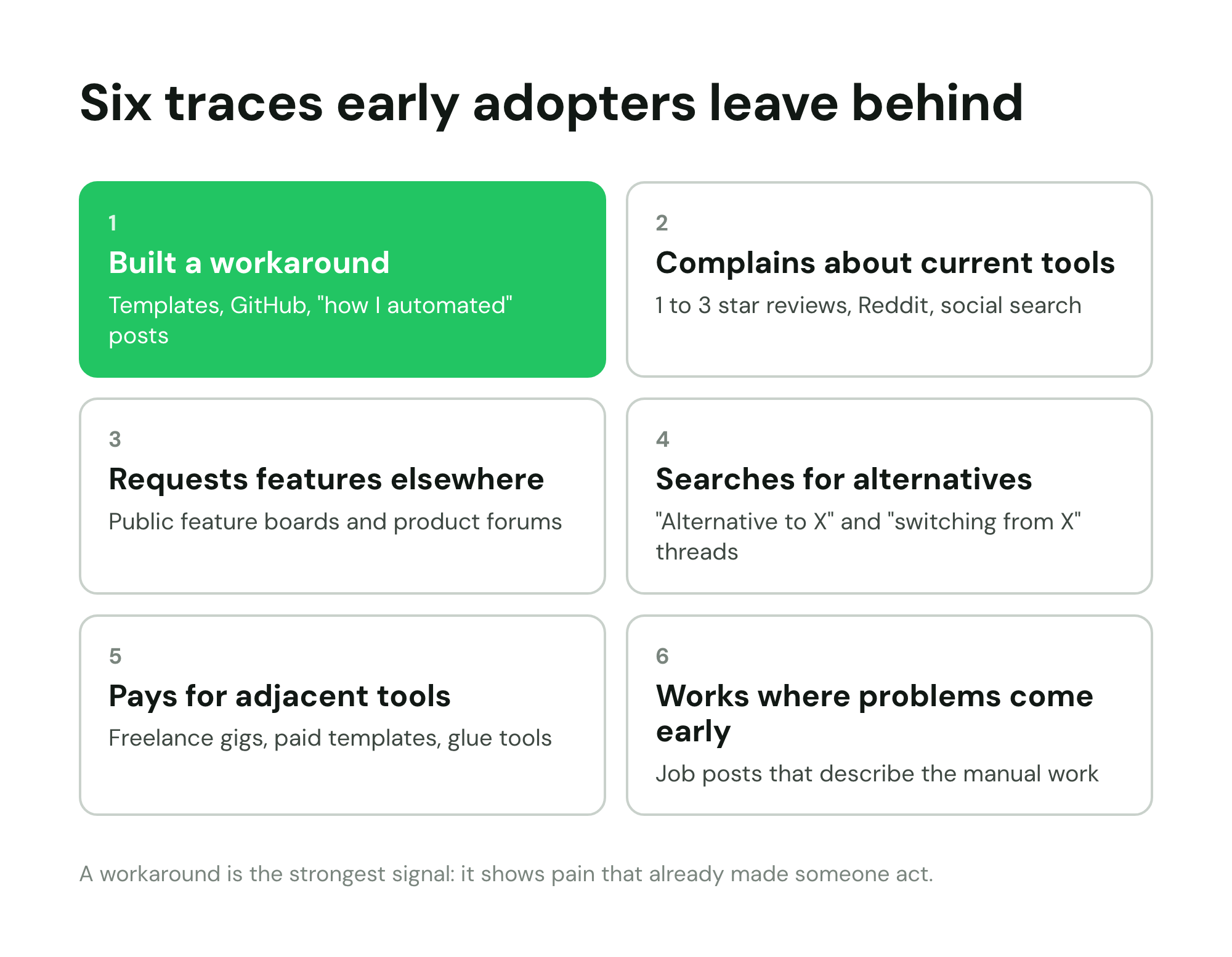
TL;DR: How to find early adopters: stop looking for "tech enthusiasts" and look for evidence of pain. The people who will use and pay for an unfinished product leave traces: they have built a workaround, they complain about the tools they use, they ask for features on someone else's product, they search for alternatives, they pay for adjacent tools and they work where problems arrive early. Find those traces, approach each person with a specific message, and score them against Steve Blank's five traits (has the problem, knows it, is looking now, has a workaround, can pay) before you build anything for them. When you look for early adopters for SaaS, five to ten qualified accounts, found one account at a time, is enough to start; a consumer app needs about 100 people who love it. Below: the theory in two minutes, a scorecard, six signals with where to look, two messages to copy, real examples by market and the mistakes that keep founders stuck with the wrong first users.
Who are early adopters?
The term comes from Everett Rogers' Diffusion of Innovations, first published in 1962. Rogers divided everyone who eventually adopts a new idea into five groups along a bell curve: innovators, early adopters, early majority, late majority and laggards. In the percentages usually quoted from his work, innovators are 2.5% and early adopters 13.5%, followed by 34%, 34% and 16%. The cut points are standard deviations on a normal curve, so read them as a shape rather than a forecast.
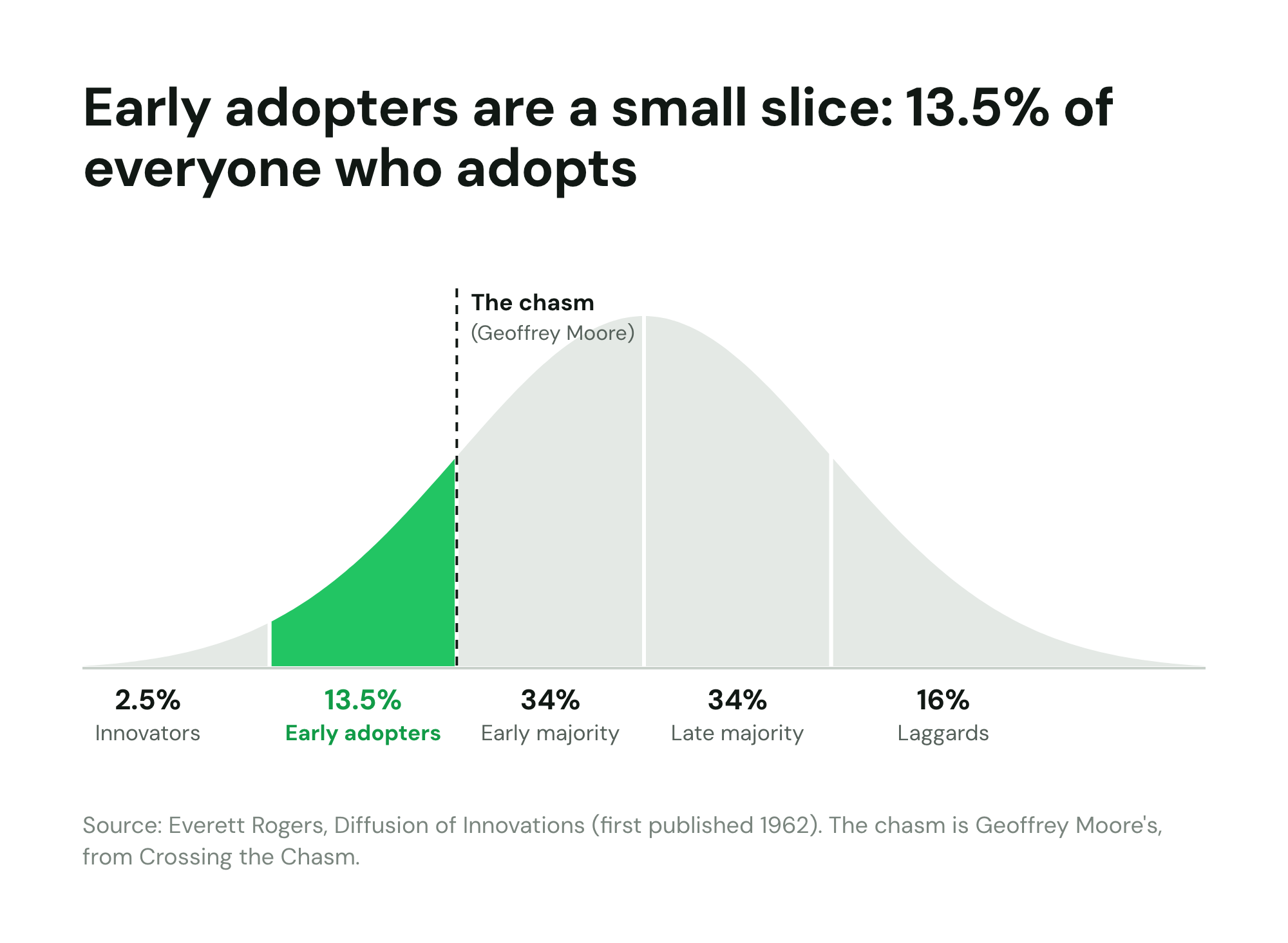
Two things about the shape matter for a founder. Early adopters are a small slice, so you are looking for a few dozen people in your market, not thousands. And the gap between them and the early majority is where many products stall, which we come back to near the end.
Early adopter characteristics, from the people who named them
Rogers and the writers who built on him describe early adopters in slightly different terms, and each adds something useful:
- Rogers: respected and listened to. A Stanford course summary of Rogers describes early adopters as earning "respect for its judicious, well-informed decision-making" and as the group "where most opinion leaders in a social system reside". They are not the wildest risk-takers; they are the people others watch.
- Geoffrey Moore: visionaries after an advantage. In his 2009 slides on Crossing the Chasm, Moore lists early adopters' motivation as gaining "dramatic competitive advantage", and their traits as being attracted by high-risk, high-reward propositions, willing to "commit to supply the missing elements" and not price-sensitive, because they see large gains.
- Steve Blank: people in pain, with money. Blank's version, built for founders, is the most practical. We turn it into a scorecard below.
Why the "tech enthusiast" definition misleads founders
Ask a room what an early adopter looks like and you get someone who queues for new phones and signs up for every beta. Moore has a name for that person, and it is not "early adopter". On the same slides, the group before early adopters, the innovators, are "technology enthusiasts" whose motivation is to "learn about new technologies for their own sake", and who "want no-profit pricing (preferably free)".
That is the trap. A gadget lover will happily try your product, praise it and leave, because their reward was the trying. The accountant who has never installed a beta in her life, but who spends six hours a month fixing the same reconciliation by hand, is the real early adopter for a reconciliation tool. Being an early adopter is not a personality type. It is a relationship between one person and one problem, and the same person can be an early adopter for one product and a laggard for everything else.
Early adopters vs beta testers vs early majority
A beta tester is defined by a task (try this and tell me what breaks), an early adopter by a need (I have to fix this now) and the early majority by caution (show me it works for people like me); for where a beta sits in a launch, see what a beta launch is.
| Beta testers | Early adopters | Early majority | |
|---|---|---|---|
| Why they show up | Curiosity, a reward, helping out | The problem costs them now | Peers they trust already use it |
| What they tolerate | Bugs, for a few weeks | Bugs and gaps, for months, if the core works | Very little |
| What they give you | Bug reports and usability notes | Usage, money, references to people like them | Volume and revenue |
| Will they pay early? | Seldom | Yes, if the pain is real | Only once it is proven |
| Who they listen to | You | Themselves; others listen to them | Other pragmatists |
| When you need them | Before release | From the first usable version | After a niche is won |
The early adopter scorecard: Steve Blank's five traits
Blank's "earlyvangelist" is an early adopter who also champions the product inside their company. In Perfection By Subtraction he lists how to identify them:
- They have a problem.
- They understand they have a problem.
- They are actively searching for a solution and have a timetable for finding it.
- The problem is painful enough that they have cobbled together an interim solution.
- They have, or can quickly acquire, money to purchase a product that solves it.
He adds that these customers buy the vision first and the product second, which is why they will stay with you "the many times you screw up". It is also why you can find them before the product exists.
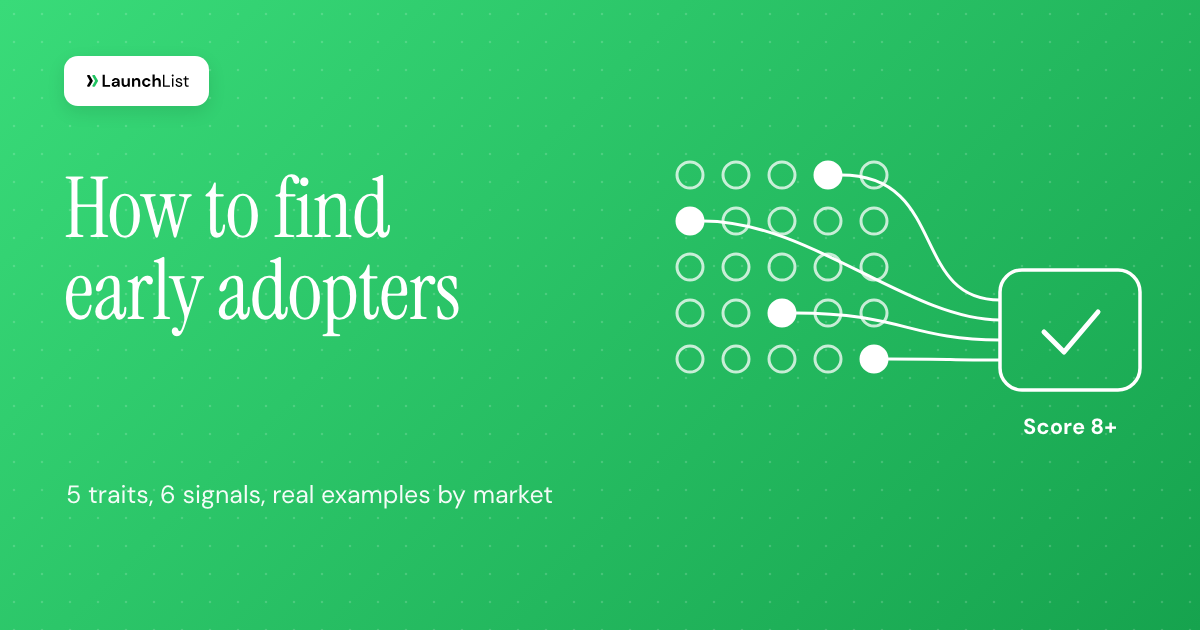
Each trait can be scored, which turns a vague hunch into something you can compare across 30 conversations. Score every prospect 0, 1 or 2 per trait:
| Trait | 0 points | 1 point | 2 points |
|---|---|---|---|
| Has the problem | No, or rarely | Every month or two | Every week |
| Knows they have it | Does not name it | Agrees when you describe it | Brings it up before you do |
| Looking now, on a timetable | Not looking | Looked once and gave up | Looking now, with a deadline |
| Built a workaround | Nothing | A habit or a manual routine | A spreadsheet, script, hire or paid tool they maintain |
| Has or can get budget | No money and no say | Would need to ask someone | Pays for something today, or owns the budget |
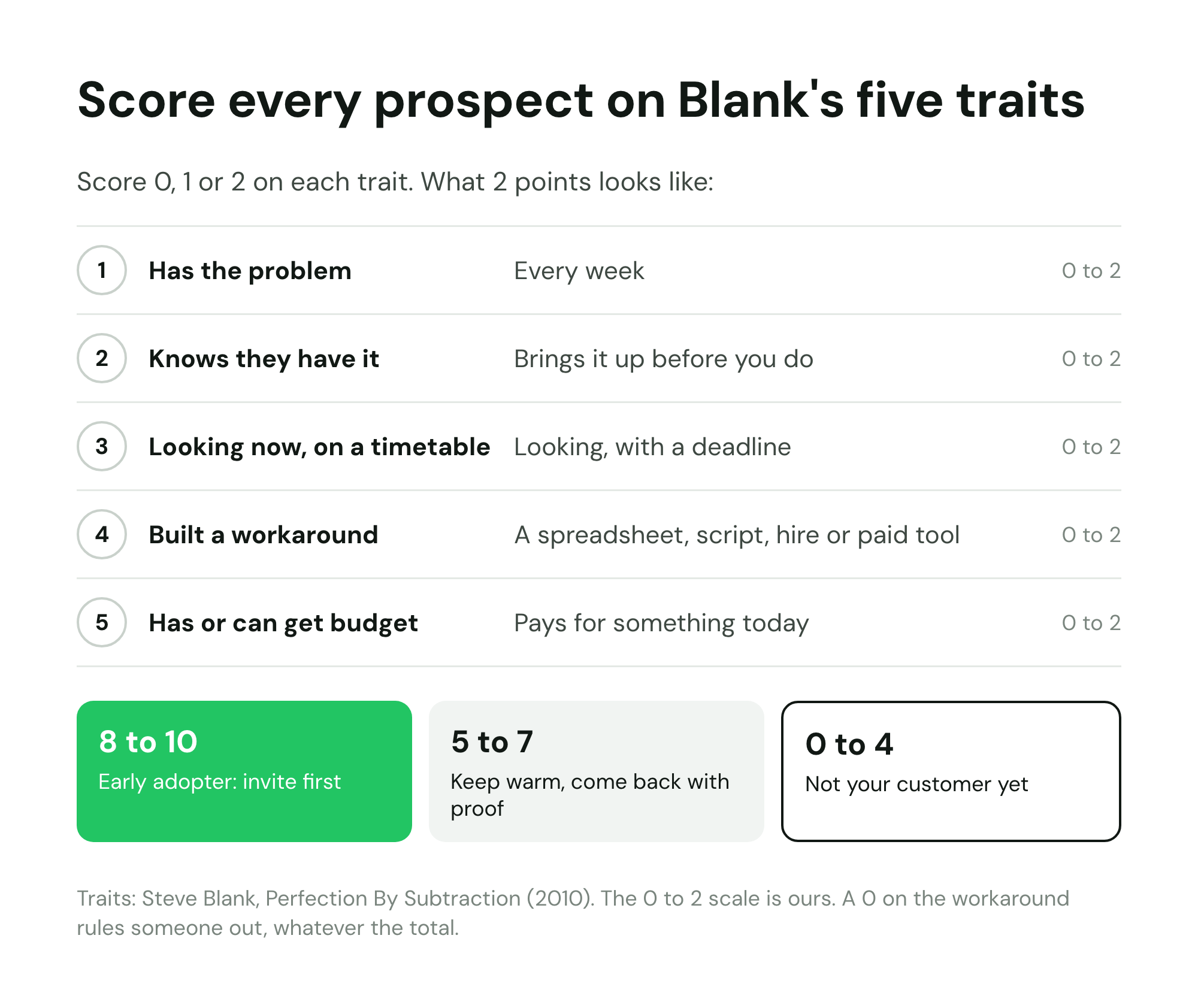
Read the total like this: 8 to 10 is an early adopter, so build with them and invite them first. 5 to 7 is a likely early-majority customer, so keep them warm and come back with proof. 0 to 4 is not your customer yet. One override: anyone who scores 0 on the workaround is not an early adopter, whatever the total. Pain that has never pushed someone to do anything about it is not the kind that makes them switch.
Here is the scorecard on three people, for an example product that reconciles payment payouts with accounting for small software companies:
- Priya, solo founder: reconciles every week (2), raised it in the first minute (2), wants it fixed before her tax filing in March (2), maintains a spreadsheet with a script she wrote (2), pays a bookkeeper today (2). 10: build with her.
- Dana, operations lead: monthly (1), agrees when asked (1), not looking (0), does it by hand in her accounting tool (1), needs her cofounder's sign-off (1). 4: not yet.
- Marco, finance-app enthusiast: no software revenue (0), finds the idea "really cool" (1), signs up for everything (1), no workaround (0), no budget (0). 2, and the workaround override applies. Marco is the person most founders mistake for an early adopter, because he is the most excited.
How to find early adopters: six signals to look for
If you want to know how to find early adopters, start with behavior, not demographics: they are hard to find by age or job title and easy to find by what they do. Customer Dev Labs makes this point in where to find early adopters: list what someone actively seeking a solution would do, then turn each action into something an outsider can see. These are the six traces that show up again and again, and where to look for each.
| Signal | Where to look | How to reach them |
|---|---|---|
| They built a workaround | Template galleries, GitHub repos, "how I automated" posts and videos, automation tool forums | Comment on or email the author about their setup |
| They complain about current tools | 1 to 3 star reviews on G2, Capterra, app stores; Reddit; social search | Help in public first, then message |
| They request features on another product | Public feature boards, community forums, GitHub issues of incumbent tools | Reply in the thread where allowed, or message |
| They search for alternatives | "Alternative to X" threads, "switching from X" posts, comparison questions | Reply with an honest comparison and offer a call |
| They pay for adjacent tools or people | Freelance gigs doing the task by hand, paid templates and courses, glue tools | Ask the freelancer or creator for an introduction |
| They work where problems arrive early | Job posts describing the manual work, people who recently joined fast-growing companies | A short note that references the specific post |
1. They built a workaround
This is the strongest signal because it is Blank's fourth trait made visible. Search the places where people publish their fixes: spreadsheet and Notion template galleries, GitHub (search the problem in plain words and sort by recently updated), YouTube tutorials titled "how I track" or "how I automate", and the community forums of automation tools, where people post the multi-step setups they built to paper over a gap. The author of a template with 200 copies is an early adopter, and so are the people asking questions underneath it.
2. They complain publicly about the tools they use
Read the one to three star reviews of the tools your product would replace. Five-star reviewers are happy and one-star reviewers are sometimes just angry, but the two- and three-star reviewer who writes "does everything except the one thing I need" is describing your product. On Reddit and social platforms, search the problem plus words like "hate", "frustrating" or "is there a tool". Check the date: someone who complained three years ago has either solved it or given up.
3. They ask for features on someone else's roadmap
Many software companies run public feature boards and community forums. Requests that sit unanswered for months, with a long tail of "+1, we need this too", are lists of early adopters with their problem already written down. Zapier's founders found their first users exactly this way (more in the examples below).
4. They search for alternatives
Someone typing "alternative to [tool]" or posting "switching from [tool], what do you use?" has passed Blank's third trait: they are looking now. These threads also tell you what the person is leaving and why, which is the most useful sentence you can have before your first message.
5. They pay for adjacent tools or people
Money already spent is the clearest evidence of Blank's fifth trait. Look for freelance gigs where someone is paid to do the task by hand, paid templates and courses about the problem, and the glue tools people use to connect two products that do not talk to each other. A freelancer who does the job for ten clients can introduce you to ten early adopters, and is often one herself.
6. They work somewhere growing fast
Companies that are growing quickly meet new problems before the rest of their market and usually have budget to solve them. Job posts are a good tell: a listing that asks someone to "maintain our reporting spreadsheets" or "manually reconcile" anything is describing a workaround and a budget in the same paragraph. People who recently joined a fast-growing company in the role your product serves are worth a short note.
Where early adopters gather
The six signals show up in the same handful of places. What to look for in each:
- Reddit: subreddits for the role or the problem, and threads titled "is there a tool for" or "how do you handle", plus the replies that say "same here".
- Indie Hackers: founders describing the tools they stitched together and what still breaks, which matters most when your users are founders or makers.
- Hacker News: "Ask HN" threads about tools and workflows, where commenters describe the scripts they wrote instead of buying something.
- Product Hunt: the comments on products like yours, where people say what is missing. Loom's first ~3,000 users came from its launch day there, according to Lenny's Newsletter.
- Review sites such as G2 and Capterra: the two- and three-star reviews of the tools you would replace, which often state the reviewer's role and company size.
- Slack and Discord groups: role communities where people ask peers for recommendations; read the help and tools channels, and follow each group's rules on promotion.
Beyond these, your second-degree network, newsletters and launch sites each send different crowds. For the channel side, see how to promote your waitlist and where to launch your startup. This guide stays on the harder part, which is telling an early adopter apart from everyone else who shows up.
How to qualify an early adopter in one conversation
Most advice on how to get early adopters for a startup stops at a list of names. The scorecard needs facts, and the fastest way to get them is a 20-minute conversation about the past, not the future. Ask when they last ran into the problem, what they did about it, what that cost them in time or money, and what they have already tried or paid for. Avoid "would you use this?": almost everyone says yes, and it scores nothing.
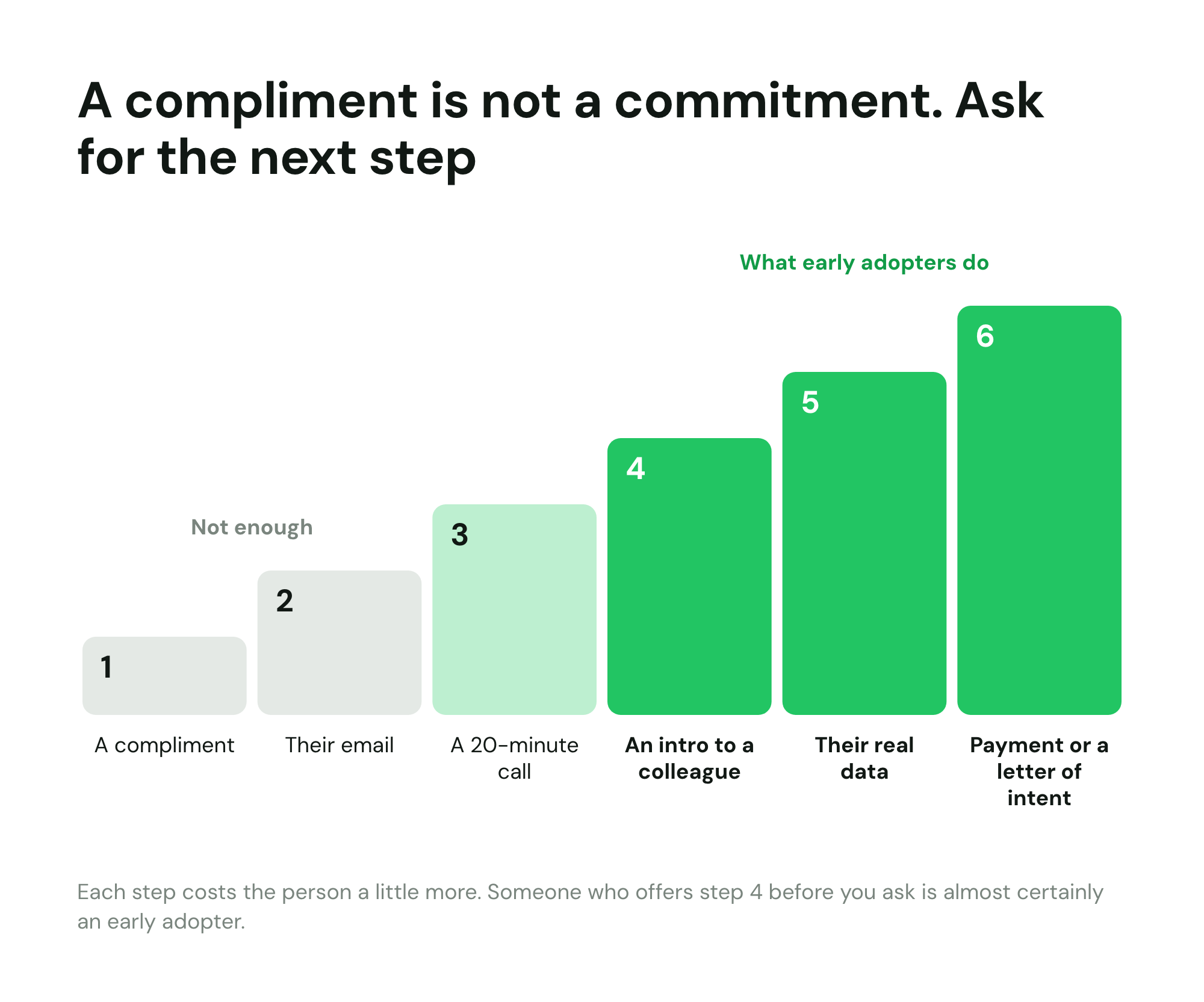
Then ask for something, because words are cheap. Each step up the ladder costs the person a little more, from a compliment to an email, a 20-minute call, an introduction to a colleague, time with their real data and finally a payment, a deposit through your own checkout or a signed letter of intent. Someone who stops at step 1 or 2 is not an early adopter, however enthusiastic, and someone who offers step 4 before you ask almost certainly is.
Messages to copy when you approach early adopters
Both start from a signal you found, which is what keeps them from reading like spam. Keep them short, mention the specific thing they wrote or built, and ask for one small step.
1. Message to someone who built a workaround
I found your [template, script, post] for [problem]. It is the clearest setup I have seen, and the fact that you built it tells me the existing tools miss something. I am building [product] to do this without the [manual step]. Could I ask you three questions about how you use it? I will send you early access when it is ready, whatever you say.
2. Email to someone who requested a feature on another product
You asked [company] for [feature] back in [month]. I am building a tool that does exactly that for [type of user], and I am looking for a handful of people to shape the first version. Would you tell me how you get around it today? If it fits, you would be among the first in, with a founding price written down.
If you collect people through a signup page instead of one by one, send the same kind of personal note to the people whose answers scored highest. For more ready-made emails, see waitlist email templates.
What to offer early adopters
Early adopters are giving you time, patience with bugs and often money before anyone else will. Offer what they value, which is rarely a discount on its own:
- The product sooner. Real early access, let in on a date you keep.
- Influence. A monthly call, a vote on the next feature, and visible proof that you shipped what they asked for, such as a build in public changelog that names the request.
- A direct line to the founder. Only promise the response time you can keep for a year.
- A founding price, written down. State the price, the plan, how long it lasts and what happens after. The guide to running an early access program covers founding pricing and when to charge.
Do not make it free by default. In Moore's model the innovators want free; early adopters pay because the gain is large. If someone with a score of 9 will not pay anything for a product that removes their workaround, the problem is smaller than you think, and you want to learn that now. For what happens when the list turns into revenue, read how to convert a waitlist to paying customers.
How many early adopters you need, and how to keep them
Fewer than most founders expect, as long as they are the right ones:
- Slack started with "maybe six to ten companies", found by begging friends at other companies to try it, according to Stewart Butterfield in First Round Review.
- Airbnb: Paul Graham's advice to its founders was "Focus on 100 people that love you, rather than getting a million people to kind of like you," as Brian Chesky told CNBC.
- Superhuman's Rahul Vohra says around 40 respondents give "directionally correct results" for a product-market fit survey, in First Round Review.
A working rule from those three: for a B2B product, 5 to 10 qualified accounts that use it every week; for a consumer app, about 100 people who use it every week; and enough of either to get 40 honest answers to "How would you feel if you could no longer use this product?".
Keeping them is mostly about showing that their effort changed something:
- Ship one thing they asked for in the first two weeks. Small is fine. It proves the influence is real.
- Close the loop in writing. When you ship a request, tell the person who asked, by name.
- Send a short update on a fixed day. What changed, what is next, one question.
- Let them bring people. Early adopters are opinion leaders, in Rogers' sense. Give them a way to invite colleagues and see who joined; the waitlist referral program guide covers how.
- Let the wrong ones go. If someone scores low and asks for a different product, thank them and stop building for them.
Early adopters for SaaS: B2B vs consumer traits
The traits are the same, but they show up differently.
| SaaS and B2B | Consumer apps | |
|---|---|---|
| The workaround looks like | A spreadsheet, a script, a hire, three tools glued together | A habit, a notes app, a group chat, a second app |
| Budget means | A card on file or a budget owner who says yes | Willingness to pay a few dollars, or to switch and stay |
| Where they talk | Role communities, vendor forums, review sites, job posts | Subreddits, campuses, hobby groups, creator audiences |
| How many to start | 5 to 10 accounts | About 100 weekly users |
| What spreads it | One champion inviting their team | Friends inviting friends |
For early adopters for SaaS, Blank's budget trait is decisive: a person who loves the idea but cannot get it bought is a fan, not a customer. Look for the person who owns the workaround, because they usually own or influence the budget for replacing it. If you are building software for businesses, waitlist software for SaaS covers the pre-launch side.
For consumer products, budget is mostly time and attention. Lenny Rachitsky's review of how the biggest consumer apps got their first 1,000 users found that most relied on a single strategy, none used more than three, and the most common was going to target users directly, offline or through friends (the table in the examples below shows two). In consumer, find one dense group where the problem is shared, and win it completely.
Early adopter examples: how five companies found theirs
These are the clearest documented cases, each showing one of the signals at work.
Examples of early adopters by market
Examples of early adopters: in every market below, the first users had the problem badly enough to try something unfinished, and the founders went to where they already were.
| Market | The early adopters | How they were reached | Source |
|---|---|---|---|
| Consumer hardware | 68,929 Kickstarter backers who pre-ordered the Pebble watch in 2012 | A crowdfunding page with a $100,000 goal; pledges reached $10,266,845 | Guinness World Records |
| Consumer app | USC sororities and fraternities (Tinder); designers with large Twitter followings (Instagram) | Pitched in person; early access given to people others follow | Lenny's Newsletter, above |
| B2B software | Six to ten friends' companies (Slack); Highrise users asking for a Google Contacts integration (Zapier) | Personal asks; replies in product forums | First Round Review; Instapage podcast, below |
| Community | Readers of the founders' blogs (Stack Overflow); a homeowners association's board (Nextdoor) | A private beta for followers; a partnership with the board | Lenny's Newsletter, above |
Zapier: feature requests on other products' forums
Zapier's first users were people asking other software companies for integrations that did not exist. Wade Foster described it on the Instapage podcast, Harvesting Existing Demand for Your Product: "I remember going to the Highrise forums and people were asking for years for a Google contacts integration." The team replied in threads like that across many products, said people could build it with the APIs, mentioned that they were working on a way to do it without code, and invited people to get in touch. Signal 3, worked by hand.
Slack: friends at other companies, then progressively larger teams
Slack's team "begged and cajoled our friends at other companies to try it out and give us feedback," Butterfield told First Round Review. Rdio started with a small group of front-end developers, then the whole engineering group, then all 120 people in the company. "The pattern was to share Slack with progressively larger groups," and each wider group surfaced new feedback. Early adopters inside one company became the references for the next team.
Superhuman: narrowing to the people who would be very disappointed
When Superhuman first asked users the Sean Ellis question, only 22% said they would be "very disappointed" without the product, below the 40% benchmark. Vohra's response, documented in First Round Review's article on Superhuman, was to narrow the market to the kinds of users who answered "very disappointed", which raised the score to 33%, and to build for them; three quarters later it was 58%. He also advised to "politely disregard" those who would not be disappointed. It is the scorecard idea applied after launch: find your real early adopters inside your users, and build for them.
Airbnb: 100 people who love it
After Graham's advice, Airbnb's founders went to New York, where their few active users were, photographed listings in person and learned how hosts saw the business, as Chesky recounted to CNBC. In Do Things That Don't Scale, Graham writes that about 30 days of going out and engaging with users in person "made the difference between success and failure". The lesson for founders is to go to where the early adopters already are, physically if you can.
Dropbox: developers who had built their own sync
Drew Houston posted Dropbox to Hacker News in April 2007. The best-known reply argued that a Linux user could "already build such a system yourself quite trivially" with an FTP account and version control. That comment is usually told as a story about skeptics, but it is also a description of signal 1: an audience full of people who had cobbled together their own sync. The Dropbox referral program case study covers how that early group then spread it.
Mistakes that keep founders with the wrong first users
- Mistaking friends for early adopters. A guest post on Steve Blank's blog by two founders who got Customer Development wrong warns that the earlyvangelists you thought you had may be "just very polite users", and that you can only be sure when they pay.
- Mistaking enthusiasts for early adopters. Excitement is not pain. Score Marco honestly.
- Counting tire-kickers. A signup with no answers, no reply and no workaround is a name, not an early adopter. A waitlist that is not converting is often full of them.
- Building for the loudest. The person who sends the most feature requests is not always the one with the highest score. Weigh requests by score, not by volume.
- Asking about the future. "Would you pay for this?" produces kind lies. Ask what they did last time.
- Staying with early adopters too long. They are the start, not the market. More on this next.
Early adopters vs early majority: knowing when to move on
Moore's slides put the problem in one line: "Pragmatists don't trust visionaries as references." The early majority, in his words, "insist on good references from trusted colleagues" and "want to see the solution in production at the reference site". Visionaries, meanwhile, "demand high degree of customization and support". A product shaped entirely by early adopters can end up with a dozen custom features, glowing quotes from people the mainstream does not trust, and no growth.
Signs you are staying too long:
- Every new customer needs something built or configured by hand before they can start.
- Your references all come from adventurous companies, and prospects ask "who else like us uses it?"
- Your roadmap is a list of individual customers' requests.
Moore's way across, as summarized on Wikipedia, is to focus on one group of customers at a time, with "a whole product that nails the use case", and use each group as a base for the next. In practice: pick the narrowest segment where your early adopters already cluster, make the product complete for that segment without hand-holding, and let those customers be the references for their peers.
Using a waitlist to find and sort early adopters
Everything above is manual work, and it should be: knowing how to find early adopters does not mean a tool can do it for you, and LaunchList does not. What a waitlist can do is give every signal you work one place to send people, and make early adopters identify themselves when they arrive. LaunchList is pre-launch waitlist software for founders, and this is one of the things it is used for.
- A signup form that asks the scorecard questions. Build a hosted waitlist landing page from one sentence, or embed the form on your own site; you can also add it to an app made with an AI builder through a prompt. The waitlist form builder takes dropdowns, single or multiple choice and long-text questions on every plan, so ask "What do you use today for [problem]?", "When did you last run into it?" and "Are you looking for a fix this quarter?". A hidden field records where each person came from: a link ending in
?source=reddittells you which signal they came through. - Pull out the highest scorers. Read the answers, then tag the people who score 8 or more; tags are on every plan. On the Launch plan and the Grow plan you can build your own segments from those answers, such as "built a workaround and looking this quarter". Waitlist management shows where everyone stands, from Waitlist to Invited, Joined, Converted or Declined.
- Invite them first, personally. Personal invites are on every plan; the Free plan includes a fixed number, and pricing has the details. Invite one person or up to 1,000 at once. Each person gets an email linking to their private waitlist status page, with their code and a "Claim access" button; codes expire after 14 days unless you set otherwise. Early access invite codes explains the details, and Analytics shows what share of each batch used its code.
- Let early adopters bring others. Every signup gets a referral link and a live queue position, with a leaderboard, on every plan. The referral waitlist page shows how it works.
- Keep them close between batches. From the Collect plan, you can email your waitlist with the short weekly update described above.
If you are still checking whether the problem is real, an idea validation landing page is the closest starting point.
Early adopters FAQ
What is an early adopter?
An early adopter is someone who takes up a new product before most people do, because the problem it solves costs them enough that an unfinished product is better than what they have. In Everett Rogers' diffusion of innovations model they are the second group to adopt, after the innovators, and the group where most opinion leaders sit. For a startup, the practical definition is narrower: a person who has the problem, knows it, is looking for a fix, has built a workaround and can pay.
What percentage of people are early adopters?
In Rogers' model, early adopters are 13.5% of the people who eventually adopt an innovation, after innovators at 2.5%. The early majority and late majority are 34% each, and laggards 16%. The percentages come from dividing a bell curve by standard deviations, so treat them as a shape, not a count you can plan revenue on. Your own early adopters are the small slice of your specific market that feels the problem most.
How do I find early adopters for my startup?
Look for behavior, not personality. Early adopters leave traces: they build workarounds in spreadsheets and scripts, complain publicly about current tools, request features on other products' forums, search for alternatives, pay for adjacent tools or freelancers, and work at companies that are growing fast enough to hit new problems first. Find those traces, reach out one by one with a specific message, and score each person against Steve Blank's five traits before you spend time on them.
What are the characteristics of an early adopter?
Steve Blank lists five: they have a problem, they understand they have it, they are actively searching for a solution on a timetable, the problem is painful enough that they have cobbled together an interim solution, and they have or can quickly get the money to buy. Rogers adds that early adopters are respected for well-informed decisions and hold most of the opinion leadership in their group, which is why others follow them.
What is the difference between early adopters and beta testers?
Beta testers try a pre-release product and report what breaks; they may never use it again. Early adopters are your first real users and customers, who take up the product because they badly need it and keep using it after the test ends. Some beta testers become early adopters, but many good testers are curious rather than desperate, and that difference shows up the day you ask for money.
What is the difference between early adopters and the early majority?
Geoffrey Moore calls early adopters visionaries: they want a big advantage, accept risk and will supply missing pieces themselves. The early majority are pragmatists: they want steady improvement, prefer proven products and insist on references from trusted colleagues. Moore's slides add that pragmatists don't trust visionaries as references, which is why a product loved by early adopters can still stall. He calls that gap the chasm.
How many early adopters do I need?
Fewer than most founders expect. Slack started with six to ten companies found through friends. Paul Graham told Airbnb's founders to focus on 100 people who love them rather than a million who kind of like them. Superhuman's founder says about 40 survey responses give a directional product-market fit read. For a B2B product, 5 to 10 qualified accounts is a working start; for a consumer app, aim for about 100 people who use it every week.
What should I offer early adopters?
Offer what they actually want: the product sooner, real influence over what you build next, a direct line to the founder, and a founding price written down with its terms. Avoid making it free by default. In Moore's model it is innovators, the technology enthusiasts, who want free; early adopters are not price-sensitive because the gain is large, and their willingness to pay is the signal you need.
What are examples of early adopters?
The 68,929 Kickstarter backers who pre-ordered the Pebble watch in 2012, before it existed. The Highrise users who had asked for years for a Google Contacts integration and became Zapier's first users. The six to ten companies run by friends who first used Slack. The USC sororities and fraternities Tinder's team pitched in person, and the readers of the founders' blogs who joined Stack Overflow's private beta. Each group had the problem badly enough to try something unfinished.
Can I find early adopters before I have a product?
Yes, and it is the best time. Early adopters buy the vision first and the product second, as Steve Blank puts it, so a clear description, a demo or a manual version of the service is enough to start conversations. Zapier's founders replied to forum threads asking for integrations before the product could handle them, and helped those people by hand. Collect them on a waitlist with a few qualifying questions so you can invite the strongest first.