Waitlist Referral Programs: How to Build a Dropbox-Style Viral Waitlist (2026)
TL;DR: A waitlist referral program turns every signup into a recruiter. The mechanics are deceptively simple: a unique referral link per subscriber, a visible position counter, a leaderboard, and milestone rewards that get progressively better. But the difference between a viral waitlist and a dead one is in the details: reward design that scales, fraud detection that protects leaderboard integrity, and a post-signup page and first email that prompt sharing in the first 60 seconds. This guide covers the mechanics, the reward psychology, how to stop referral fraud, the common ways founders kill their own virality, and a step-by-step setup in LaunchList, pre-launch waitlist software for founders, where the referral link, live position and leaderboard are on every plan (the Free plan included), referral credit only lands after the friend is verified, and rewards and points tasks start on the Collect plan.
The single most-cited example in pre-launch growth is Dropbox. After bolting a referral program onto their waitlist, signups grew roughly 60% via referral and the user base went from about 100,000 to 4 million in 15 months. Robinhood used a similar referral queue to amass roughly 1 million pre-launch signups. Harry's reportedly captured about 100,000 emails in a week with a tiered referral campaign. Morning Brew built a multi-million subscriber newsletter on the back of a referral program with physical and digital rewards.
These outcomes weren't accidents. They share a specific structural pattern. Here's how to replicate it.
What is a waitlist referral program?
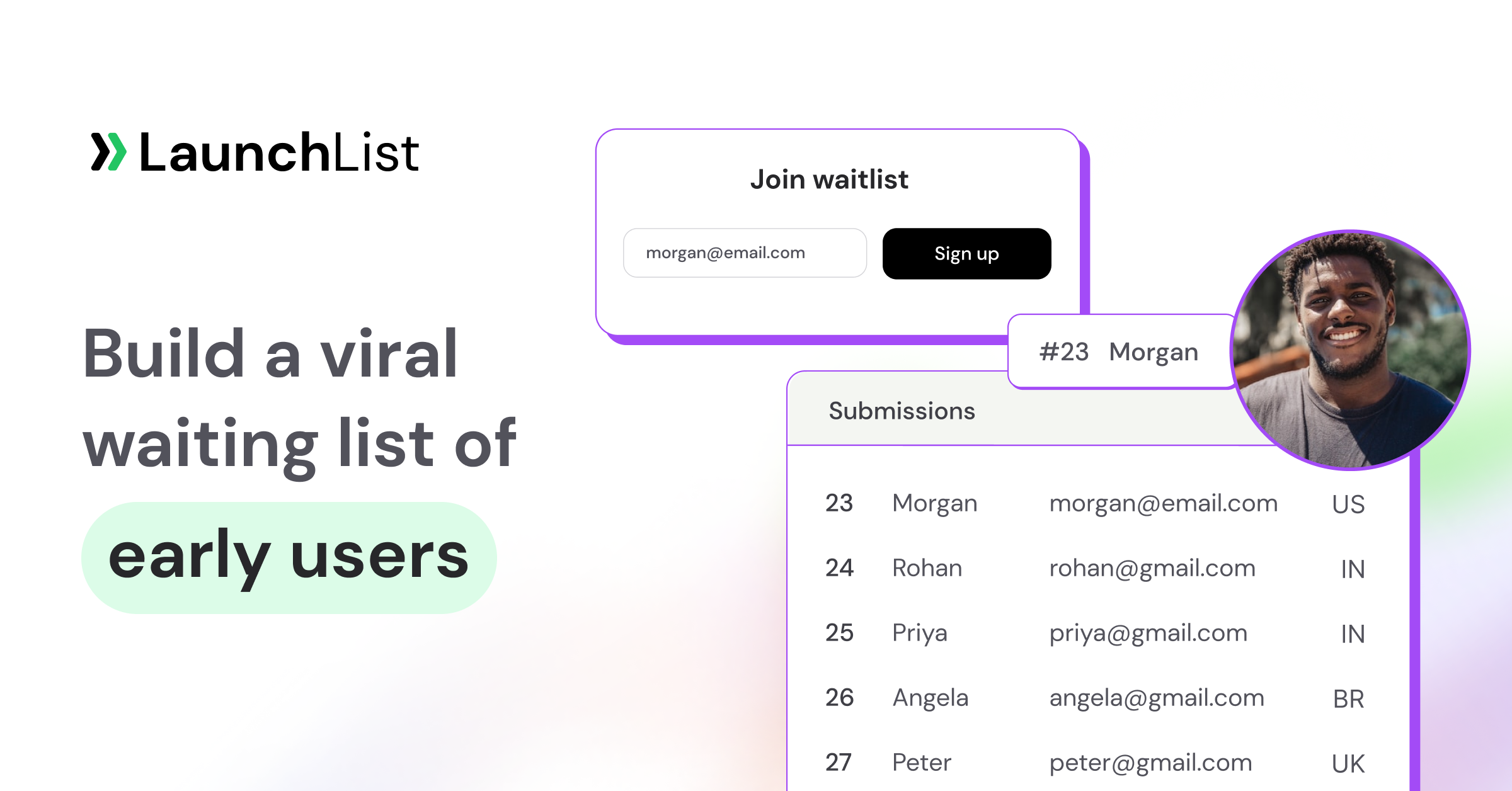
A waitlist referral program is a viral mechanic layered on top of a pre-launch waitlist. Each subscriber gets a unique referral link. When friends sign up through that link, the original subscriber moves up the queue, unlocks rewards, or both. The page shown after signup is the primary surface where this loop happens.
The four mechanical components are non-negotiable:
- A unique referral link per subscriber: usually
yoursite.com/?ref=ABC123 - Position tracking: every subscriber sees where they stand
- A leaderboard or counter: visible progress against either themselves or others
- Milestone rewards: discrete unlocks at 1, 3, 5, 10, 25, 50 referrals
Take any of these out and the loop weakens. Position tracking without rewards feels arbitrary. Rewards without position tracking remove the urgency. A leaderboard without fraud detection turns into a contest of who can spin up the most fake email accounts.
The mechanics, in detail
Unique referral link per subscriber
Every signup needs to immediately receive a personal share URL. This link is the atomic unit of the whole program. It needs to appear:
- On the post-signup confirmation screen
- In the very first email after confirmation
- In every subsequent waitlist update email
- Inside any "you moved up the queue!" notification
LaunchList gives every signup a referral code and a share link the moment they join, on every plan. The link carries a ?ref= code and works when it points at any page of your site, not just the signup page: the code is stored in the visitor's browser for 90 days alongside any UTM parameters, so a friend who reads three pages and comes back tomorrow still credits the person who sent them. Under Audience, Referrals & rewards, Settings you choose where referral links land: your hosted launch page, your own site, or any URL. Whatever tool you use, this should be one of the first things you verify works.
Position tracking
Showing someone "You're #4,217 in line" creates immediate emotional commitment. Once a person sees their number, they care about that number. This is the same sunk-cost psychology that makes loyalty points work: the position is a tangible asset they now own and want to improve.
In LaunchList, position is computed live from the leaderboard every time it is read, so it moves the moment anyone above or below changes, with no nightly recalculation. The line is ordered by points: a friend who joins is worth 10 points on a new project (you can change it), and signup order breaks ties, so someone who refers nobody still stays ahead of everyone who joined after them. An optional Start numbering at setting shows the first signup as, say, #1,247 instead of #1. It is display-only and applied to everyone equally; some founders use it as early social proof and others consider it dishonest, so it is off by default and the call is yours.
Leaderboard
Public leaderboards work best when your audience is competitive (developers, traders, gamers, fitness). Private views ("you've climbed 312 spots since yesterday") work for almost everyone. Don't show a public leaderboard if your top referrers can be poached (B2B SaaS waitlists especially).
LaunchList's leaderboard is real-time and appears in three places: on each person's status page, as a block on your hosted page, and as a one-line widget for your own site. Inside the dashboard, Analytics, Referrals ranks your top referrers by network (everyone they referred, plus everyone those people referred), which is the list to thank personally.
Milestone rewards
Tiered rewards convert better than a single "invite friends to skip the queue" message. A subscriber who refers 1 friend has psychological investment to refer 2. A subscriber sitting at 4 referrals will push to hit 5 if there's a visible reward at 5.
Reward design: what to actually offer
This is where most founders get stuck. The reward needs three properties: it must be valuable to your audience, it must scale to thousands of redemptions without bankrupting you, and it must be easy to verify and deliver.
| Reward type | Best for | Cost to deliver | Scales? |
|---|---|---|---|
| Queue-jump (skip the line) | Any pre-launch waitlist | $0 | Infinitely |
| Early access tier (week 1, week 2, week 4) | SaaS, AI tools, beta products | $0 | Infinitely |
| Permanent discount or locked-in founding price | Paid SaaS post-launch | Margin | Yes |
| Premium plan free for N months | Freemium SaaS | Margin only | Yes |
| Exclusive feature unlock | Product with upgrade tiers | $0 | Yes |
| Branded swag (sticker, t-shirt, mug) | Consumer brands, communities | $5–$25/unit | Limited |
| Hardware product (Harry's-style razor) | Physical product brands | High | Limited |
| 1:1 founder call | Premium B2B, high-ticket | Time only | No |
| Cash or gift card | Almost never recommended | High | Yes (but attracts fraud) |
The pattern that consistently works: start with queue-jump and early access (free to deliver), layer in a digital reward at the 3–5 referral mark (free trial of a premium tier, exclusive Discord, gated content), and reserve physical or high-cost rewards for the 25–50+ tier where the math works. Make the first rung reachable with one or two referrals: an early win is what convinces someone the mechanic is real.
Example tier structure (SaaS pre-launch)
- 1 referral: Move up 100 spots
- 3 referrals: Bonus week of early access
- 5 referrals: Free Pro plan for 1 month at launch
- 10 referrals: Free Pro plan for 6 months
- 25 referrals: Permanent 50% discount + name in launch credits
- 50 referrals: Free forever + founder call
This structure works for most software products. Adapt the language for your industry: a crypto waitlist might offer token allocation tiers; an AI startup waitlist might offer model credits or higher rate limits; a mobile app waitlist might offer in-app currency or premium-tier unlocks.
How rewards are delivered in LaunchList
Rewards and milestones are on the Collect plan and up. You can add up to 20 rungs, each unlocked by a number of credited referrals. For each one you choose who delivers it:
| Delivery | What happens when someone unlocks it | Good for |
|---|---|---|
| You send it | They are told, and LaunchList keeps a list of who is still owed it; you mark each one fulfilled | Swag, discounts or anything that lives in your own product |
| Add a tag | The contact is tagged, so you can filter, export or start an email flow from it | "Founding member" groups, beta cohorts |
| Give bonus points | Points are added, which moves them up the line | Compounding the queue-jump |
| Jump them ahead | A single jump of the number of places you set | "Skip 100 spots" rewards |
Every unlock sends its own announcement email automatically, once per grant, so you don't build an automation for it. Reward announcements count toward your monthly email allowance; if it has run out, the email waits and the reward still shows on the person's status page immediately. Each reward has a recipient list where you can grant, fulfil or void per person, and the status page shows the whole ladder: what someone has unlocked, what is next and how many more people it takes. Rewards read referral count, never points.
Points and tasks: a second way to move up
Not everyone will refer, but many will follow you or join your Discord. On the Collect plan and up, LaunchList's points tasks add up to 20 actions people claim from their status page ("Follow us on X, +50 points"), one claim per person per task. They are on the honor system, so treat them as engagement rather than proof. Points move position only and never unlock rewards, which keeps a referral worth more than a stack of small actions unless you decide otherwise.
A quick word on the math (K-factor)
Your viral coefficient (sometimes called the K-factor) is roughly the number of new signups each existing signup generates. If every subscriber refers an average of 0.5 friends who then sign up, your K is 0.5 and your waitlist grows but doesn't go viral. If K crosses 1.0, every signup more than replaces itself and growth becomes exponential.
The two levers are the share rate (what % of subscribers actually share their link) and the conversion rate of those shared links. Most pre-launch waitlists land somewhere between K=0.2 and K=0.6. Hitting K>1 is rare and almost always requires a genuinely remarkable product and a sharp incentive. We cover the math (and how to measure it) in detail in our dedicated viral coefficient post. For now, just know that improving share rate by 10 percentage points usually moves the needle more than improving conversion rate by 10 percentage points. LaunchList's Analytics, Referrals tab states your list's viral coefficient in one sentence (referred signups per 100 confirmed signups, all time) under referred signups, referrers and referrals per referrer.
Case studies: what actually worked
Dropbox
The canonical example. Dropbox offered 500 MB of free storage to both the referrer and the referred friend, capped at 16 GB. The reward was perfectly aligned with the product itself: using the product more was the reward for spreading the product. Public reporting attributes a roughly 60% lift in signups directly to the program, with growth from approximately 100,000 to 4 million users in 15 months.
The lesson: when your reward is your product, the people you attract are the right people. A free tier of your own product is almost always a better referral reward than a gift card.
Robinhood
Robinhood's pre-launch waitlist used a queue-jump mechanic: refer friends to move up. The position counter was the entire game. Roughly a million people signed up before the product was usable. There was no monetary reward, no swag, no premium tier. Just position.
The lesson: for products with high inherent demand, position is enough. Don't over-engineer rewards if the product is the prize.
Morning Brew
Morning Brew offered tiered physical rewards (branded mug, t-shirt, sweatshirt) at increasing referral counts. The genius wasn't the swag itself; it was that opening a free daily newsletter every morning naturally surfaced the referral CTA in the footer. The product was the channel.
The lesson: every touchpoint with subscribers is a referral surface. Email signatures, success pages, post-purchase screens, in-app notifications.
Harry's
Harry's pre-launch campaign reportedly captured around 100,000 emails in a week using tiered physical-product rewards (refer 5 friends → free shaving cream; refer 50 → a year of free blades). The tiers were aggressive but the brand was new enough that the rewards felt genuinely valuable.
The lesson: tier the rewards aggressively and make the top tier worth bragging about.
Superhuman
Superhuman didn't run a traditional referral program but maintained a long invite-only waitlist where existing users could refer friends to skip the line. The scarcity itself became a status signal: being on the waitlist was a flex, and being invited off it was a bigger one.
The lesson: scarcity and exclusivity can substitute for explicit rewards if your positioning supports it.
Referral fraud: how to keep the leaderboard honest
Within hours of launching a public leaderboard, someone will try to game it. Burner emails, disposable domains, scripts, one person on five browsers. Once a leaderboard contains obvious fake top entries, real users disengage: the game looks rigged. No waitlist can make referral farming impossible, only expensive. Here is how LaunchList raises the cost, on every plan:
- Credit on verification, not signup. With double opt-in on (the default for waitlist forms), a referral counts when the friend confirms their email. Typing made-up addresses earns nothing. Turning verification off makes credit instant, which is a faster loop and a weaker one.
- Self-referral, IP and velocity checks. A signup that refers itself from the same device is refused credit. By default one referrer can earn at most 3 credited referrals from one IP address and 20 in an hour (adjustable under Project settings, Privacy & spam).
- Every refusal has a reason. A skipped referral records why (not verified yet, already in your audience, failed a fraud check), so "why didn't my referral count?" has an answer you can see.
- Contact Trust on every signup. Each contact gets one verdict: Verified, Valid, Unknown, Risky or Fake. A contact is only marked Fake when two independent signals agree; one failed check makes it Risky. Suspicious signups are held for review instead of entering the list, and held signups never count toward your bill.
- Farms caught after the fact. Device clustering flags three or more signups sharing one device fingerprint, recomputed on a schedule, so a burst that slipped through is caught once the rest of the wave lands. The referrer then loses the points and position that contact earned them. If a reward was already granted, the grant stands until you void it from the reward's recipient list.
- Spam guard layers. Rate limits, a honeypot and time trap, disposable-domain and MX checks, IP reputation, and an optional CAPTCHA with your own Turnstile, reCAPTCHA or hCaptcha keys. Strictness is Off, Relaxed, Balanced or Strict.
For how these stacks compare across tools, see our Viral Loops alternatives breakdown and KickoffLabs comparison.
Common pitfalls that quietly kill your virality
1. Fake signups poisoning the leaderboard
Covered above, and it is first on this list for a reason: a basic anti-fraud layer (rate limiting, disposable-email blocking, and referral credit that waits for the friend to confirm their email) isn't optional. A clean leaderboard from day one is much easier than cleaning a poisoned one later.
2. Vague or ambiguous rewards
"Get exclusive perks" doesn't move anyone. "Free Pro plan for 6 months at launch" does. The more specific and tangible the reward, the higher the share rate. If you can't describe the reward in one sentence, it's too vague. Write it in the reader's words: "Skip the queue and get in on day one" lands; "Tier 2 unlocked" does not.
3. Rewards that can't scale
Promising "a free t-shirt for 10 referrals" is a disaster if 5,000 people hit that tier and your shipping budget is $200. Model the cost at every tier assuming 1%, 5%, and 10% of total signups will hit it. Cap rewards or use unit economics that work at scale.
4. No share prompt in the first minute
The window between signup and the first share is roughly 60 seconds. If the only share prompt is in an email that lands 4 hours later (or never), you've lost most of the share opportunity. The post-signup page must show the share link prominently with one-tap share buttons, and the first email must arrive fast. In LaunchList the status page's share buttons open WhatsApp, X and other networks with a message you write and the person's own referral link already filled in. We cover email copy in our waitlist email templates guide.
5. Burying the leaderboard
If users have to click a link to see their rank, they won't. Position and rank belong on the post-signup screen, in every email, and on a "your status" page they can revisit. LaunchList's status page lives at a personal address for each signup, and the status-link email lets people get back to it, which also answers the "am I on the list?" emails that otherwise land in your inbox.
6. No periodic re-engagement
Subscribers who signed up 6 weeks ago and never heard from you have moved on. A weekly or bi-weekly update ("you've climbed 1,200 spots, here's what's new, here's your link") keeps the program alive.
7. Treating the waitlist as separate from the launch
Your waitlist isn't a list. It's an audience. The referral program should naturally feed into your launch-day playbook: the people who referred most are the first you invite and the first you ask for a launch-day upvote. Pair this guide with our Product Hunt launch guide to see how the two stack.
Step-by-step setup with LaunchList
You can ship a fully working referral waitlist in under an hour. Here's the sequence we recommend.
Step 1: Create your waitlist and landing page
Sign up for LaunchList, free with no card. Your account starts with a project, a signup form and a launch page already wired together. Publish the hosted launch page as it is (edit the words first, or have the AI draft the page from a sentence about your product), or embed the form on your existing site: there are step-by-step guides for Carrd, Framer, Webflow, WordPress, Squarespace, Shopify, React and plain HTML. The referral program is already running: every signup gets a link and a position from the first one. Add the referral leaderboard and reward milestones blocks to the page so visitors see the game before they join. The Free plan holds 100 contacts; reward tiers need the Collect plan, from $9 a month (see pricing).
Step 2: Define your reward tiers
Open Audience, Referrals & rewards, press Edit rewards and choose Add a reward for each rung: how many friends it takes, what it unlocks, and who delivers it (see the delivery table above). You can start from a template and change the words. A new project starts with no rewards on purpose, so nobody is promised something you didn't choose to give. Three tiers is usually right.
Step 3: Set points, tasks and position
On the same screen, Settings holds points per referral, where referral links land and the optional Start numbering at head start. More ways to move up holds points tasks (Collect plan and up). Add one or two at most; a referral should stay the best move.
Step 4: Check the status page
A waitlist form in LaunchList sends people to their personal status page by default: position number, referral link with share buttons, how many people they have brought in, the reward ladder with what is next, and any points tasks. Someone who hasn't confirmed their email yet is told so there, with a button to resend it. Edit it under Pages, Status page in its own block editor: write the share message, add a post-signup survey, or drop in a widget. If you would rather show a message in place of the form, the inline message can still carry {POSITION} and {REFERRAL_LINK}.
Step 5: Wire up the emails
With double opt-in on (the default for waitlist forms), the first email is the confirmation, and the referral only counts once it is clicked, so keep it short and get it delivered. Confirmation, verification and welcome emails send on every plan from LaunchList's authenticated shared domain and never count toward your allowance; on the Launch and Grow plans you can send from your own subdomain instead (three CNAME records), so emails come from [email protected] rather than a generic sender. From the Collect plan up, every broadcast can carry each person's referral link and position as merge tags, and the library's Referral nudge and Reward unlocked emails are ready to edit. On the Launch and Grow plans, automations do the follow-up for you:
- Trigger on Referral credited, optionally only when someone reaches N referrals, to thank or tag them.
- Branch on referred at least N to send a nudge only to people who haven't shared yet. The draft "Keep signups engaged" flow every new project gets already does this.
- Invite people automatically when they hit a referral count, so the reward "early access at 3 referrals" delivers itself.
Step 6: Check fraud protection
The defaults are already on: rate limiting, disposable-address detection, device clustering, a trust verdict on every signup, and referral credit that waits for email confirmation. Under Project settings, Privacy & spam you can set how strict the spam guard is and change the per-IP and per-hour referral caps. A CAPTCHA costs some conversion, so most launches leave it off until they are actually under attack. Use Test mode to simulate referrals without polluting your real numbers.
Step 7: Put the proof where people decide
Under Embed & API, Your website, Widgets, add a live signup counter, the referral leaderboard or a milestone bar to your own site, one <div> each, on every plan. Widgets publish aggregate numbers only and never an email address or phone number.
Once live, drive traffic through the channels covered in our waitlist promotion guide: build-in-public threads on X, IndieHackers posts, niche subreddits, and a few targeted DMs. For high-conversion landing page patterns, see the waitlist landing page examples breakdown.
Connecting referrals to your own product
If rewards live inside your product (credits, a Pro month, a feature flag), wire them up instead of fulfilling by hand:
- Webhooks.
referral.made,referral.skipped,reward.granted,reward.fulfilledandreward.voidedare among 27 events, signed with HMAC-SHA256 and retried 7 times over about two and a half days. Zapier, Make and n8n can receive them through their webhook triggers. - REST API. Read any contact's live position and their referrals, on every plan; 53 operations described by a public OpenAPI spec.
- MCP for AI agents. Connect Claude, ChatGPT or Cursor to LaunchList's MCP server (35 tools, every plan). An agent can look up a contact's live leaderboard position and how many referrals they need to move up, find people one referral from a reward, and tag them. It can't delete contacts, and email sends need a separate confirmation step.
Already running a referral waitlist elsewhere?
LaunchList's CSV import recognizes exports from Viral Loops, KickoffLabs, Prefinery, Waitlister and GetWaitlist by their column headers and maps everything, including who referred whom, so positions and referral counts survive the move. Importing never emails anyone, triggers automations or fires webhooks.
How to measure whether it's working
Track these four metrics weekly:
- Share rate: % of new subscribers who click their share link or copy it within 24 hours
- Referral conversion rate: % of clicks on shared links that complete signup
- Average referrals per subscriber: total referred signups ÷ total subscribers
- Top-tier hit rate: % of subscribers who reach your highest reward tier
If share rate is below 20%, your confirmation experience needs work. If conversion rate of shared links is low, your landing page is probably the issue. If average referrals are below 0.3, your reward tiers aren't compelling enough.
In LaunchList, the Referrals tab in Analytics covers most of this on every plan: referred signups, how many people referred them and referrals per referrer against the period before; a chart of referred versus organic signups; a funnel from signed up to referred at least one to reached a reward, with the biggest drop marked and one suggestion for it; each reward with how many people reached it and how many are one referral away; the leaderboard by network; and a quality line counting blocked referrals and held signups. It counts signups a link produced, not clicks or shares (there is no share event to count), so for the click side tag your share links with UTMs and read them in your own analytics.
Industry-specific considerations
Different audiences respond to very different mechanics:
- SaaS pre-launch: Free Pro tier and locked-in founding prices dominate. Permanent discounts work too.
- AI startups: Compute credits, higher rate limits, early access to new models.
- Crypto and web3: Token allocation tiers, allowlist spots, NFT rewards. Fraud detection is critical here: bots arrive within minutes. (LaunchList can identify people by wallet address instead of email; note that ownership proof is the email confirmation click, so on a wallet-only form there is no address to confirm and credit applies as soon as the fraud checks pass; device clustering and the per-IP and per-hour caps do the heavy lifting there.)
- Mobile apps: Premium subscription unlocks, in-app currency, exclusive cosmetics.
- E-commerce: Discounts, early product access, free shipping, branded swag.
- Online courses: Cohort spots, free access to past cohort recordings, 1:1 mentor time.
Frequently asked questions
How does a waitlist referral program work?
Every signup gets a personal referral link and a place in line. When a friend joins through that link and is verified, the referrer is credited, moves up the line and works toward milestone rewards. In LaunchList the link, live position and leaderboard are on every plan, including the Free plan.
Why hasn't my waitlist referral been counted?
The usual reasons are that the friend hasn't confirmed their email yet, they were already on the list, or the signup failed a fraud check such as a self-referral from the same device. LaunchList credits referrals on verification, not signup, and records the reason for every skipped referral.
What rewards work best for a waitlist referral program?
Access usually beats merchandise: earlier entry, a free month of the paid plan, a founding-member badge or a vote on the roadmap cost little and are what people joined for. Make the first tier reachable with one or two referrals and keep physical rewards for the top tier, where the numbers are small.
Should the leaderboard be public?
For competitive audiences (developers, traders, gamers, fitness), yes; for B2B and most consumer products, a private status view works better and avoids poaching. In LaunchList the status page always shows a person their own position, a public leaderboard is a page block or widget you choose to add, and rows show the name your form collected or a masked identifier.
How do I stop people gaming a referral waitlist?
Credit referrals only after the friend verifies, refuse same-device self-referrals, cap referrals per IP address and per hour, and take credit back when a contact turns out to be fake. LaunchList does all four on every plan, with defaults of 3 referrals per IP and 20 per hour.
Do I need a paid plan for waitlist referral rewards?
In LaunchList, rewards, milestones and points tasks are on the Collect plan and up, from $9 a month. The referral link, live position and leaderboard are free on every plan.
Can I run a referral program without a tool like LaunchList?
Technically yes, with a form, a database, a unique-link generator, email automation and a fraud layer, but that is weeks of engineering before launch. See our Viral Loops, Prefinery and KickoffLabs breakdowns for tool comparisons.
Does the referral program work after launch too?
Yes. Most teams keep the same mechanics live as a customer referral program after launch; the reward shifts from queue position to product credit or a discount, while the unique link, leaderboard and milestone structure carry over.
Build your referral waitlist today
A referral waitlist is the single highest-leverage growth mechanic available to a pre-launch product. The mechanics are simple, the case studies are well-documented, and the tooling is mature. The only question is whether you ship it.
LaunchList is pre-launch waitlist software for founders. It gives you a referral link and live position for every signup, a real-time leaderboard, reward tiers that deliver themselves and points tasks (from the Collect plan up), verified-only referral credit with a trust verdict on every signup, and the emails that keep people sharing, all on one list. Use the hosted launch page or embed the form on your own site. It is in beta and free to start: the Free plan holds 100 contacts. Start free →
Related reading: