Referral Program Examples: What 8 Companies Rewarded and What to Borrow Before Launch
TL;DR: The referral programs founders still copy rewarded something the sharer already wanted, counted a friend only once that friend was real, and let people see their progress. Below are eight examples, each checked against the company's own words or the press of the time, and five things to borrow for a waitlist before launch:
- Pay in place or access before money. Robinhood moved people up its line, and Monzo let people give a friend a way past its line. Neither paid out money per referral.
- Make the first reward easy to reach. Harry's first tier took 5 friends, and Morning Brew's took 3.
- Reward with what you make. Harry's gave shave cream and razors. Morning Brew gave a Sunday edition, stickers and merch.
- Count real friends only. Harry's blocked repeat signups from one IP address, and Morning Brew waited for the friend to confirm their email.
- Keep cash for when you can earn it back. PayPal paid $10 to each side, and Peter Thiel called that unsustainable on its own.
This post is the examples. How to build a program is in our waitlist referral program guide, whether to run one at all is the fifth decision in our waitlist marketing strategy, and the math of whether it spreads is in the viral coefficient guide. Sources were checked on November 9, 2026.
The 8 referral programs at a glance
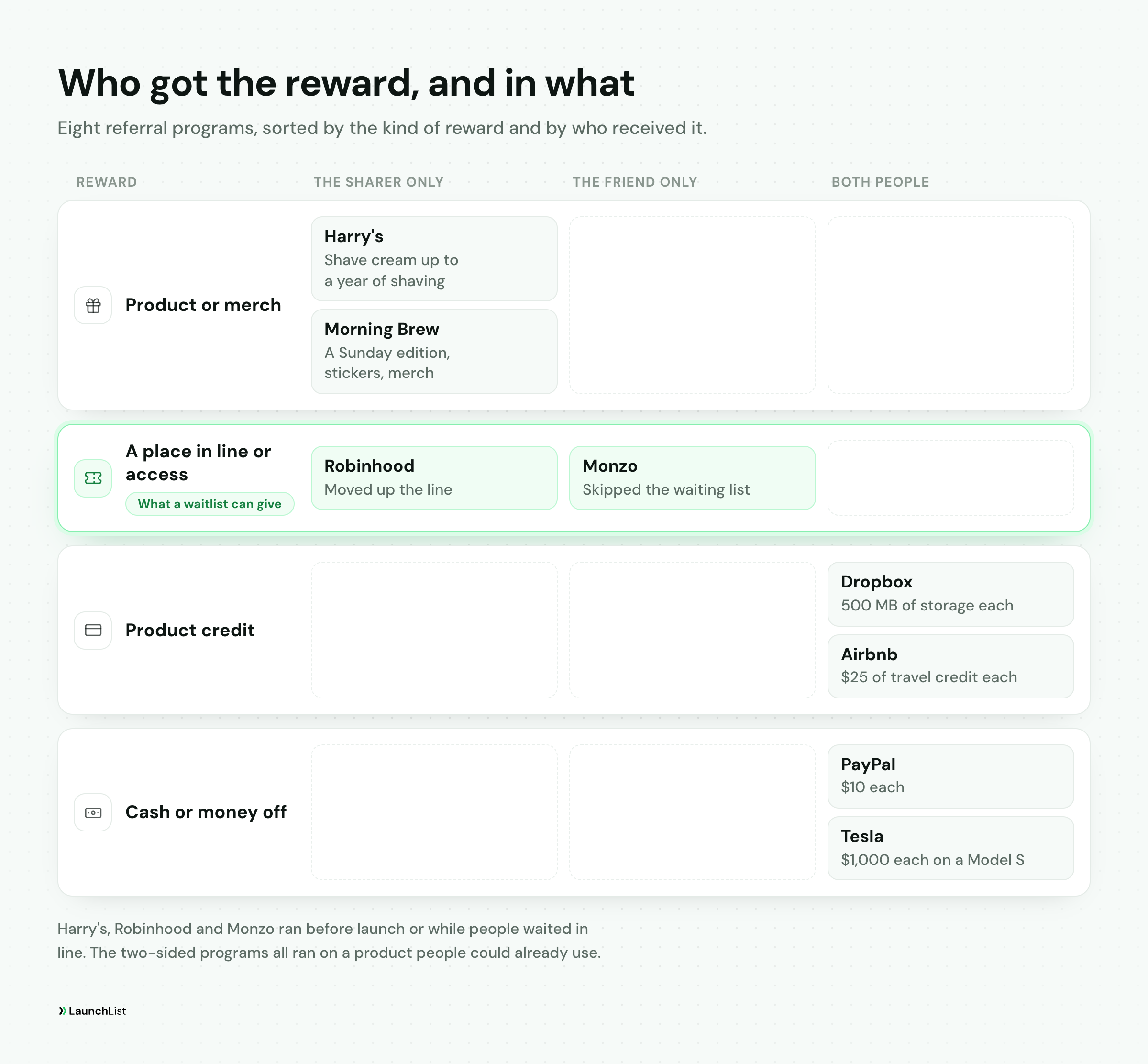
Three ran before launch or while people waited in line. Five ran on a live product, which can pay in things a waitlist cannot, such as storage, travel credit or a car.
| Company | What the sharer got | What the friend got | The mechanic | The lesson |
|---|---|---|---|---|
| Harry's | Free product at 5, 10, 25 and 50 friends | Nothing extra | A one-week prelaunch page with a personal link and a progress tracker | Make the first tier easy to reach |
| Robinhood | A better place in line | A place in line | Line ordered by referral count, ties by signup date | Position costs you nothing |
| Monzo | A golden ticket to give | A card straight away, past the waiting list | A shareable code | When the line is real, access is the gift |
| Morning Brew | A Sunday edition, stickers, a private group, merch | The free newsletter | Milestones at 3, 5, 10 and 25, a link in every issue | Rewards that pull people closer to the product |
| Dropbox | 500 MB per friend, up to 16 GB | 500 MB | Credit after the friend installs and verifies their email | Pay in the product itself |
| Airbnb | $25 of travel credit | $25 of travel credit | Credit after the friend's first trip | "Sharing $25" beat "earning $25" |
| PayPal | $10 per friend | $10 for joining | Cash on both sides | Cash grows your costs as fast as your list |
| Tesla | $1,000 credit, a free Model X for the first to 10 | $1,000 off a Model S | A time-boxed experiment | Give a push an end date |
1. Harry's: free product for 5, 10, 25 and 50 friends
Harry's, the shaving brand, opened its online store in March 2013. In the week before, it ran a prelaunch page that co-founder Jeff Raider later wrote up in full on Tim Ferriss's blog.
The mechanic. Two pages. The first asked for an email address and nothing else. The second gave each person a personal link, buttons to share it by email, Facebook and Twitter, and one plain promise: "Invite Friends and Earn Product." A tracker showed how many friends had joined and which prize came next.
The rewards. Shave cream at 5 friends, a razor at 10, a shave set with the premium Winston handle at 25 and a year of free shaving at 50. The team also considered a lifetime of product for 1,000 referrals and dropped it, "worrying that it would discourage people from participating at all."
What happened. Raider reports "over 85K valid email addresses (and over 100K emails in total) in the span of seven days," and that "77% of the emails were collected via referral, meaning about 20K people referred about 65K friends." More than 200 people reached the top tier, and Harry's sent product to about 3,000 people.
Why it worked. The reward was the product, so the people chasing it wanted razors. The first tier took five friends, not fifty. The team of 12 seeded the page to their own friends and chose not to pitch the press. And it guarded the door: once one IP address had signed up two email addresses, it could sign up no more, and an address whose welcome email bounced was treated as fake. As Raider puts it, "we saw the most fraudulent activity in the highest tier."
What to borrow. The shape of the ladder: a first reward a few friends away, a top reward only a few hundred people will reach, and a total cost you have added up before you publish it. Then check the top of your board hardest, because that is where the fakes go.
2. Robinhood: a better place in line
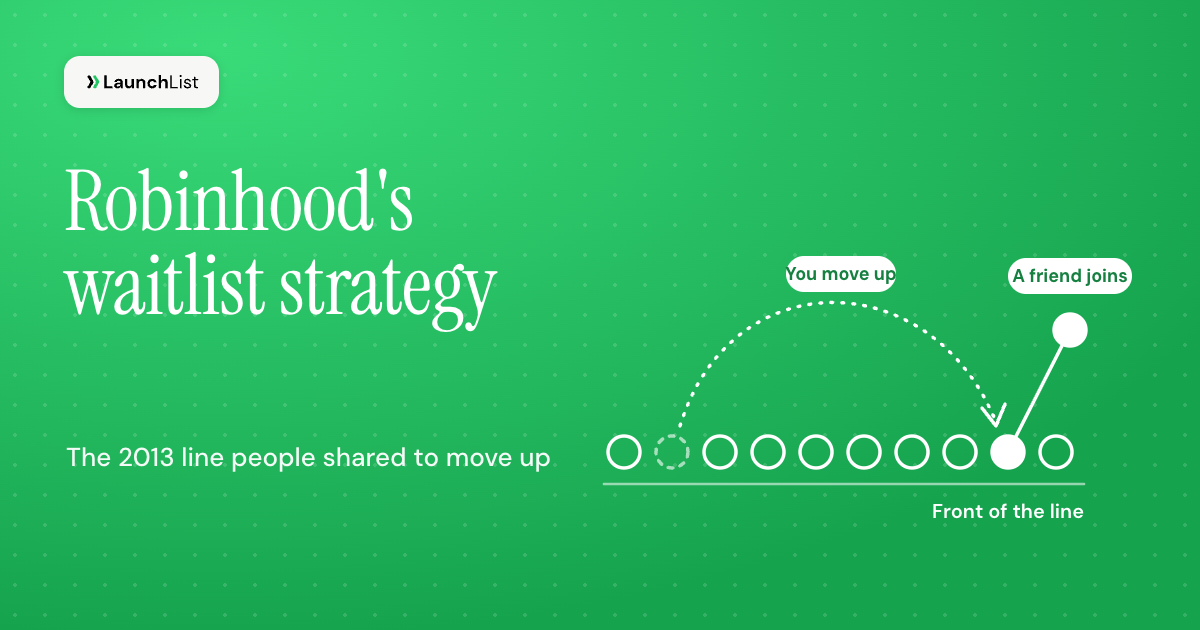
Robinhood's waitlist gave nothing but position. Its FAQ at the time, archived in July 2014, said "you can improve your position in line by referring friends with valid email addresses to Robinhood. Line position is determined by referral count, with ties broken by signup date." Co-founder Vlad Tenev told Business Insider that the page showed people "There's this many people ahead of you, this many people behind you," an idea inspired by the Mailbox app. When the app opened to everyone in March 2015, Robinhood wrote that it had "invited all 800,000 people who signed up for our waitlist." The lesson: a place in line costs nothing per referral, and it is worth something only if you let people in by that order. The full story is in our breakdown of Robinhood's waitlist.
3. Monzo: a golden ticket to give a friend
Monzo, the UK bank, added a waiting list in March 2016 because, as its team wrote two years later, "we were literally posting out every single card ourselves and we couldn't keep up with the demand." People who already had a card wanted one for a partner or a friend, and the only answer was to join the queue.
In October 2016 Monzo announced golden tickets on its community forum: "a unique code that you can share with a friend so they get a Monzo card, instantly, totally skipping the waiting list."
Why it worked. The reward went to the friend. What the person sharing got was the chance to give something nobody could buy. That only works because the queue was real: Monzo could not post cards any faster. When it could, in May 2018, it removed the waiting list and said golden tickets would stay "as an easy way for you to invite friends to Monzo."
What to borrow. If your first batches are limited by something real, such as the seats you can onboard by hand or your support hours, let your earliest people bring a friend in with them. It gives your keenest signups a reason to recruit without a prize budget. It does not survive a fake limit: a skip past a queue that does not exist is worth nothing.
4. Morning Brew: rewards that pull readers closer
Morning Brew is a free daily business newsletter. Each issue ends with a "Share the Brew" section holding the reader's own link and a referral hub where they track progress and rewards, as the Morning Brew shop's FAQ describes it.
The rewards. In a 2019 interview with The Idea, co-founder Austin Rief listed them: three referrals for Light Roast, the Sunday edition; five for stickers; ten for a private Facebook group; 25 for T-shirts, "so on and so forth, up to the Morning Brew mug."
Why those rewards. Rief picked each one to pull a referrer further into the product: "for me it's important to make the incentive align with what we want." The first reward was more of the newsletter, aimed at "the person who's so passionate about the product, that they want more of it and they're upset that they don't get it on Sunday." Stickers went to people who would show the brand off. By then, he said, over 50,000 people had reached three referrals.
What happened. Rief said in 2019 that "25% of our subscribers come from people telling other people." In October 2020, Morning Brew wrote that the program "has driven 35% of our 2.4+ million subscribers."
How it counted. The same FAQ: "After someone signs up using your link, they need to confirm their email address (this ensures the email is legit)."
What to borrow. Rewards that cost little and bring people further into what you are building: a bonus update, a private group, merch people will wear. And put the link in every email you send the list, not just the first.
5. Dropbox: more of the product, for both people
Dropbox gives both people extra storage, and the program still runs. Its help center says free Basic accounts get "500 MB per referral and can earn up to 16 GB," and "Friends who sign up to Dropbox through your referral earn 500 MB of additional free storage." A referral completes only after the friend installs the desktop app and verifies their email address, and a friend "attempting to register with the same computer as you" is ineligible. The reward is more of the product, which is the part a waitlist cannot copy: before launch there is nothing to give more of. Its history and results are in our Dropbox referral program case study.
6. Airbnb: travel credit for both, after the first trip
In 2014 Airbnb rebuilt a referral program that, in the words of engineer Jason Bosinoff, "was underutilized and underperforming." His write-up on Airbnb's engineering blog describes the deal: "$25 of travel credit" for both the sender and the friend, paid "when the invited user completes their first trip."
The team rebuilt it for the website and both mobile apps and began asking at the moments people were most likely to share: "just after booking a reservation, or after leaving a positive review." The post reports the program's signups and bookings up "by over 300% per day," and bookings up "by over 25% in some markets."
The test worth remembering. One email told people they could earn $25 for inviting a friend. Another told them they were sharing $25 with a friend. "The altruistic email performed better globally."
What to borrow. The framing: say what the friend gets before what the sharer earns. And the timing: ask right after someone has done the thing they came for, which on a waitlist is the moment they join. The first-trip condition does not carry over before launch, because there is no first trip yet.
7. PayPal: $10 in cash to each side
PayPal needed what Peter Thiel calls a "critical mass" of a million users, and "Advertising was too ineffective to justify the cost." So it paid. From the excerpt of Thiel's Zero to One that Business Insider published in 2014: "We gave new customers $10 for joining, and we gave them $10 more every time they referred a friend. This got us hundreds of thousands of new customers and an exponential growth rate."
Thiel is plain about the cost. The strategy "was unsustainable on its own," because "when you pay people to be your customers, exponential growth means an exponentially growing cost structure." It made sense for PayPal because the money could come back: "Given a large user base, PayPal had a clear path to profitability by taking a small fee on customers' transactions."
What to borrow. Mostly a warning. Cash is a reward everyone wants, including people who will never use your product, and before launch you have no fee to earn it back with. If you want money in the reward, make it money off your own product, such as a founding-member price.
8. Tesla: $1,000 each way, for a limited time
In July 2015 Tesla began a referral program that Elon Musk called an experiment, reported by CNBC. A buyer referred by an owner got $1,000 off a Model S, and the owner got "a credit for the same amount to go toward a new vehicle purchase, service or accessories." The offer was set to run through October 31, and "The first current customer to make 10 referrals will also receive a free Model X, Tesla's next vehicle to be released."
What to borrow. An end date, which gives people a reason to share this week rather than someday, and a name that admits it is a test, which leaves you free to change the reward afterward. And a top prize run as a race for the first to reach 10, which caps that prize at one.
What the eight have in common
- The reward fit the product. Razors from a razor company, a Sunday edition from a newsletter, storage from a storage company, a card from a bank with a queue. Each drew people who wanted the thing itself. PayPal paid in something everyone wants, and it paid for that.
- A friend counted only once they were real. Harry's blocked repeat signups from one IP address and treated bounced emails as fake. Robinhood asked for valid email addresses, Morning Brew waited for a confirmed email, Dropbox for an install and a verified email, Airbnb for a first trip and Tesla for a sale.
- People could see their progress. Harry's had a tracker, Robinhood showed the people ahead and behind, Morning Brew has a referral hub, and Dropbox shows the status of each invite.
- The first step was short. Three referrals at Morning Brew, five at Harry's, one at Dropbox, Airbnb and Monzo.
- The rules were written down. Robinhood's FAQ said how the line was ordered, and Tesla's offer had an end date.
All four two-sided programs, the ones that gave the friend something too, ran on a product people could already use. Before launch a friend cannot spend storage or credit, so the reward a friend can use is a way in, which is what Monzo gave.
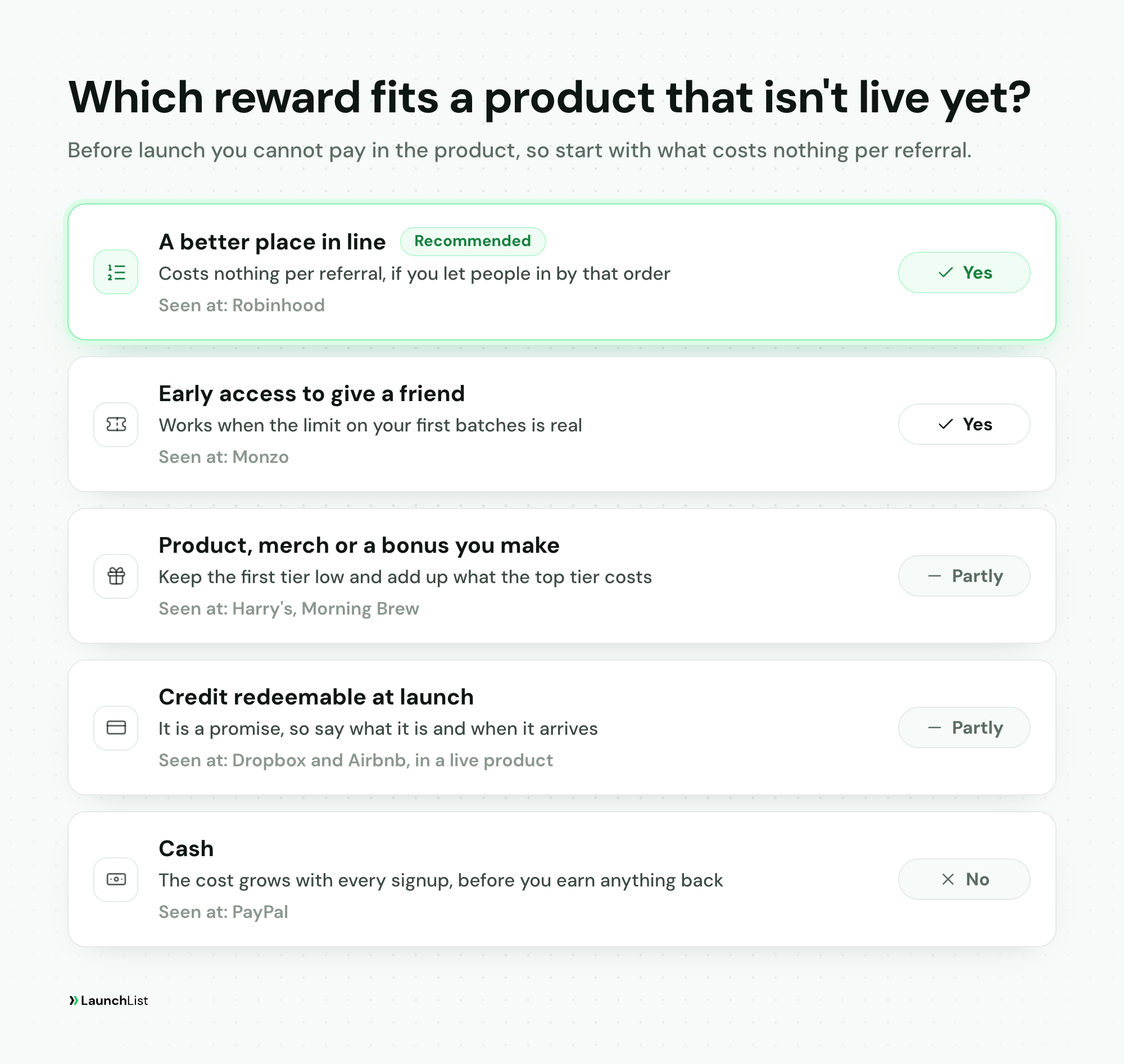
What to borrow for a waitlist before launch
What carries over:
- A better place in line. Robinhood's rule, with ties broken by signup date, so someone who joined early and shared nothing still stays ahead of later signups who shared nothing either. Write the order on the page and keep to it.
- Access to give a friend. Monzo's golden ticket, when your limit is real.
- A short ladder of rewards you make or control. Early access, a call with you, merch or a founding-member price. Put the first rung within a few friends, and add up what the top rung costs before you publish it.
- Credit on verification. A friend counts when they verify their email, as at Morning Brew.
- Asking at the right moment. Right after someone joins, and in every email you send the list.
- A push with an end date. Harry's ran for one week, and Tesla's offer had a closing day.
What does not carry over:
- Rewards paid in a product nobody can use yet. Storage, travel credit and account credit all need a live product. A credit "at launch" is a promise, so if you offer one, say what it is and when it arrives.
- Credit on a first purchase or trip. There is none yet. A verified email address is the proof you have.
- Cash. See PayPal.
- The results. Robinhood's page reached No. 1 on Hacker News before its planned press launch, Tenev said, and Harry's was seeded by a team of 12 and by friends with large followings. Use these numbers to see what is possible, not to set your goal.
When the top of your line is ready to come in, our guide to running an early access program covers what comes next.
Set it up in LaunchList
Disclosure: LaunchList is our product. It is pre-launch waitlist software for founders, and the parts of these programs that carry over to a waitlist are settings, not code.
- A place in line, as at Robinhood. Every signup gets a personal referral link and a live place in line, shown on their status page. The line is ordered by points: a friend who joins gives 10 points on a new project, and actions you add, such as following you on X, give as many points as you set. Ties go to signup order.
- A reward ladder, as at Harry's and Morning Brew. Rewards such as early access, merch or a call are reached by the number of friends who joined, on the Collect plan and up. You hand them out and mark them given.
- Real friends only. The signup form has a switch, Ask people to verify their email, on by default for a new signup form. Everyone who signs up is on your list either way. With it on, a referral counts when the friend verifies, not when they submit. Self-referrals, repeated referrals from one IP address and bursts that come in too fast are refused.
- Progress people can see. A signup counter, a referral leaderboard, a milestone bar and a countdown can go on your launch page or be embedded on your own site, on every plan.
- Letting people in. Under Audience → Invites, enter a number and LaunchList invites that many people, most referrals first and signup order for ties.
The Free plan holds 100 contacts, and broadcasts start on the Collect plan. To try it on a real page, create a waitlist and decide your first reward before you share the link.
Referral program examples FAQ
What are some good referral program examples?
Eight with primary sources behind them: Harry's prelaunch page (free product at 5, 10, 25 and 50 friends), Robinhood's waitlist (referrals moved you up the line), Monzo's golden tickets (a friend skipped the waiting list), Morning Brew (a Sunday edition, stickers, a private group and merch at referral milestones), Dropbox (extra storage for both people), Airbnb ($25 of travel credit for both, after the first trip), PayPal ($10 in cash to each side) and Tesla ($1,000 to each side on a Model S).
What is a two-sided referral program?
One that rewards both the person who shares and the friend who joins, such as Dropbox's extra storage for both or Airbnb's $25 of travel credit for both. A one-sided program rewards only the person who shares, as Harry's and Robinhood did. Before launch, one-sided is usually the practical choice, because the friend's reward would be a product they cannot use yet. The friend's reward can simply be getting in sooner, which is what Monzo's golden tickets gave.
What rewards did Morning Brew's referral program offer?
In 2019 co-founder Austin Rief described the tiers as: 3 referrals for Light Roast, the Sunday edition; 5 for stickers; 10 for a private Facebook group; 25 for T-shirts; and more merch up to a mug. A referral counted only after the friend confirmed their email address.
How did Harry's referral program work?
In the week before its March 2013 launch, Harry's asked visitors for an email address, then gave each person a personal link. Friends who signed up through it earned the sharer free product: shave cream at 5, a razor at 10, a shave set at 25 and a year of free shaving at 50. Its co-founder wrote that it collected over 85,000 valid email addresses (over 100,000 in total) in seven days, and that 77% of the emails came through referrals.
Should a referral program before launch offer cash?
Usually not. Cash costs the same whether or not the friend ever becomes a customer, and before launch you cannot tell which they will be. PayPal paid $10 to each side, and Peter Thiel called it unsustainable on its own; it made sense because PayPal could earn a fee on every user's transactions. A better place in line, early access for a friend or a small product reward costs far less and draws people who want the product.
When should a referral count?
When the friend is real. Every program here waited for some proof: Harry's blocked repeat signups from one IP address and treated bounced emails as fake, Morning Brew counted a referral once the friend confirmed their email, Dropbox once the friend installed the app and verified their email, and Airbnb after the friend's first trip. Before launch, a verified email address is the proof you have.