Referral Program Software for Startups: What to Look For Before You Have Customers
TL;DR: Most referral program software is built for a company that already has customers: it rewards a purchase, pays a commission or tracks referred revenue. A startup before launch has none of those yet. What it needs is a waitlist referral program: a personal link for every signup, a visible place in line, fraud checks that count only real friends, and milestones it can reach before launch. Five things to settle before you pay for one:
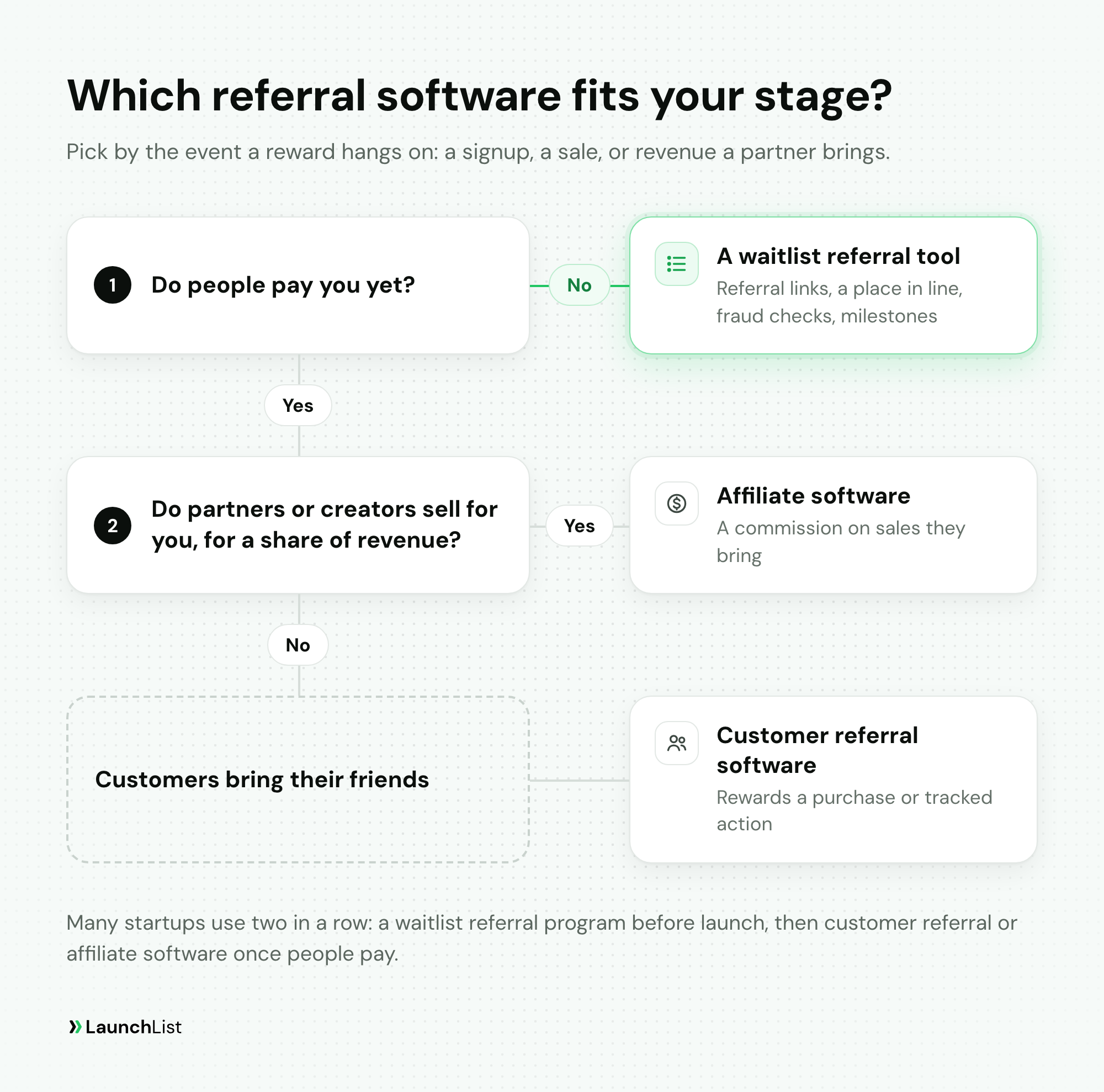
- Match the software to what you have. No customers yet: a waitlist referral tool. Paying customers: customer referral software. Partners or creators who sell for you: affiliate software.
- Ask when a referral counts. Before launch the proof you have is a verified email address, so credit should wait for it.
- Ask how it stops self-referrals. The three to ask about are the same device, repeated referrals from one IP address and bursts that arrive too fast.
- Read the pricing unit, not the price. Some tools charge per participant, some per new lead, some on referred revenue, and before launch those behave very differently.
- Measure two numbers. The share of signups that came through a referral, and what each one cost you in rewards.
This post is about choosing the tool. How to design the program itself is in our waitlist referral program guide, what eight well-known programs rewarded is in referral program examples, and the math of whether a program spreads is in the viral coefficient guide. Disclosure: LaunchList is our product, and it is one of the waitlist tools below. Vendor prices and descriptions were checked on their own websites on November 11, 2026.
Referral program software vs a waitlist referral tool
Search for the best referral program software and most of what you find compares tools for two buyers: an online store that wants customers to bring friends, and a software company that wants partners to resell it. Both assume something a pre-launch startup does not have yet: customers, orders or revenue to attach a reward to.
So it helps to split the category in three before you compare anything:
| Customer referral software | Affiliate software | Waitlist referral tool | |
|---|---|---|---|
| Built for | A live product with customers or users | Partners, creators and affiliates who promote you | A product that is not open yet |
| A referral counts when | The friend buys, subscribes or does an action you track | A tracked sale or subscription | The friend joins, and verifies their email if you ask |
| The usual reward | Credit, a discount or cash | A commission on the revenue | A better place in line, early access or a reward you make |
| Examples | GrowSurf; ReferralCandy for online stores | Rewardful | Viral Loops, Prefinery, KickoffLabs, ReferralHero, LaunchList |
The lines blur at the edges. GrowSurf runs customer referral and affiliate programs, ReferralHero sells waitlist campaigns and customer referral programs on the same plans, Prefinery describes a campaign as "a pre-launch waitlist or referral program", KickoffLabs runs waitlists, referral programs with milestones and giveaways, and ReferralCandy sells referral and affiliate programs together. What separates the three columns is the event the reward hangs on.
Customer referral and affiliate tools hang it on a purchase or on revenue, which is the right proof once you have it. GrowSurf is plain about this: it says it is a strong fit if you have "an established customer, user, or partner base" and can "define a trackable signup, purchase, or qualified action." Before launch, the only event you have is a signup. So the job of the software is to make a signup trustworthy and to give people a reason to share that costs you little.
What a pre-launch referral program needs
Six parts. The waitlist referral program guide covers how to design each one; this is the list to check a tool against.
- A personal link for every signup, handed over the moment they join, on the page they see right after signing up and in their first email. The link should survive real browsing: someone who arrives through it, reads three pages and signs up tomorrow should still count as that person's friend.
- A visible place in line. Robinhood ordered its waitlist by referral count, with ties broken by signup date. A place in line costs you nothing per referral, as long as you really let people in by that order. The full story is in our Robinhood breakdown.
- Credit for real friends only. Fake signups go where the rewards are, which is the top of the leaderboard, so the checks in the next section matter more than any share screen.
- Milestones counted on verified friends. Tiers reached at a set number of friends, counted only once those friends are real, with a record of who is owed what. What to put on each tier is your call; the referral program examples show what eight companies chose.
- Progress people can see. A leaderboard, a milestone bar, the next reward and how many friends it takes. A reward nobody can see moves nobody.
- A way to let people in by that order. When your first batch is ready, invite from the top of the line, so the promise you made on the page is the one you keep.
What you do not need yet: commission tracking, affiliate payouts, coupon codes tied to a store checkout, or rewards that wait for a first purchase. They are real features. They are for later.
Questions to ask before you pay
A demo shows the share screen. These questions show what happens when someone games it, and when you grow.
- When does a referral count? On submit, or once the friend verifies? A tool that credits on submit lets anyone climb by typing made-up addresses.
- What does it do about self-referrals? Ask about all three: the same person on the same device with a second address, many referrals from one IP address, and a burst that arrives faster than real friends do. One IP address alone is not proof, since a household or an office shares one, so a cap is fairer than a block.
- Can it take credit back? A cluster of fake signups is often only visible once the rest of the wave has landed. If credit can only ever go up, the leaderboard stays wrong.
- Can you see why a referral did not count? "Why didn't my referral count?" is the question your keenest signups will ask. A recorded reason per referral lets you answer it in one line.
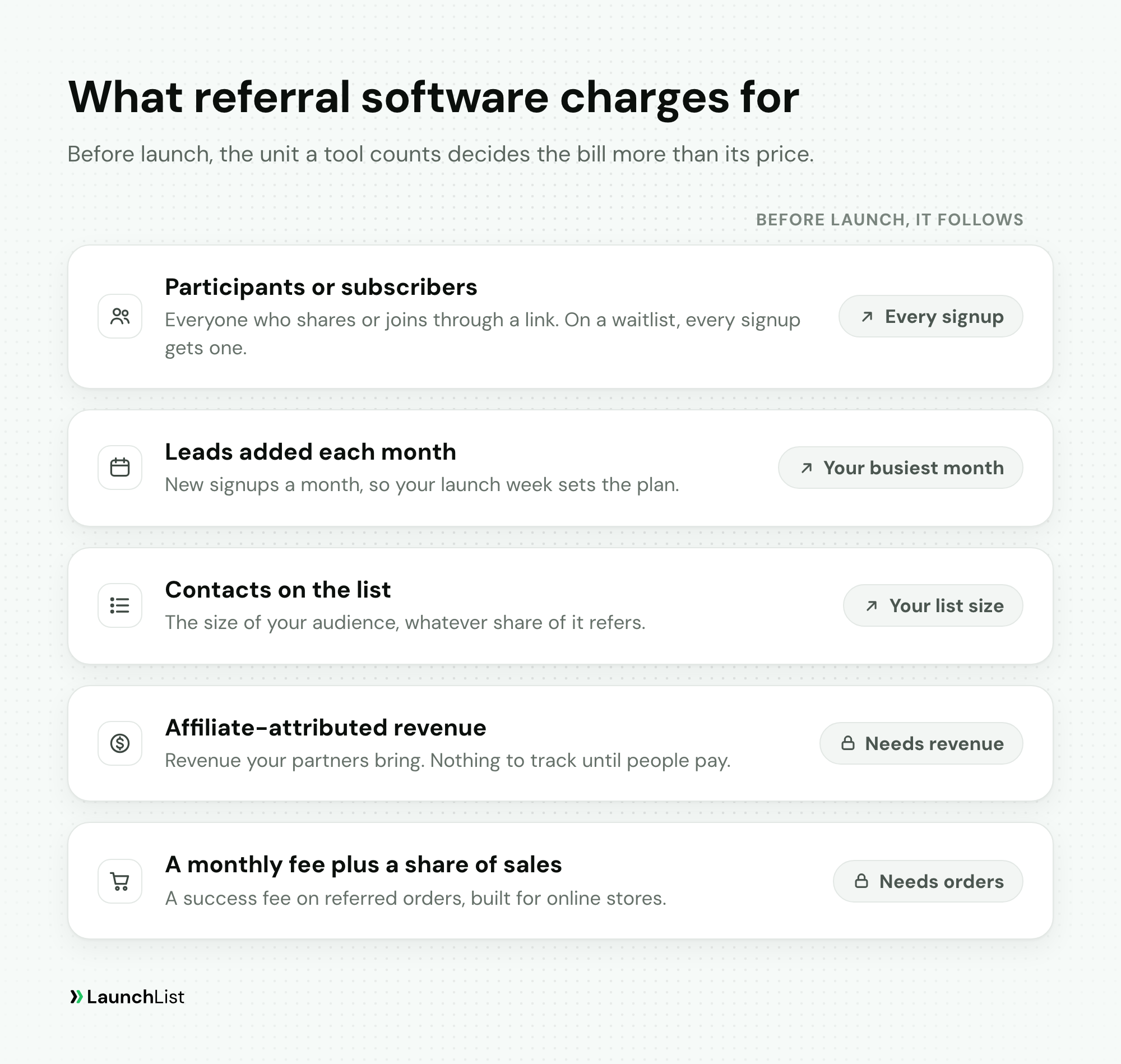
- What counts toward your bill? Participants, subscribers, leads a month, contacts on the list or revenue. The next section shows why this matters more than the headline price.
- What happens past your plan's size? Are new signups refused, deleted or held until you upgrade? A launch day is the worst moment to find out.
- Can you take the referral graph with you? Export every contact with who referred them and how many people they brought in, and check that the next tool can import it.
- Does it work where your signups happen? A hosted page, a form on your own site, a site builder plugin or an API. If your site runs on Webflow, WordPress or Framer, check the plugins a tool offers before you rebuild anything.
Referral software pricing: what you actually pay for
Referral software is priced on very different units, and before launch the unit decides the bill more than the price does. Here is what each tool counted on November 11, 2026, from its own pricing page:
| Tool | What it is | What you pay for | Entry plan, per month |
|---|---|---|---|
| GrowSurf | Customer referral and affiliate | Participants: people who get a referral link or sign up through one | $179 for up to 2,500 participants, billed monthly |
| ReferralHero | Waitlists and customer referral | Subscribers: everyone who joins a campaign, directly or through a referral | $249 for up to 1,000 subscribers |
| Prefinery | Waitlists and referral programs | Users: everyone who joins a campaign | $39 for 1,000 users, billed every six months (monthly billing costs more) |
| KickoffLabs | Waitlists, referral programs, giveaways | Leads added each month | Free for 50 a month; $49 for 1,000 a month, billed monthly |
| Rewardful | Affiliate and referral tracking for Stripe | Affiliate-attributed revenue a month | $49 for up to $7,500 of it, billed monthly |
| ReferralCandy | Referral and affiliate for online stores | A monthly fee plus a success fee on referred sales | $39 plus 10.5% |
| LaunchList | Pre-launch waitlist software | Contacts on your list | Free for 100 contacts; paid plans on our pricing page |
Viral Loops, the other name founders compare, also prices by participants; our Viral Loops comparison has its plans side by side with ours. Prices change, so check each vendor's page before you buy.
What each unit means for a waitlist:
- Participants and subscribers count both sides. On a waitlist every signup gets a link, so every signup is a participant. The bill follows the whole list, not just the people who share.
- Leads a month follows your busiest month, which is usually the week you announce.
- Contacts on the list is the same idea as users: you pay for the size of your audience, whatever share of it refers.
- Revenue-based pricing costs little before you have revenue, but it also has nothing to track until people pay you. Rewardful, for example, is built around Stripe billing.
- A success fee charges only on sales, which a waitlist does not have.
Price the size you hope to reach at launch, not the size you are today.
When a waitlist tool is enough, and when to buy referral software
A waitlist tool is enough while your product is not open, the reward you can give is a place in line or a way in, and the proof you have is an email address. It also does the rest of the pre-launch work a referral suite does not: the signup page, the list, the emails before launch and the invites when you open.
Buy customer referral software once people pay you and you want to reward a referred subscription or purchase, with credit or a discount inside your product. That is what a referral program for SaaS looks like after launch, and it is what SaaS referral software is built to track.
Buy affiliate software when partners, creators or consultants promote you for a share of the revenue they bring. It needs a billing system to read that revenue from, so it starts to make sense once you charge.
For an online store, a referral app built for your store platform tracks orders directly; ReferralCandy, for example, says it is built for Shopify brands and charges the same on BigCommerce, WooCommerce, Magento and custom stores.
Many startups use two of these in a row: a waitlist referral program before launch, then customer referral or affiliate software once people pay. LaunchList is in the first column only. It takes no payments, tracks no purchases and pays no commissions or cash, so the day you need those, referral marketing software built for them is the right buy.
How to tell if it is working
Two numbers tell you whether a pre-launch referral program is working.
The share of signups that came through a referral. Your viral coefficient, or K-factor, is the number of new signups each signup brings in: invites sent per signup times the share of invites that join. Most tools see the signups a link produced, not every time someone pasted it into a chat, so the practical reading before launch is referred signups divided by all signups over the same period. Below 1, referrals add to your growth and other channels still carry it, and a K that stays above 1 for long is rare. The viral coefficient guide shows how to calculate it by cohort and how to move each part.
What each referred signup cost you in rewards. Add up what you spent on rewards actually given and divide by the referred signups that counted. Say 1,000 people joined, 150 of them through a friend's link, and you sent 40 T-shirts at $12 each: that is $480, or $3.20 per referred signup. Compare it with what a signup costs you from any other channel. A place in line and early access cost almost nothing per referral, which is why they come first. The referral program ROI calculator works out the most one reward can cost before the program loses money.
Watch one more line: referrals refused or taken back. A rising count usually means someone is farming the top of your board. Check the leaders by hand before you send anyone a reward.
Set up a referral program in LaunchList
Disclosure: LaunchList is our product. It is pre-launch waitlist software for founders, and the parts of a referral program that matter before launch are settings, not code.
- A link and a place in line for every signup, on every plan. Each signup gets a personal referral link and a live place in line, shown on their status page. The line is ordered by points: on a new project a friend who joins gives 10 points, and ties go to signup order. The link's code is kept in the visitor's browser for 90 days, so a friend who browses first still counts. How it works: how referrals work.
- Credit for real friends. A new signup form asks people to verify their email by default, and with that on, a referral counts when the friend verifies. If your form does not ask, Hold referrals until the friend verifies under Project settings → Privacy & spam keeps the check for referrals only. Self-referrals from the same device are refused, and by default one person can earn at most 3 credited referrals from one IP address and 20 in an hour; you can change both caps. Every referral that does not count records why, and credit is taken back when a contact is later deleted or found to be fake. The Contact Trust checks behind it are explained in spam and trust.
- Rewards, on the Collect plan and up. Up to 20 rewards, each reached by the number of friends who joined. You send a reward yourself and mark it given, or LaunchList adds a tag, gives bonus points or moves the person ahead the number of places you set. When someone reaches a reward, LaunchList emails them about it, and that email counts toward your plan's monthly emails. Rewards go to the person who shared; if you want the friend to get something too, say so on your page and honor it when you invite them. Setup: rewards and milestones.
- Progress people can see. On every plan, a referral leaderboard, a signup counter and a milestone bar toward a shared signup goal can go on your launch page or on your own site as a widget. With rewards set up, each signup's status page shows their next reward and how many friends it takes.
- Letting people in by that order. Under Audience → Invites, enter a number and LaunchList invites that many people, most referrals first and signup order for ties. The Free plan invites your first 100; paid plans have no invite limit. More in early access.
- The two numbers above. Analytics → Referrals shows how many signups came through a referral, referrals per person who referred, your viral coefficient in words and, on the Collect plan and up, how many people are one referral away from a reward.
- Moving from another tool. The CSV import recognizes exports from Viral Loops, KickoffLabs, Prefinery, Waitlister and GetWaitlist by their column headers and keeps who referred whom.
The full feature is on the referral waitlist software page. The Free plan holds 100 contacts with referral links and the leaderboard included; rewards start on the Collect plan, and every plan is on the pricing page. To try it on a real page, create a waitlist and decide your first reward before you share the link.
Referral program software FAQ
What is referral program software?
Software that gives people a personal link, records who joined or bought through it, and credits the person who shared. There are three kinds: customer referral software, which rewards a purchase or a qualified action on a live product; affiliate software, which pays partners a commission on the revenue they bring; and waitlist referral tools, which credit a signup before launch with a better place in line or a milestone such as early access.
What referral program software should a startup use before launch?
A waitlist referral tool. Before launch there is no purchase or revenue for a customer referral or affiliate tool to track, so the event that matters is a signup. You need a personal link for every signup, a visible place in line, fraud checks that count only real friends, milestones counted on verified friends and a way to invite people in the order they earned.
What is the difference between referral software and affiliate software?
Referral software rewards customers or signups for bringing friends, usually with credit, a discount, access or a place in line. Affiliate software pays partners, creators or other businesses a commission on the sales they bring, and is usually priced on that revenue. Rewardful, for example, prices its plans by monthly affiliate-attributed revenue.
How much does referral program software cost?
It depends on what the tool counts. On November 11, 2026, GrowSurf started at $179 a month for 2,500 participants, ReferralHero at $249 a month for 1,000 subscribers, KickoffLabs at $49 a month for 1,000 leads a month (with a free plan for 50), Rewardful at $49 a month for up to $7,500 of affiliate-attributed revenue and ReferralCandy at $39 a month plus a 10.5% success fee. Prices change, so check each vendor's pricing page.
What is the best referral program software for SaaS?
It depends on your stage. Before launch, a waitlist referral tool. Once people pay you, customer referral software that rewards a subscription or a qualified action inside your product. If partners or creators sell for you, affiliate software that tracks the revenue they bring, often through your billing system.
How do I stop fake referrals before launch?
Count a referral only once the friend verifies their email, refuse self-referrals from the same device, cap credited referrals from one IP address, slow down bursts that arrive too fast, and take credit back when a contact later turns out to be fake. Then check the top of your leaderboard by hand, because that is where fake signups go.
How do I measure whether a referral program is working?
Track two numbers. The share of signups that came through a referral, which is the output side of your viral coefficient, and what each referred signup cost you in rewards. A place in line or early access costs almost nothing per referral; merch and cash cost the same whether or not the friend ever becomes a customer.