Robinhood Waitlist Strategy: How the Original Line Worked and What to Copy
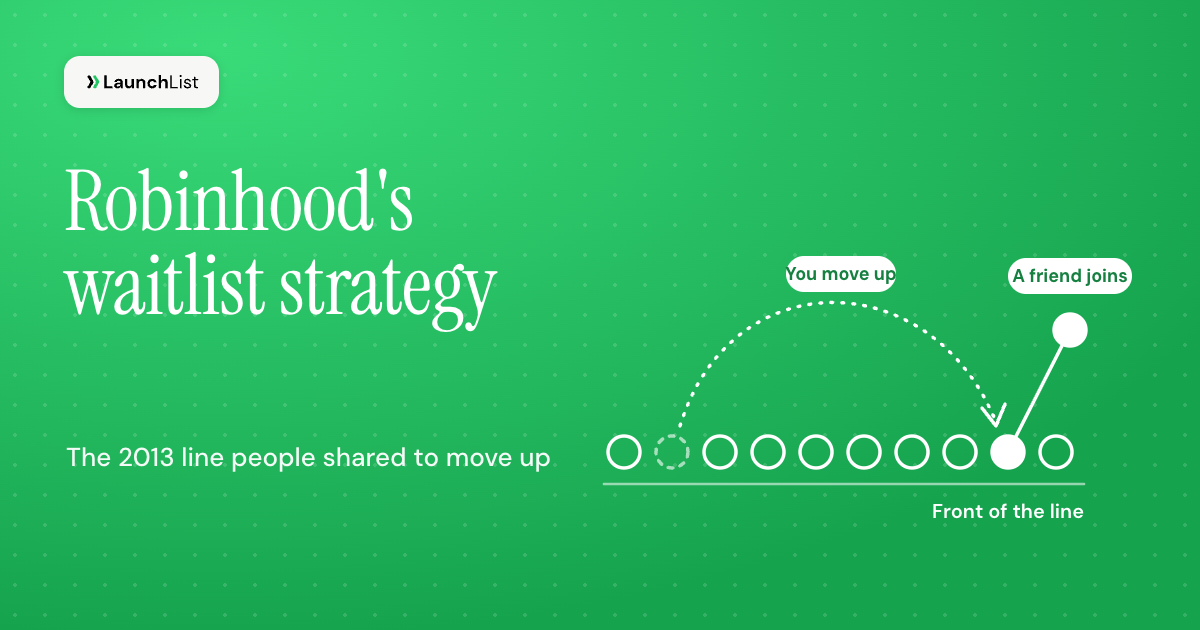
TL;DR: In December 2013, Robinhood put up a one-page site for a stock trading app nobody could use yet. It said one thing, "Stop paying $10 for every trade," and asked for one thing, an email address. Everyone who joined saw their place in a line and could move up by referring friends. Once it reached Hacker News, the page drew over 10,000 signups in 24 hours, and by March 2015 Robinhood had invited 800,000 people from it. The parts worth copying:
- An offer people already wanted, said in one sentence.
- A limit that was real. A new brokerage could not let everyone in at once, and it said why.
- A visible place in line, with people ahead of you and behind you.
- One written rule for the order: referral count first, signup date for ties.
- Invites in that order, a batch at a time, until the list was empty.
This is a teardown of the original waitlist, the one Robinhood ran before its app launched, built from Robinhood's archived pages and posts, its founders' interviews and press from the time. Robinhood still uses waitlists for new products, such as the Gold Card it announced in March 2024, but that one works differently: its help page says "you won't be able to view your place on the waitlist." Sources were checked on November 9, 2026.
What Robinhood's waitlist page looked like
The page went up on a Friday night in December 2013, at robinhood.io. An archived copy from December 15, 2013 shows how little sat at the top:
- a headline: "The world's $0 commission stock brokerage."
- one reason to care: "Stop paying $10 for every trade."
- one email field and one button, Get Early Access, repeated in the menu bar as you scrolled.
Below that came short sections on why a brokerage without storefronts could skip commissions, how accounts were protected and what the app would do. A Hacker News commenter that weekend called the design great and listed why: the tagline said what it was, the second line said why to sign up, and the call to action was a clear "get early access."
The fine print defined what you were signing up for: "Getting early access to Robinhood is defined as signing up for a place in line in Robinhood's virtual waiting room." It added that invites would go first to people in states where Robinhood was registered, "based on current position in line."
After you entered your email, the page changed to show where you stood. Co-founder Vlad Tenev described it in a 2017 Business Insider interview: "you would join this wait list where we would actually show you: There's this many people ahead of you, this many people behind you." He said they were inspired by Mailbox, "this other product that launched about a year before."
How the line worked, step by step
The rules lived in Robinhood's FAQ, and an archived copy from July 2014 keeps them word for word. Put together with the page and the press from the time, the loop ran like this:
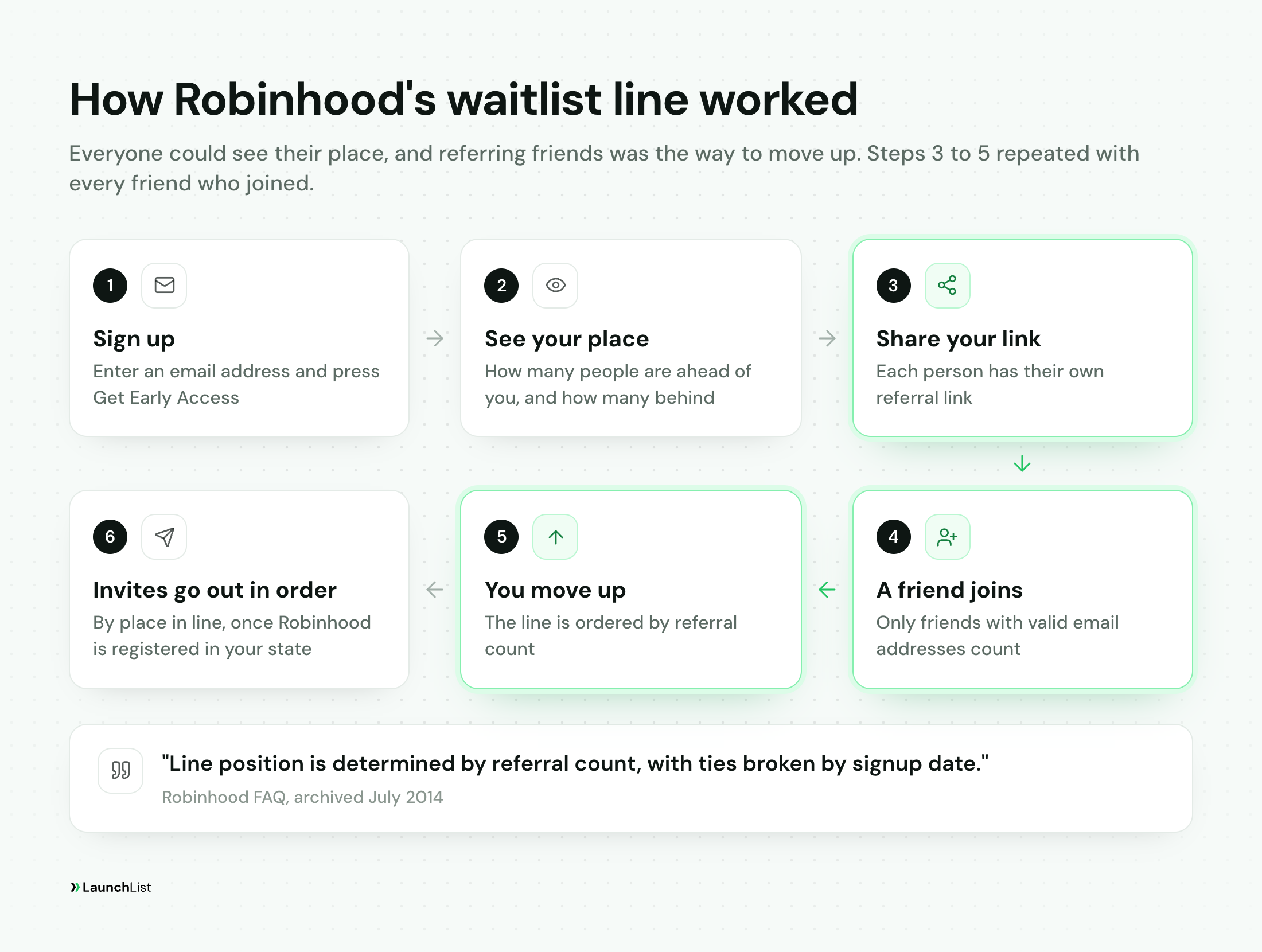
- Sign up. Enter an email address. "We'll send you an invitation via email when it's your turn to apply for an account," the FAQ said.
- See your place. The page showed how many people were ahead of you and how many were behind.
- Share your link. Each person had their own referral link. A Reddit user explained it in February 2014: "to move up the waiting list, you can link people to the site with a custom URL that gives you 'referral' points." At launch, TechCrunch called it "a Mailbox-esque scheme" in which "tweeting about Robinhood will bump up your place in line."
- A friend joins. Only friends with valid email addresses counted.
- You move up. The FAQ's rule in full: "If you're really excited, you can improve your position in line by referring friends with valid email addresses to Robinhood. Line position is determined by referral count, with ties broken by signup date."
- Invites go out in order. Your turn depended on "the queue's length as well as Robinhood's registration status in your home state." Meanwhile you could "track your position using the website or the mobile app."
Look at what that rule does. Because referral count came first, one friend who joined put you ahead of everyone with no referrals, however early they had signed up. That made the first share worth a lot, which is a strong reason to make it. It also meant someone who joined on day one and told nobody could end up behind a latecomer with a single referral. That trade-off is yours to decide before launch, and our waitlist marketing strategy guide walks through it, along with the order you let people in.
The FAQ also said why there was a line at all: "An invitation system allows us to control the rate at which new users join, and in turn, the load on our infrastructure. We have an obligation to our customers and public markets to offer a robust, error-free service."
What happened: the numbers, in order
Every figure below comes from Robinhood or from press published at the time.
| When | What happened | Source |
|---|---|---|
| December 14, 2013 | A Hacker News post links the page the morning after it goes up. It reaches number 1, and the page brings in "over 10,000 signups in 24 hours." | TechCrunch |
| The first week | Tenev recalls "over 50,000" signups | Business Insider |
| February 27, 2014 | Robinhood begins inviting "the 160,000 people who've signed up" | TechCrunch |
| February 28, 2014 | The r/finance community bans Robinhood referral links | |
| September 23, 2014 | "Half a million people have already signed up" | TechCrunch |
| December 11, 2014 | The iPhone app goes live, and Robinhood starts "on-boarding thousands of people from the waitlist" | Robinhood |
| January 26, 2015 | Robinhood has sent "more than 300,000 invitations" to people on the waitlist | Quartz |
| March 12, 2015 | Open to everyone, after inviting "all 800,000 people who signed up for our waitlist" | Robinhood |
Tenev later remembered the total as "almost 1 million." Robinhood's own figure at the time was 800,000 people invited from the waitlist, so that is the number we use. The list also reached the people it was built for: in the same March 2015 post, Robinhood said 25 percent of its customers "chose Robinhood as their first investment account."
The wait was long. TechCrunch's first story said Robinhood would "launch free stock trading early next year," and the first invites did go out in February 2014. Most of the list waited far longer. In September 2014, TechCrunch noted that Robinhood had "some users on its wait list for 9 months now," and at the iPhone launch it reported that co-founder Baiju Bhatt's biggest worry was "getting people who've waitlisted for a year onboarded as quickly as possible without any snafus that could hurt its credibility."
Why Robinhood's waitlist worked
The offer was the whole pitch
Other brokerages charged $7 to $10 a trade, and Robinhood charged nothing. TechCrunch put the case in one line in December 2013: "if you're young, on a budget, and only buying $500 of stock, a $7 fee is a steep price to pay." The page did not need to persuade anyone. It needed to state the offer, and it did that in one line.
That is the part most copies miss. A referral line multiplies demand that already exists. It does not create it. If your page needs paragraphs to explain why anyone should want the product, fix that first. A referral line will not do it for you.
The limit was real, and explained
A brokerage cannot open to everyone on day one. TechCrunch reported that Robinhood was approved as a broker-dealer by FINRA, the industry regulator, in October 2013 "after eight months of waiting." It also had to be registered state by state, which is why the fine print tied invites to your home state. And every new customer had to pass an identity check. Quartz reported in March 2015 that "Robinhood couldn't just register people instantly," and that as many as 10% of registrations needed more documents.
Robinhood also explained the wait in plain words in its FAQ. Nobody had to trust a "limited spots" banner. The reasons for the wait were in the news, and they were believable.
Your place was visible, and it moved
"This many people ahead of you, this many people behind you" gives a person a number to improve. Under the referral-count rule, the first referral moved that number a long way, so people could see sharing work. A queue position only motivates when it is true and when it moves, and Robinhood's did both.
Sharing was the way to move
The FAQ named one way to move up: refer friends. There were no tiers to learn and no prizes to compare, just a rule that fits in a sentence. Compare Dropbox, which paid referrals in storage space (our Dropbox referral case study covers how), or the programs built on product rewards that our roundup of referral program examples compares side by side. A place in line costs nothing to give, which only works when access is what people want. Building a full program is in our waitlist referral program guide, and measuring whether yours spreads on its own is in our viral coefficient guide.
It was ready when it was found
Robinhood did not choose its launch day. Tenev said the press launch was planned for "the following Wednesday or Thursday," and an anonymous Hacker News post found the page first. Soon after, he said, the team realized: "None of the emails are wired up. The website's broken." Everyone went into the office that Saturday to fix it. The lesson: once a page is public, someone can find it, so the confirmation email and the place in line should work before you share the link with anyone.
What went wrong: people gamed the line
The same rule that made sharing worth it made cheating worth it. In March 2015, Quartz reported that "gaming it had become a spectator sport," and that Robinhood "found itself going in to clear out fake emails used to trick the system." Bhatt told Quartz: "There were definitely people who were algorithmically referring people. They were writing scripts to move up the waitlist."
The links also spread where they were not welcome. When r/finance banned them in February 2014, a moderator explained: "We get 4 or 5 submissions of people trying to use referral codes everyday and its not contributing anything to the sub."
The cause is in the wording of the rule. It counted "friends with valid email addresses," and a rule like that is only as strong as the check behind "valid." If a made-up address can pass, a script can climb the line, and every honest sharer it passes drops a place.
What to copy in 2026, and what to change
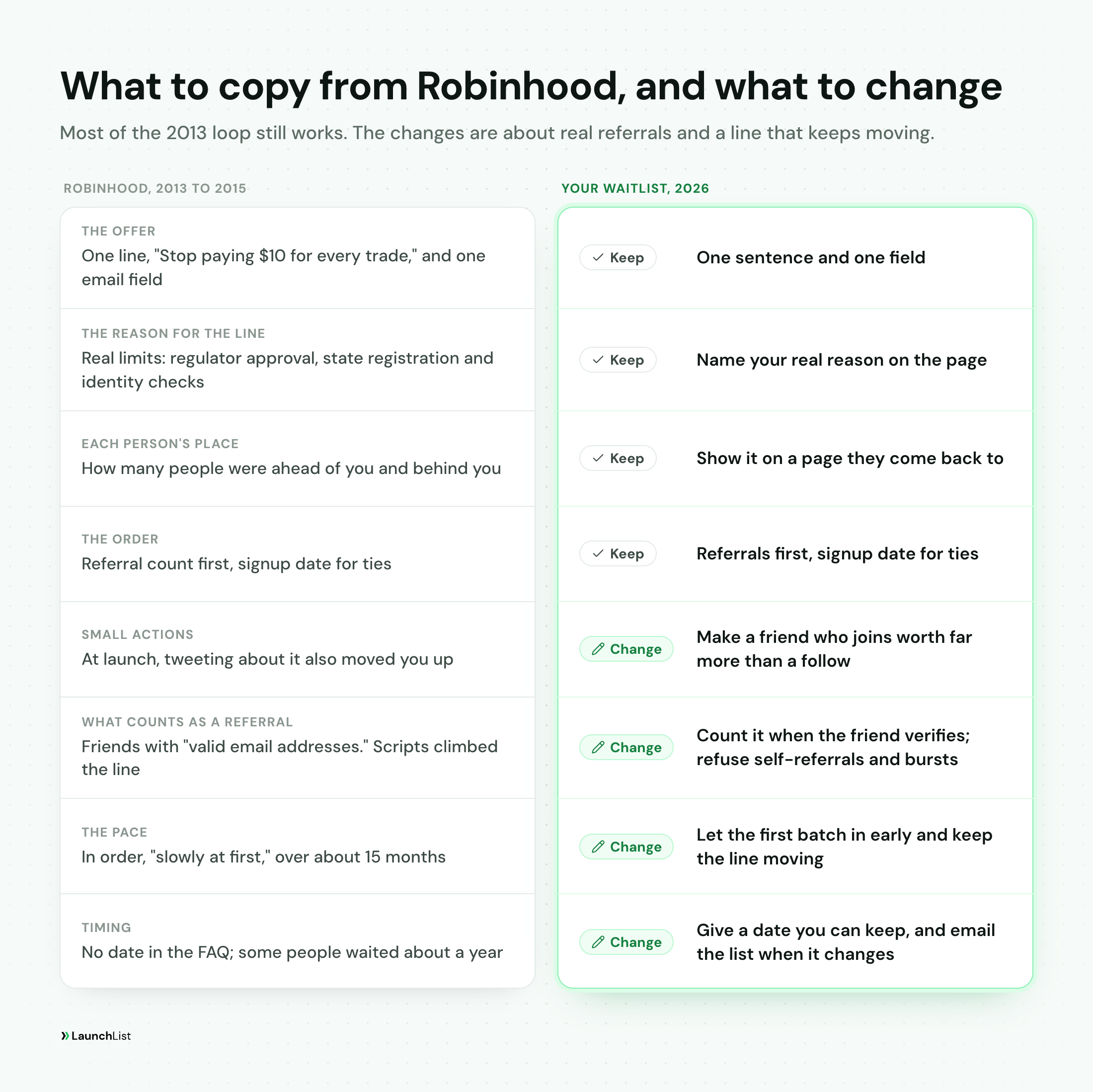
Copy these as they were:
- One sentence and one field. Say what people get and ask for an email address.
- A real reason for the line, on the page. Server capacity, onboarding by hand, a regulator: name it.
- Each person's place, on a page they can come back to. Show where they stand and how to move.
- One written rule for the order. Referrals first and signup date for ties is easy to explain and hard to argue with.
- Invites in that order, in batches. Robinhood's FAQ said it would let people in "slowly at first" and then "dramatically increase the pace," and it emptied the list before opening to everyone.
Change these:
- Count a referral when the friend verifies their email, not when they submit the form. A made-up address cannot click a link. Our guide to queue jumping covers the other checks: a second signup from the same device, repeated referrals from one IP address and bursts that come in faster than anyone really shares.
- Weight a friend above small actions. TechCrunch's first description had tweeting move you up. If you reward actions like following you on X, make a friend who joins worth much more, or the line fills with people who followed you and told nobody.
- Keep the line moving. Robinhood held its list for up to 15 months, with more demand than most products will ever see. On a smaller list, a long wait with no invites makes a referral feel pointless. Let the first batch in early and keep batches coming, as our guide to running an early access program explains.
- Be honest about timing. Robinhood's FAQ avoided a promise it could not keep: "We can't say specifically how long it will take for you to get an invitation." That is better than a date that slips. If you give a date, give one you can keep, and email the list when it changes.
- Give people a message for a friend, not a code for a forum. Links pasted into communities that ban them cost you goodwill, as r/finance showed.
How to set up the same waitlist in LaunchList
Disclosure: LaunchList is our product. It is pre-launch waitlist software for founders, and Robinhood's loop maps onto it step by step.
- The page. One field and one button, on a launch page we host or as a form on your own site.
- The place in line. Every signup gets a personal referral link and a live place in line, shown on their status page.
- The rule. The line is ordered by points. A friend who joins gives 10 points on a new project, and actions you add, such as following you on X, give as many points as you set. Ties go to signup order, as Robinhood's did.
- Real referrals. Ask people to verify their email is a switch on the signup form, on by default for a new one. Everyone who signs up is on the list either way, and with it on, a referral counts when the friend verifies, not when they submit. Self-referrals, repeated referrals from one IP address and bursts that come in too fast are refused.
- Invites in order. Under Audience → Invites, enter a number and LaunchList invites that many people, most referrals first and signup order for ties. A batch holds up to 1,000 people. You can also choose people yourself.
- The visible line. A signup counter, a referral leaderboard, a milestone bar and a countdown can go on your launch page or be embedded on your own site, on every plan.
- Rewards, if a place is not enough. Rewards are earned by the number of friends who joined, on the Collect plan and up.
The Free plan holds 100 contacts, and broadcasts start on the Collect plan. To build Robinhood's loop for your own product, create a waitlist, write your one sentence and decide your order before you share the link.
Robinhood waitlist FAQ
Why did Robinhood have a waitlist?
Because it could not let everyone in at once. A new stock brokerage needs regulatory approval, registration state by state and an identity check on every customer. Robinhood's own FAQ said its invitation system let it 'control the rate at which new users join, and in turn, the load on our infrastructure.' The limit was real, which is a large part of why people believed the line and shared it.
How long was the Robinhood waitlist?
About 15 months for the original one. The signup page went up in December 2013, the first invites went out on February 27, 2014, and Robinhood opened to everyone on March 12, 2015, after inviting the whole list. Some people waited about a year. Robinhood's waitlists for newer products have their own timing: the Gold Card's help page says the wait 'may vary.'
How did the Robinhood waitlist referral system work?
Everyone who signed up saw how many people were ahead of them and behind them, and got a personal link to share. Robinhood's FAQ set one rule: 'Line position is determined by referral count, with ties broken by signup date,' counting friends with valid email addresses. Invites went out in that order, and also depended on whether Robinhood was registered in your state yet.
How many people joined Robinhood's waitlist?
Over 10,000 in the first 24 hours, according to TechCrunch, and 160,000 by late February 2014. By March 2015 Robinhood said it had 'invited all 800,000 people who signed up for our waitlist.' Co-founder Vlad Tenev later recalled almost 1 million; we use Robinhood's own count from the time.
Does a Robinhood-style waitlist still work in 2026?
Yes, when two things are true: the offer is something people already want, and the limit on access is real. Change three things from 2013. Count a referral only when the friend verifies their email, refuse self-referrals and bursts of signups, and tell people honestly how long the wait is likely to be.