

Rewards and milestones
Decide what people unlock by referring others, and how to pick rewards that motivate without costing you a fortune.
Position alone motivates more than most founders expect. Rewards stack on top of it, giving people a concrete reason to share rather than an abstract one.
Which plans include rewards#
Rewards and milestones and points for follows and shares are on Collect, Launch and Grow. The referral program itself, a referral link, a place in line that moves up with each referral and the leaderboard, is on every plan, Free included.
If a workspace moves to Free, the ladder you built is kept and stays visible on status pages, but no new rewards are granted until the plan includes them again. Nothing anyone already unlocked is taken back.
Setting up tiers#
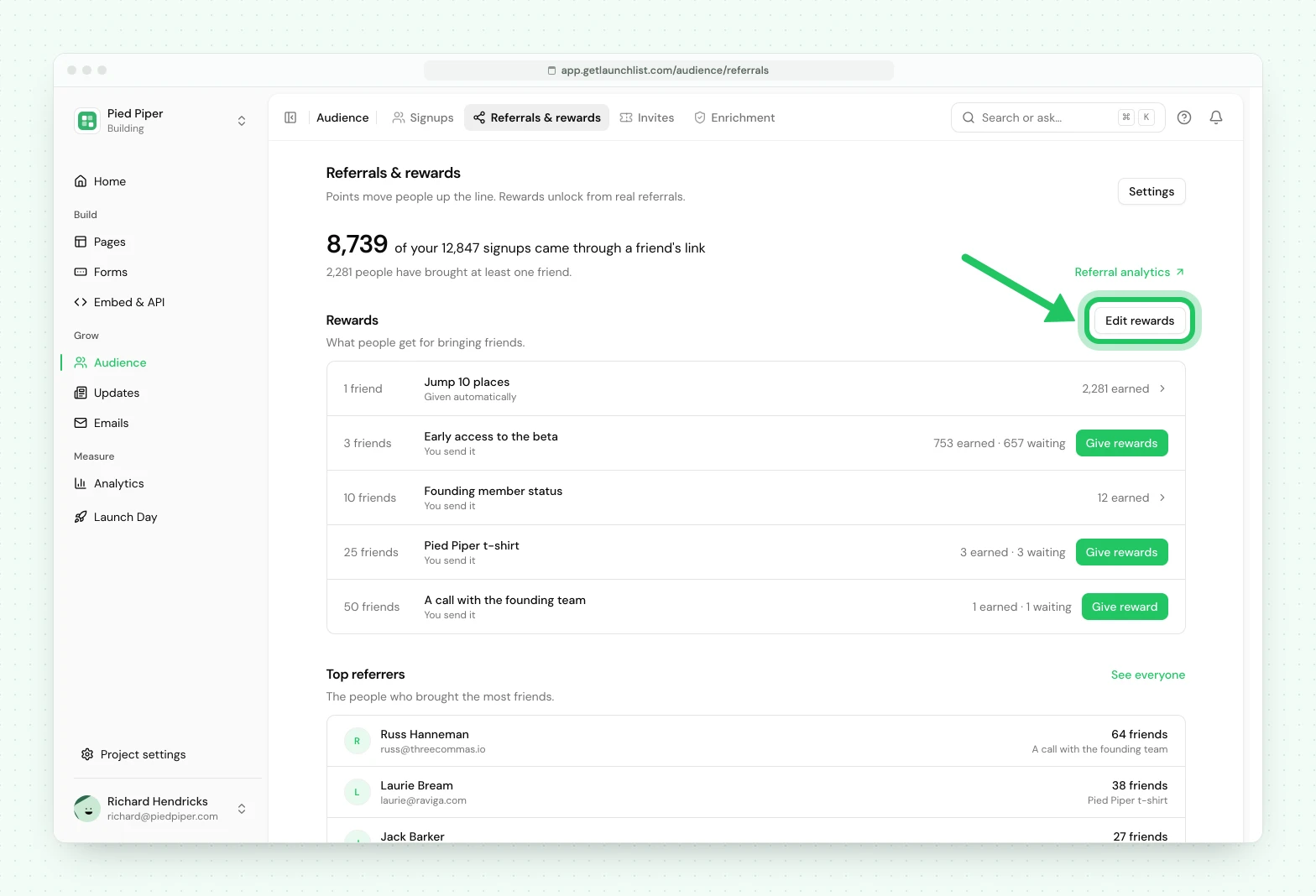
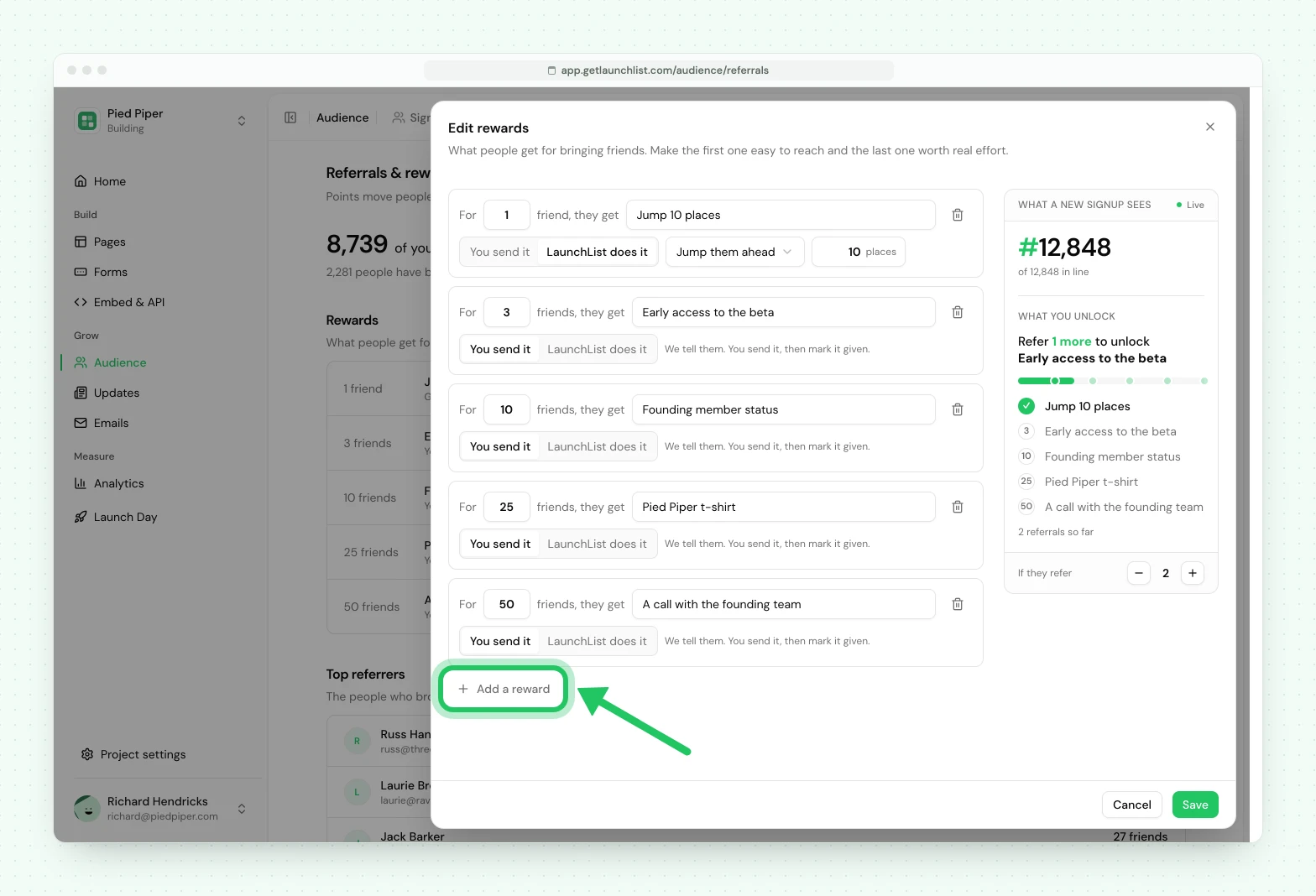
A new project starts with no rewards, on purpose: an empty ladder promises nobody something you did not choose to give. When you are ready, open Audience → Referrals & rewards, press Edit rewards and choose Add a reward: how many friends it takes, what it unlocks, and whether LaunchList delivers it or you do (see delivering). On an empty ladder, Start from the suggested three gives you three rewards to change the words of, or write your own.
Signups see the whole ladder on their status page: what they have unlocked, what is next, and how many more people it takes. Visible progress is what makes the mechanic work; a hidden reward motivates nobody.
Choosing rewards that work#
Access beats merchandise. Early entry, an extended trial, a higher usage tier, a founding-member badge, a vote on what gets built first. These cost almost nothing, arrive instantly, and are what people joined the waitlist for anyway.
Physical rewards are a trap. Shipping stickers to 400 people across 30 countries is a job you have accidentally given yourself in the middle of a launch.
Make the first tier easy. One or two referrals. An early win is what convinces someone the mechanic is real; a first tier at ten referrals reads as impossible and people stop before starting.
Make the top tier mean something. If every tier is reachable in an afternoon, none of them carry weight.
A ladder that works for most launches:
| Referrals | Unlocks |
|---|---|
| 1 | Move up the queue, plus a founding-member badge |
| 3 | Early access, ahead of general availability |
| 10 | Lifetime discount, or a say in the roadmap |
Write it in their words#
The reward description is customer-facing copy, not a config field. "Skip the queue and get in on day one" lands; "Tier 2 unlocked" does not.
Position offsets#
In Settings on Audience → Referrals & rewards, Start numbering at gives everybody a starting offset, so the first signup sees "#1,247" instead of "#1".
It is display-only and applied identically to everyone, so it changes nothing about ordering or who is genuinely ahead. Some founders use it for early social proof; others find it dishonest. It is off by default and the call is yours.
When rewards are withheld#
Referral credit does not apply if the new signup has not verified (when you ask them to), was already in your audience, or failed a fraud check. Rewards follow credit, so a farmed tier does not unlock in the first place. A credit taken back after a tier was already granted lowers the referral count but leaves the grant standing, so check the reward's recipients before you give it if the unlock was not earned.
See how referrals work for the detail, and spam and trust for how the judgment is made.
Delivering the reward#
Some rewards deliver themselves. In the reward editor, Who gives this reward is either You send it or LaunchList does it; when LaunchList does it, you pick What LaunchList does:
| Action | What happens when they unlock it |
|---|---|
| Add a tag | Tags them, so you can filter, export or start an email flow from it |
| Give bonus points | Gives them points, which move them up the line |
| Jump them ahead | A one-time jump of the places you set, as soon as they get there |
You send it (we tell them, and keep the list of who is still waiting for it) is the honest setting for anything physical, or anything that lives inside your own product. LaunchList still tracks who has unlocked what, so you always know who is owed something. When you have sent one, press Give rewards on its row, pick the people and choose Mark given.
LaunchList tells them itself. Every unlocked tier sends its own announcement, on every rung of the ladder, once per grant, so you do not build an automation for it. What you write is the reward description; the email is already wired.
Reward announcements count toward your monthly email allowance. If the allowance has run out, the announcement waits and goes out when the allowance resets on the 1st or as soon as you add emails. The reward itself unlocks on the person's status page straight away.
Next#
Common questions
What rewards work best for a waitlist?
Access is usually stronger than merchandise. Earlier entry, an extended trial, a founding member badge or a feature vote cost you almost nothing and are what people actually joined for. Physical rewards are expensive and slow to deliver.
Do I need rewards for referrals to work?
No. Queue position alone motivates more than most founders expect, because it is visible and immediate. Rewards add to that; they do not replace it.
Which plans include rewards?
Rewards and milestones, and points for follows and shares, are on Collect, Launch and Grow. The referral program itself, with a referral link, a place in line and a leaderboard for every signup, is on every plan, Free included.
How many referral tiers should I have?
Three is usually right. The first should be reachable with one or two referrals so people get an early win, and the top one should be genuinely aspirational.