Side Project to Startup: When to Go All In
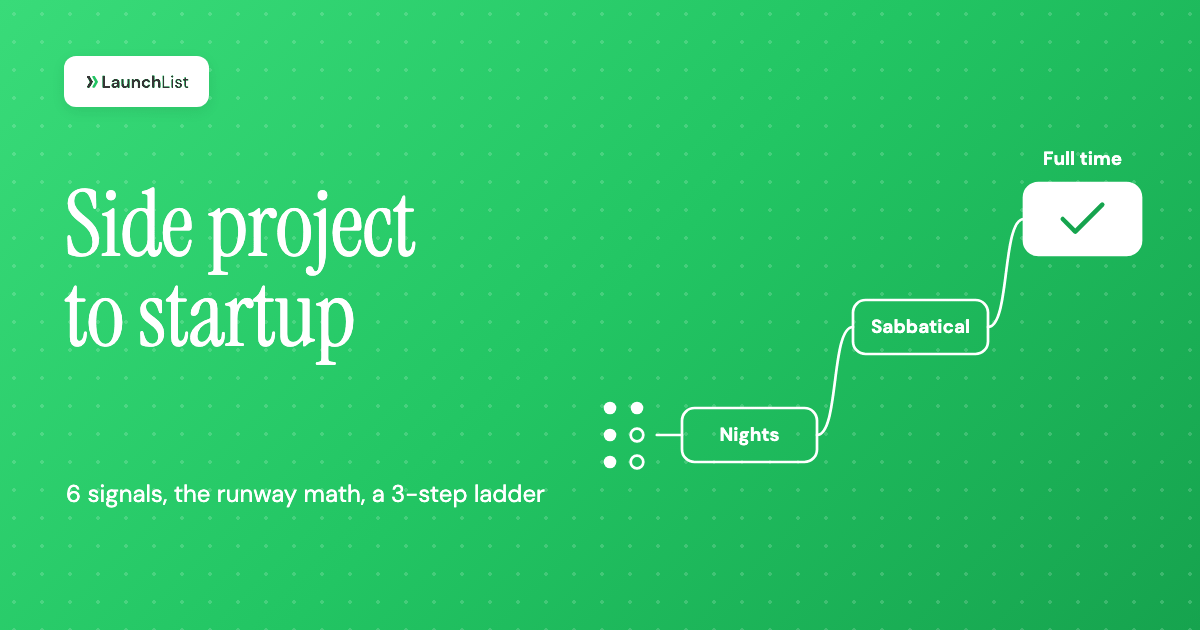
TL;DR: Going from side project to startup is a decision you can make with evidence instead of a gut feeling. Before you quit anything, run a weekend audit of six signals: strangers sign up without being asked, people come back in week 2, someone pays or asks to, it grows when you stop promoting it, businesses ask for things, and you still want to work on it on a bad week. Ignore likes, upvotes, friends' praise and one viral day. Then climb one rung of a commitment ladder (nights and weekends, reduced hours or a sabbatical, full time), after doing the runway math and reading your employment contract's IP and moonlighting clauses. Below are the scorecard, the math, a legal checklist and 8 real side projects that became companies.
Side project vs startup: what actually changes
A side project is built for interest and can stay small; a startup is built to grow fast, and its success is measured in growth. The difference is not size or quality. It is what you expect the thing to do, and what you will give up for it.
Paul Graham's definition is the cleanest one: a startup is "a company designed to grow fast." In the same essay he writes that "a good growth rate during YC is 5-7% a week," and that if you can only manage 1%, "it's a sign you haven't yet figured out what you're doing." A side project has no such expectation. It can grow at 1% a month, or not at all, and still be a success if you enjoy it or it pays for itself.
| Side project | Startup | |
|---|---|---|
| Intent | You build it because it interests you | You build it because people need it |
| Growth expectation | Any growth is a bonus | Fast, steady growth is the point |
| Your time | Nights and weekends, when you feel like it | Most of your working hours, on a schedule |
| Money | Spare cash; a few hosting bills | Savings, revenue or investors' money |
| Risk | A few lost weekends | Income, savings and years of your career |
| Success looks like | It works, you learned, maybe it earns a little | It grows into a company that pays people |
| Who decides what to build | You | Your users, and the numbers |
There is a third outcome, and it is what most people mean when they want to turn a side project into a business: a small, profitable company that never aims for venture-style growth. That is a fine result, and everything below applies to it until the question of raising money.
Paul Dornier, who turned a student project into the Y Combinator company Meetingbird, put it well in YC's post on the subject: the move from side project to startup means "going from building something that interests you to building something people want." The rest of this guide is how to tell, with numbers, whether people want it. If you are still choosing what to build, start with idea validation tools instead.
Turn a side project into a business: 6 signals to measure first
Opinions about your project are cheap and mostly kind. Behavior is expensive and honest. Every signal below is something a stranger does, measured from data you either already have or can collect in a weekend. Read them before you decide when to quit your job for your startup, not after.
One rule applies to all six: count strangers, not people who know you. Friends and followers sign up and say nice things because they like you, which is generous and useless as evidence. Tag the people you know (a spreadsheet column is enough) and leave them out of every count.
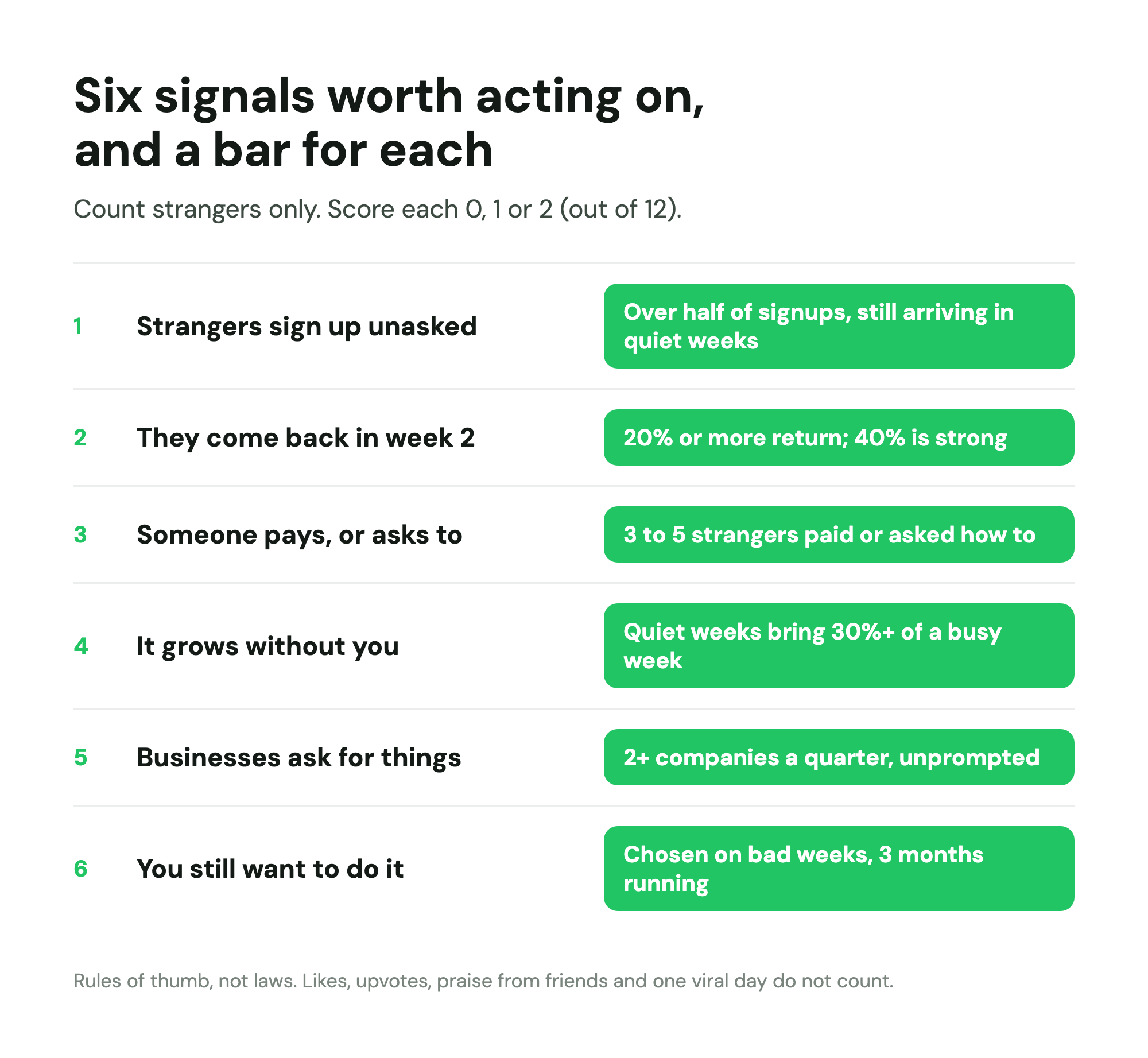
1. Strangers sign up without being asked
What it tells you: that the problem is real enough for someone who owes you nothing to hand over an email address.
How to measure it: put a signup form or page in front of the project if it does not have one, and add a source tag to every link you share (for example ?source=reddit or ?source=newsletter). Then count signups that came from people you have never met, through links you did not send to them personally. If you are still deciding what to build, an idea validation landing page does the same job before any product exists.
Rule of thumb: strangers make up more than half of your signups, and they keep arriving in weeks you did not post anything. The trend matters more than the total: ten strangers a week, every week, beats 400 signups from one post followed by silence. If visitors arrive but few sign up, read why your waitlist is not converting before you blame the idea.
2. People come back in week 2
What it tells you: that the project solves a problem that comes back, not just a curiosity.
How to measure it: take everyone who first used the project in a given week and count how many used it again 7 to 14 days later, without a reminder email from you. Any analytics tool can do this as a simple cohort; a spreadsheet of user IDs and dates works too.
Rule of thumb: 20% or more coming back in week 2 is worth taking seriously, and 40% or more is strong, for something people should use weekly. For context, Lenny Rachitsky's widely cited benchmarks put good six-month retention at about 40% for consumer SaaS and about 60% for small and mid-market SaaS. Week 2 should sit well above those six-month numbers, because retention only falls from here.
Once you have 30 or more active users, add one survey question, the one Sean Ellis popularized: "How would you feel if you could no longer use this product?" Ellis found that "the magic number was 40%" answering "very disappointed," according to Superhuman founder Rahul Vohra's account in First Round Review. Superhuman's own score started at 22%. A low score early is normal; it tells you who the product is really for.
3. Someone pays, or asks how to
What it tells you: that the problem is worth money, which is the line between a hobby and a business.
How to measure it: count strangers who paid anything, strangers who asked about price before you mentioned one, and the share who said yes to a real commitment such as a preorder or a paid pilot.
Rule of thumb: three to five strangers paying anything, or asking how to, is a stronger signal than a thousand free signups. Rob Fitzpatrick's book The Mom Test, summarized here by Michael Lynch, puts it bluntly: "Compliments are the fool's gold of customer learning: shiny, distracting, and worthless." Commitment is the opposite: people "giving up something they value such as time, reputation, or money." If you are not sure what to charge, the pre-launch MRR calculator turns a list size and a conversion guess into a revenue range you can sanity-check.
4. It grows when you stop pushing
What it tells you: that people talk about it, which is the only growth that does not cost you more hours.
How to measure it: pick two weeks where you post nothing and message nobody. Count new signups in those weeks and where they came from (referral links, search, a thread somebody else started), and compare with your busiest promotion week.
Rule of thumb: in your quiet weeks, you still get at least 30% of the signups you get in a busy week. If it drops to zero every time you stop, you have a promotion habit, not a product people share. If people do share, the viral coefficient (how many new people each user brings) puts a number on it.
5. Businesses ask for things
What it tells you: that someone with a budget sees value, often before you thought of selling to them.
How to measure it: keep a simple log of inbound requests that only a company would make: a team plan, an invoice, single sign-on, an API, a security questionnaire, a custom integration, "can we use this for our customers?" Count requests from different companies, not repeat requests from one.
Rule of thumb: two or more unsolicited requests from different companies in a quarter. They arrive slowly and are worth more per person: companies usually pay more, and the retention benchmarks above show business customers staying longer.
6. You still want to work on it on a bad week
What it tells you: whether you can last. Every other signal can be strong while you quietly dread the work.
How to measure it: for one month, log your hours on the project and how you felt before each session. Did you choose it in a week when nothing went well? Can you say in one sentence why the problem matters to you beyond money?
Rule of thumb: three months in a row of choosing the project on bad weeks. Dornier's YC post puts the bar in the same place: the right time to make the switch is simply when the difficulty of the work no longer puts you off. PropelAuth's side project checklist suggests testing this deliberately: add deadlines and commit more time, and see whether your enthusiasm survives a stricter schedule.
The six signals at a glance
| Signal | How to measure it | Rule of thumb (not a law) |
|---|---|---|
| Strangers sign up unasked | Source tags on every link; exclude people you know | Strangers are over half of signups and keep arriving in quiet weeks |
| Week-2 return | Cohort: used again 7 to 14 days after first use | 20%+ worth pursuing; 40%+ strong |
| Payment | Strangers who paid, asked to pay, or committed | 3 to 5 strangers paid or asked how to |
| Growth without effort | Signups in two weeks with no promotion | Quiet weeks bring 30%+ of a busy week's signups |
| Business requests | Log of team, invoice, SSO, API requests | 2+ companies in a quarter, unprompted |
| Your energy | Hours and mood log for a month | You chose it on bad weeks, three months running |
Signals that do not count
These feel like evidence, and they are why founders quit too early or keep building something nobody needs.
- Likes, follows and reposts. They cost the giver nothing. Thousands of likes can come from people who would never open the project twice.
- Upvotes and a launch-day rank. A rank measures one day's attention from the people who browse that board. It is useful for reach (see where to launch your startup for what each platform brings) and says little about who comes back.
- Friends' and family's praise. The people who love you protect your feelings. Their enthusiasm is real; it is not data about the market.
- A single viral day. Watch the four weeks after a spike. If signups fall back to where they were, it measured curiosity, not demand.
- Total signups without a source. 2,000 people is a strong signal if strangers built the list over months, and a weak one if a giveaway built it in a weekend.
- Competitors raising money. It tells you investors like the market, not that anyone wants your project.
Run the weekend audit
You need one weekend and the discipline to write the numbers down before you interpret them.
Saturday morning: pull the numbers. Export your signups and usage, remove everyone you know, and write one raw number per signal in a sheet.
Saturday afternoon: score each signal 0, 1 or 2. Zero means absent, one means present but below the rule of thumb, two means at or above it. The total is out of 12.
Sunday: test the weakest signal directly. If payment is your zero, ask ten of your most active users for a real commitment at a real price. If week-2 return is weak, call five people who stopped and ask what they use instead. One day of direct testing often moves a score more than a month of building.
Sunday evening: read the score as a rule of thumb, not a verdict:
- 0 to 4: keep it a side project. Change one thing (the audience, the problem or the channel) and audit again in 90 days.
- 5 to 8: climb one rung of the commitment ladder below, usually a fixed block of reduced hours or a short sabbatical, and audit again at the end of it.
- 9 to 12: you have the evidence. Whether you go full time now depends on your runway, which is the next section.
Put the next audit date in your calendar before you close the sheet. The most common way to get stuck is not a bad score; it is never scoring at all.
When to quit your job for your startup
Signals tell you whether the project deserves more of you. Three more checks tell you whether you can afford to give it: your runway, your revenue as a share of what you need, and which rung of the ladder you are on.
Runway math
Runway is how many months you can live with no salary. Start with bare-bones monthly costs (rent, food, insurance, debt, transport), not your current lifestyle, and add what the project costs to run.
Common guidance varies. U.S. Bank's small business guide suggests saving at least three months' worth of business and living expenses. A money expert quoted by CNBC Select keeps "up to 12 months' worth of expenses saved up," and adds that people with fewer responsibilities may be comfortable with less. Treat 6 to 12 months of bare-bones expenses as a rule of thumb, toward 12 if you have dependents or the project has no revenue yet.
A worked example with illustrative numbers: $36,000 saved, and $4,000 a month to live and run the project.
- With no revenue, $36,000 lasts 9 months.
- If the project brings in $1,000 a month, your burn falls to $3,000 and the same savings last 12 months.
- At $2,000 a month in revenue, your burn is $2,000 and the savings last 18 months.
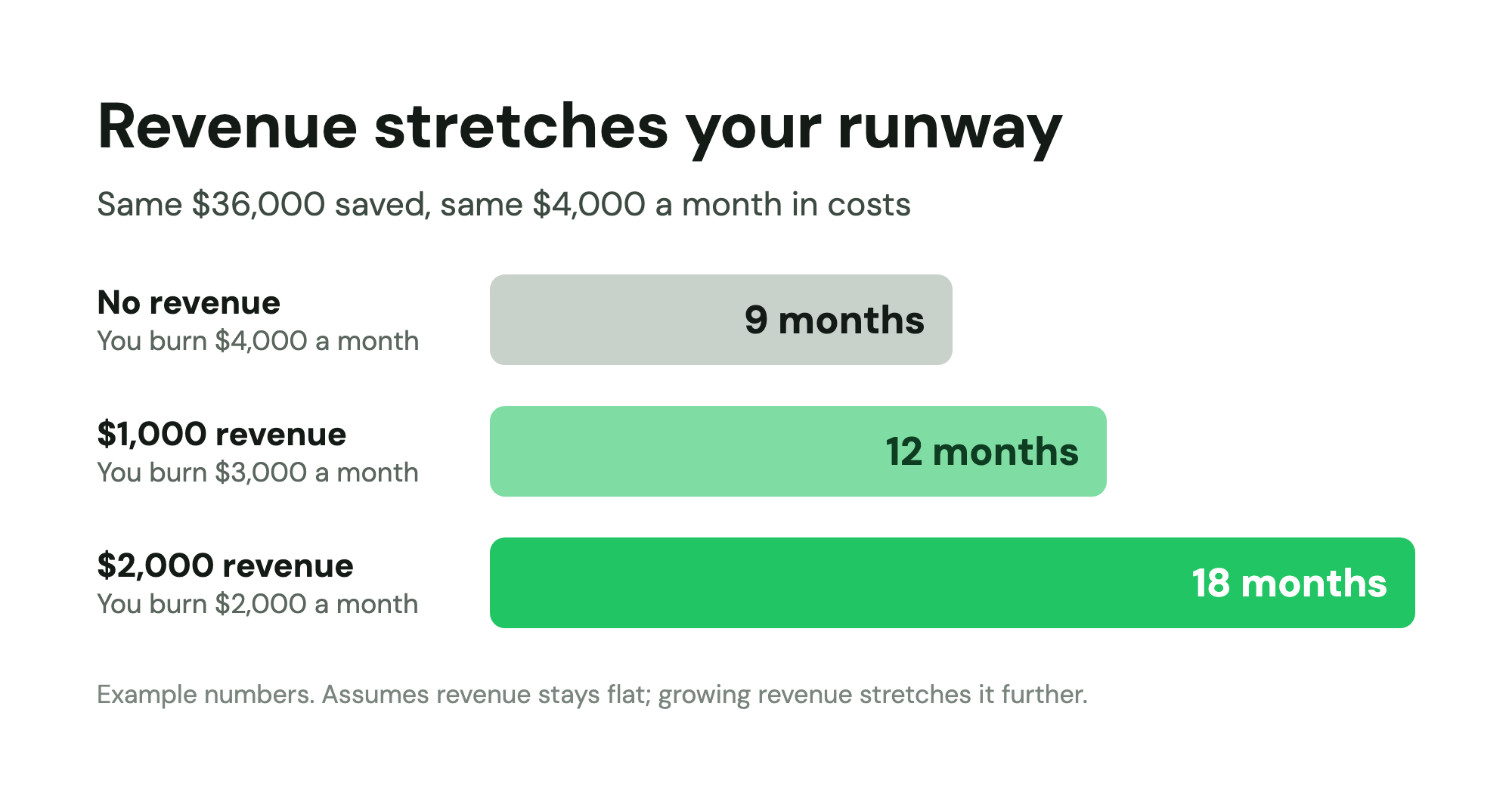
Revenue does double duty: it is your strongest signal, and runway you do not have to save. A project earning a modest amount can be safer to go full time on than one with a big list and no revenue. To run the numbers with your own costs, the startup runway calculator works out your burn rate and months of cash.
Revenue as a share of what you need
Paul Graham's essay Ramen Profitable defines the most useful milestone: "Ramen profitable means a startup makes just enough to pay the founders' living expenses." Its significance, he writes, is that "you're no longer at the mercy of investors."
You can turn that into a simple ratio: monthly project revenue divided by your bare-bones monthly costs. As a rule of thumb:
- Under 25%: stay on nights and weekends unless the other signals are very strong.
- 25% to 50%: you have a business, not yet a living. This is the range where reduced hours or a sabbatical make sense.
- 50% to 100%: with 6 or more months of savings, going full time is a measured bet, not a leap.
- Over 100%: you are ramen profitable. Every month at your job now costs the project more than it pays you.
Use the bare-bones figure, not your salary. Your salary includes things you can cut for a year. Your rent does not.
The commitment ladder
You do not have to choose between "side project" and "quit tomorrow." Each step in between is a cheaper test of whether full time is right.
| Rung | What it looks like | Move up when | Step back when |
|---|---|---|---|
| 1. Nights and weekends | 5 to 15 hours a week around a full-time job | Audit score is 5+ and at least one stranger has paid | Your score stays under 5 after two audits |
| 2. Reduced hours or sabbatical | A four-day week, unpaid leave or a fixed 1 to 3 month block | Score is 9+ and revenue covers 25%+ of bare-bones costs, or you raised money | The extra time did not move any signal |
| 3. Full time | All your working hours, with 6 to 12 months of runway | You are already here; audit every 90 days | Runway falls under 3 months with no revenue growth |
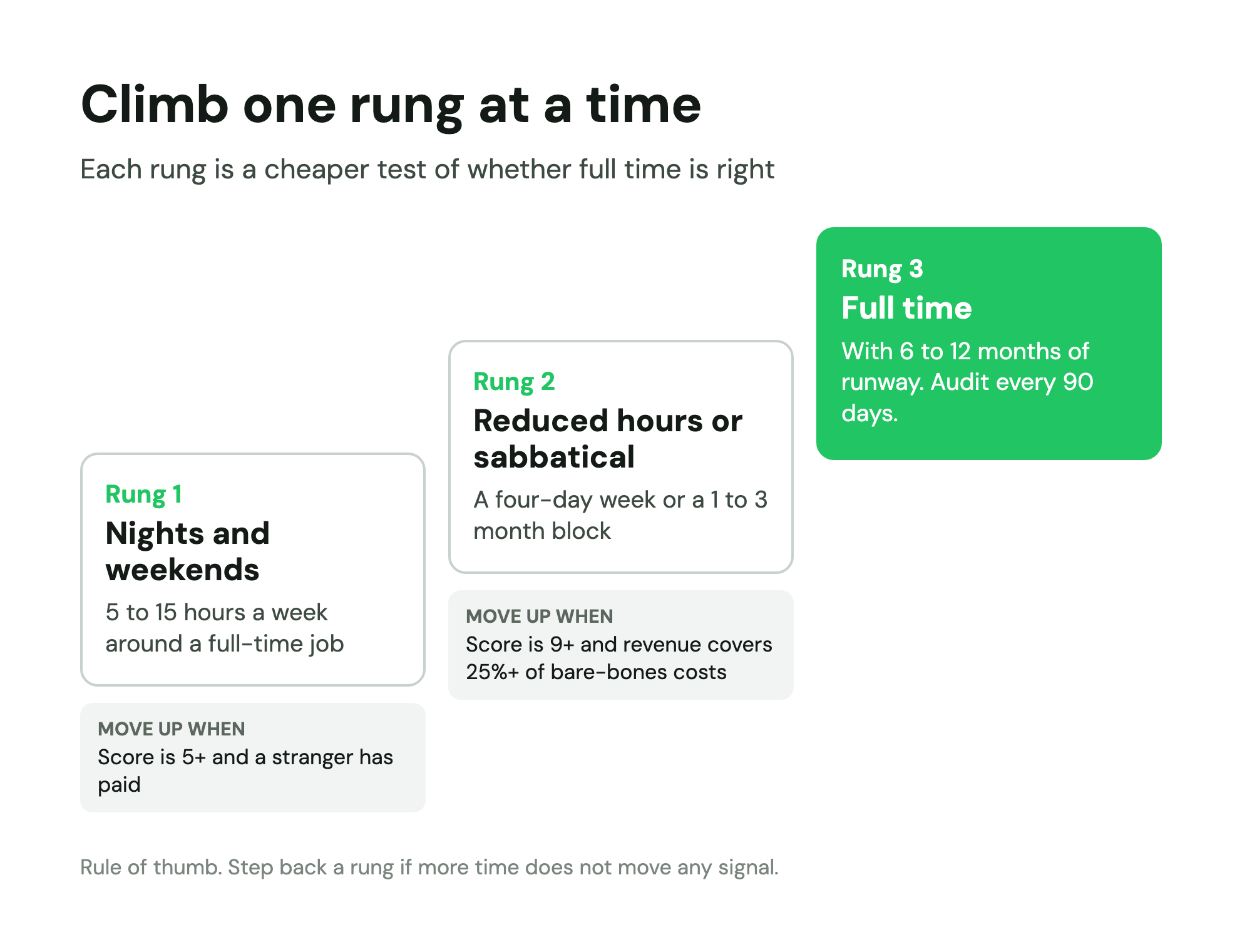
Rung 2 is the one founders skip, and the most informative. A two-week full-time trial on vacation days, or a four-day week for three months, shows whether more hours move the signals. If doubling your time moves nothing, quitting will not either.
The research says climb, do not jump
The ladder is not just caution. In a study published in the Academy of Management Journal, Joseph Raffiee and Jie Feng followed people in a long-running US survey from 1994 to 2008 and compared founders who quit their jobs to start a business with "hybrid" founders who kept a job while they started. As management-issues reported, they found "the hazard of exit is 33.3% lower for individuals who enter full-time self-employment in a staged process."
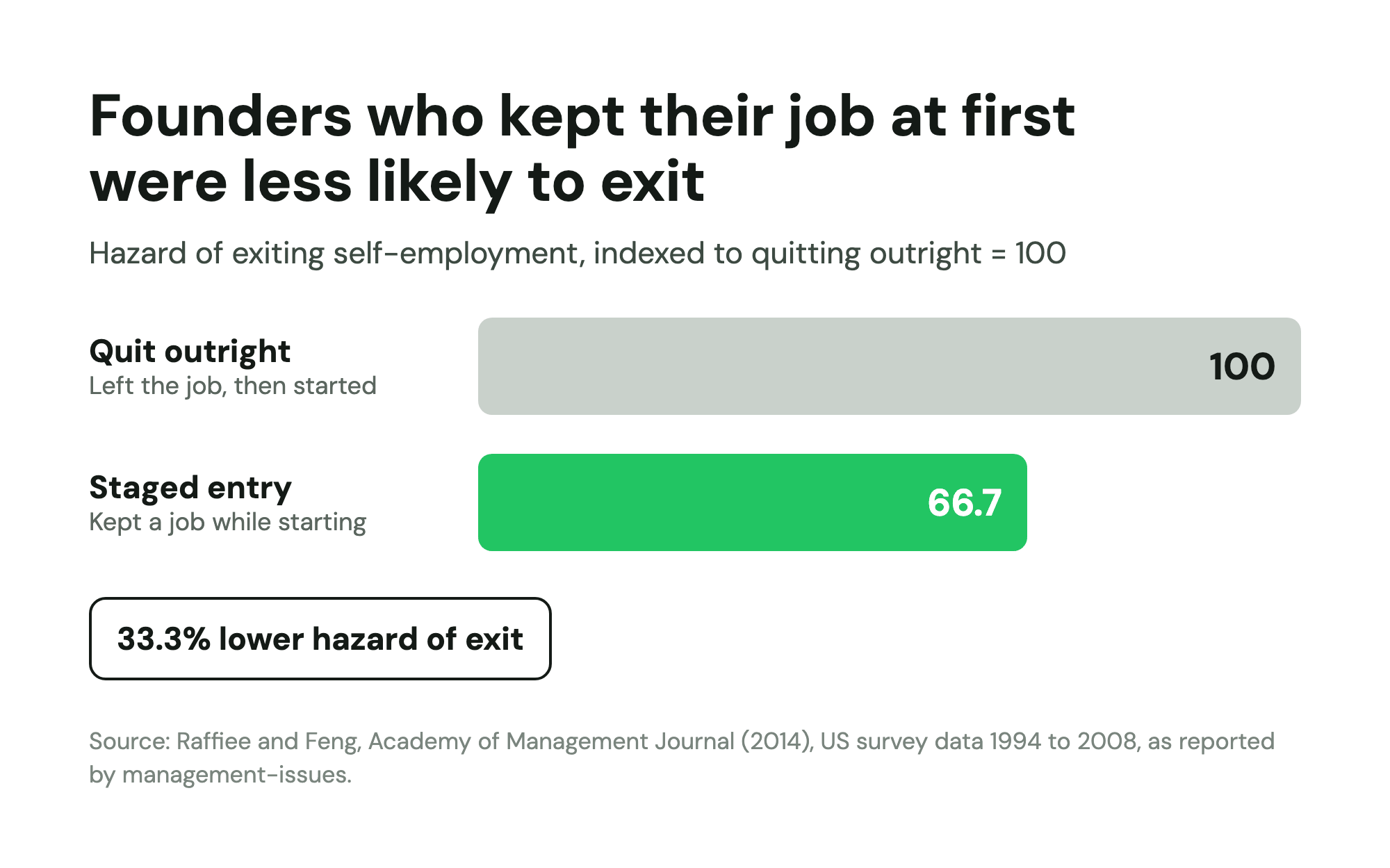
The authors' explanation is that a hybrid start means less sunk cost and downside risk, and "provides a learning experience about the enterprise in question and one's suitability for it." That is what the six signals are for. One caution: this measures survival across all kinds of self-employment, not your project's odds. It argues for evidence before you quit, not for keeping your job forever.
Do you need a co-founder?
Not to start, but it helps once you go full time. Y Combinator's FAQ says "We regularly accept solo founders," and adds that "one-person startups are tough and you're more likely to succeed with a co-founder." Paul Graham's reason, in 18 Mistakes That Kill Startups, is that "the low points in a startup are so low that few could bear them alone." A side project is a cheap trial for a co-founder: build with the person for a few months before you split ownership, and if the project can stay a small business, staying solo is a reasonable choice.
Raise money or stay bootstrapped
Decide this after the signals. Raising makes sense when the idea only works at speed (a marketplace that needs both sides fast, or a market a funded competitor could take) and you are ready to go full time. Most investors expect that: Y Combinator's FAQ says "we expect the founders to commit to working full-time on their company during the batch and afterwards if accepted."
Staying bootstrapped makes sense when the project can grow on its own revenue, or when you are not sure yet. Graham's ramen profitable essay makes the trade plain: once you do not need money, "you can get better terms." A project that pays for itself can raise later; one that raised cannot easily go back to being a side project.
Check your employment contract first
Before you build anything you hope to turn into a company, read your employment contract. Two clauses matter. This is general information, not legal advice; talk to an employment lawyer where you live.
Invention or IP assignment. Many agreements give the employer inventions you create while employed. Some cover only work related to your job; some try to claim what you build at home on weekends.
Some US states limit how far those clauses can reach. California's Labor Code section 2870 is the best known. It says an assignment clause does not apply to an invention "developed entirely on his or her own time without using the employer's equipment, supplies, facilities, or trade secret information," except inventions that relate to the employer's business or its actual or anticipated research, or that "result from any work performed by the employee for the employer." Law firm Foley & Lardner notes that seven states, California, Delaware, Illinois, Kansas, Minnesota, North Carolina and Washington, have nearly identical requirements, and New York added a similar rule, Labor Law section 203-f, in September 2023. Outside those states, and outside the US, your contract's own wording carries more weight.
Moonlighting or outside activities. Some employers require approval for any outside business, and most forbid working for or building a competitor. As Springmeyer Law explains, breaking such a policy can cost you your job, even when it does not put the startup itself at risk.
A practical checklist:
- Read the invention assignment, confidentiality and outside-activity sections of what you signed.
- Never use a work laptop, accounts, cloud credits or hours for the project.
- Keep it outside your employer's business. If it overlaps, get advice before building more.
- Keep dated records: commits on a personal account, receipts for your own hosting.
- If the contract asks you to disclose outside work, do it in writing and ask for a written release.
- Check non-solicitation terms before recruiting a coworker or selling to your employer's customers.
Registering the business and taxes (general information, not legal or tax advice; rules differ by country and state, so ask an accountant). In the US, the SBA notes that you are automatically a sole proprietor if you do business on your own without registering, which is easy but leaves you personally liable for the business's debts. An LLC protects you from personal liability "in most instances," which starts to matter once you sign contracts or take real revenue. Whichever you pick, open a separate business bank account from the first sale, as the SBA also recommends, and keep a record of every payment and expense so tax time stays simple.
Side project to startup: 8 companies that made the leap
Each of these eight went from side project to startup, or at least to a company. For each, notice which signal showed up before the founders committed.
| Company | Started as | The signal | What happened next |
|---|---|---|---|
| GitHub | Nights and weekends while a founder worked at Powerset | Launched publicly and in use | A founder turned down a $300,000 offer to go full time (2008) |
| Basecamp | 37signals' internal tool for client projects | Clients asked for their own copy | Revenue passed consulting within about a year; client work stopped |
| Craigslist | An email list of San Francisco Bay Area events | Grew from a list into a web service (1996) | The founder quit his job around 1999, about four years in |
| Product Hunt | An email list a product director built with Linkydink | A couple hundred subscribers soon after | The first website was built over Thanksgiving 2013 |
| Slack | An internal chat tool used while building the game Glitch | The team was its own daily user | Became the product after Glitch closed in December 2012 |
| A project inside the podcast company Odeo | Odeo's staff used the prototype | Became its own company in April 2007 | |
| Unsplash | Photo outtakes Crew posted to a Tumblr | More than 50,000 visits on day one | Acquired by Getty Images in March 2021 |
| Mailchimp | A side project to a web design agency (2001) | Agency clients needed email marketing | Grew into the company itself |
GitHub. Tom Preston-Werner was "employed full time at Powerset" when he and Chris Wanstrath built GitHub over "three months of nights and weekends," starting in October 2007. When Microsoft bought Powerset in 2008, he was offered a salary plus $300,000 over three years to stay. He turned it down "on the day the employment offer was due." Note the order: GitHub was public and in use before he chose it over a very good job.
Basecamp. 37signals was a web design consultancy. "We needed a tool to better manage our client projects," Jason Fried said in a 2008 interview, so they built one, and clients asked for their own copy. Within a year they were "making more money off of Basecamp than we were off our consulting client projects," and stopped client work. That is the revenue-share test above, applied to a whole company.
Craigslist. Craig Newmark started an email list for friends in early 1995. It became a web service in 1996, was incorporated in 1999, and "around this time, Newmark quit his job to work on Craigslist full-time." Four years is a useful corrective to the idea that you must decide in a month.
Product Hunt. Ryan Hoover was Director of Product at PlayHaven when he set up Product Hunt as an email list using Linkydink. He "invited maybe a couple dozen people I knew," he told First Round Review, and "soon, I had a couple hundred subscribers." The list grew through sharing (signal 4), and the first version of the website was built over Thanksgiving 2013, weeks after the list launched.
Unsplash. Mikael Cho posted outtakes from a photo shoot for his company Crew on a Tumblr for anyone to use. It received more than 50,000 visits on its first day, and Getty Images acquired it in 2021. The spike alone proved little; what followed mattered more, as photographers began contributing their own work.
Slack, Twitter and Mailchimp add one point: a side project inside a company counts, and the team or its clients can be the first demanding users.
Gmail is often cited as a "20% time" project, but its creator, Paul Buchheit, told Time in 2014 it was "an official charge," so it is not on this list.
Mistakes that keep a side project stuck
- Quitting before the evidence. Leaving before any stranger has paid or come back swaps a known income for pressure without adding information. Signals that are weak at 10 hours a week are usually weak at 50.
- Staying a side project forever. Strong signals, real revenue, and no decision because there is never a perfect moment. Treat a score of 9 or more as a deadline to climb a rung.
- Building features instead of finding users. When growth stalls, another feature is the comfortable response. Usually not enough of the right people have seen it. Guides on how to promote your waitlist and get your first 100 waitlist signups cover the unglamorous part. If people arrive and leave, talk to them before writing code.
- Testing too many ideas at once. Three side projects at 3 hours a week each produce three sets of weak, unreadable signals. Pick one for 90 days.
- Deciding alone. If someone shares your rent or depends on your income, they are taking the risk too. Show them the runway math before you hand in notice, not after.
Where LaunchList fits
LaunchList is pre-launch waitlist software for founders. It helps you measure two of the signals: whether strangers want the thing, and whether they share it. It does not build or host your project, find users, take payments, or tell you whether to quit your job. That call is still yours.
- Put a page up first. The simplest way to read signal 1 is a pre-launch waitlist. Write one sentence about the project and the AI waitlist page editor turns it into a page you can change block by block and publish at a launchlist.page address. If you already have a site, embed a form from the waitlist signup form builder; for an app made in Lovable, Bolt, v0 or Replit, ask the builder to add one.
- Tell strangers from friends. Every plan includes a hidden field that saves the source tag from your links (say
?source=reddit), so the people you invited never get counted as strangers. The Grow plan adds a breakdown of signups by source and referring site in waitlist analytics. - See if it spreads. On every plan, each signup gets a personal referral link, a live place in line and a spot on a leaderboard (referral waitlist software). Signups that arrive through those links in a week you stayed quiet are signal 4 in plain numbers.
- Reach the list when you commit. From the Collect plan you can send a broadcast to email your waitlist, then run an early access program to bring people in a group at a time. For the step after that, see how to convert a waitlist into paying customers.
Collecting signups works on the Free plan (details on the pricing page), so you can put a page in front of the side project this weekend and run your first audit on real numbers.
Side project to startup FAQ
How do I turn a side project into a business or startup?
Measure before you commit. Check six signals: strangers sign up without being asked, people come back in their second week, someone pays or asks to, it grows when you stop promoting it, businesses ask for things, and you still want to work on it on a bad week. If most of them are strong, move one step up the commitment ladder (nights and weekends, then reduced hours or a sabbatical, then full time) and check again in 90 days.
What is the difference between a side project and a startup?
Intent and growth. A side project is built for your own interest, on spare time and spare money, and it succeeds if you enjoy it or it earns a little. A startup is a company designed to grow fast: Paul Graham puts a good growth rate during Y Combinator at 5 to 7% a week. That expectation changes how you spend your time, whether you raise money and how much risk you take.
How do I know if my side project is a business?
Look for behavior from strangers, not praise from people you know. The strongest signals are money (someone pays, or asks how to), repeat use (people come back a week later without a reminder) and growth you did not push (signups from referrals or search in weeks you posted nothing). Likes, upvotes and friends saying it is great do not count.
When should I quit my job for my startup?
When the evidence is strong and the money works, not when the job feels boring. A common rule of thumb is to go full time once the project covers your bare-bones living costs, or once strong signals are paired with 6 to 12 months of savings. Research on more than a decade of US data found that founders who moved into self-employment in stages had a 33% lower hazard of exit than those who quit outright.
How much money should I save before going full time on a startup?
Advice ranges from at least three months of business and living expenses (U.S. Bank) to up to 12 months (an expert quoted by CNBC Select). Treat 6 to 12 months of bare-bones expenses as a rule of thumb, add your business costs on top, and count any revenue the project already makes, because revenue stretches runway: $36,000 lasts 9 months at $4,000 a month, and 18 months if the project brings in $2,000 a month.
Can my employer own my side project?
Possibly. Many employment agreements include an invention assignment clause, and some claim anything you build while employed. California Labor Code section 2870 limits that for inventions built entirely on your own time without the employer's equipment, supplies, facilities or trade secrets, unless the invention relates to the employer's business or results from your work for them. Several other states have similar laws. This is general information, not legal advice: read your contract and ask an employment lawyer.
Should I raise money or bootstrap my side project?
Raise only if the idea needs fast growth to work and you are ready to go full time, because most investors expect it: Y Combinator's FAQ says it expects founders to work full time on their company during the batch and afterwards. If the project can grow on its revenue, bootstrapping keeps your options open. Paul Graham's point about being ramen profitable is that once you cover your living costs, you are no longer at the mercy of investors.
How long should I work on a side project before deciding?
Set a review date instead of waiting for a feeling. Ninety days of steady work is enough to read most of the six signals, as long as real people can use or sign up for the project during that time. Some companies took far longer: Craigslist began as an email list in 1995, and its founder quit his job to run it full time around 1999.
Does a viral launch mean my side project is a startup?
No. A single day of traffic from a launch board or a popular post tells you the idea is interesting to look at, not that anyone will use it or pay. Watch what happens in the four weeks after the spike: whether signups keep arriving, whether the people who came back use it again, and whether anyone asks to pay.
Should I tell my employer about my side project?
Read your contract first. If it has a moonlighting or outside-activity clause, or an invention assignment that requires you to disclose inventions, you may be obliged to tell them, and asking for a written release is safer than hoping nobody notices. If the project competes with your employer or touches its business, get advice before you build further.