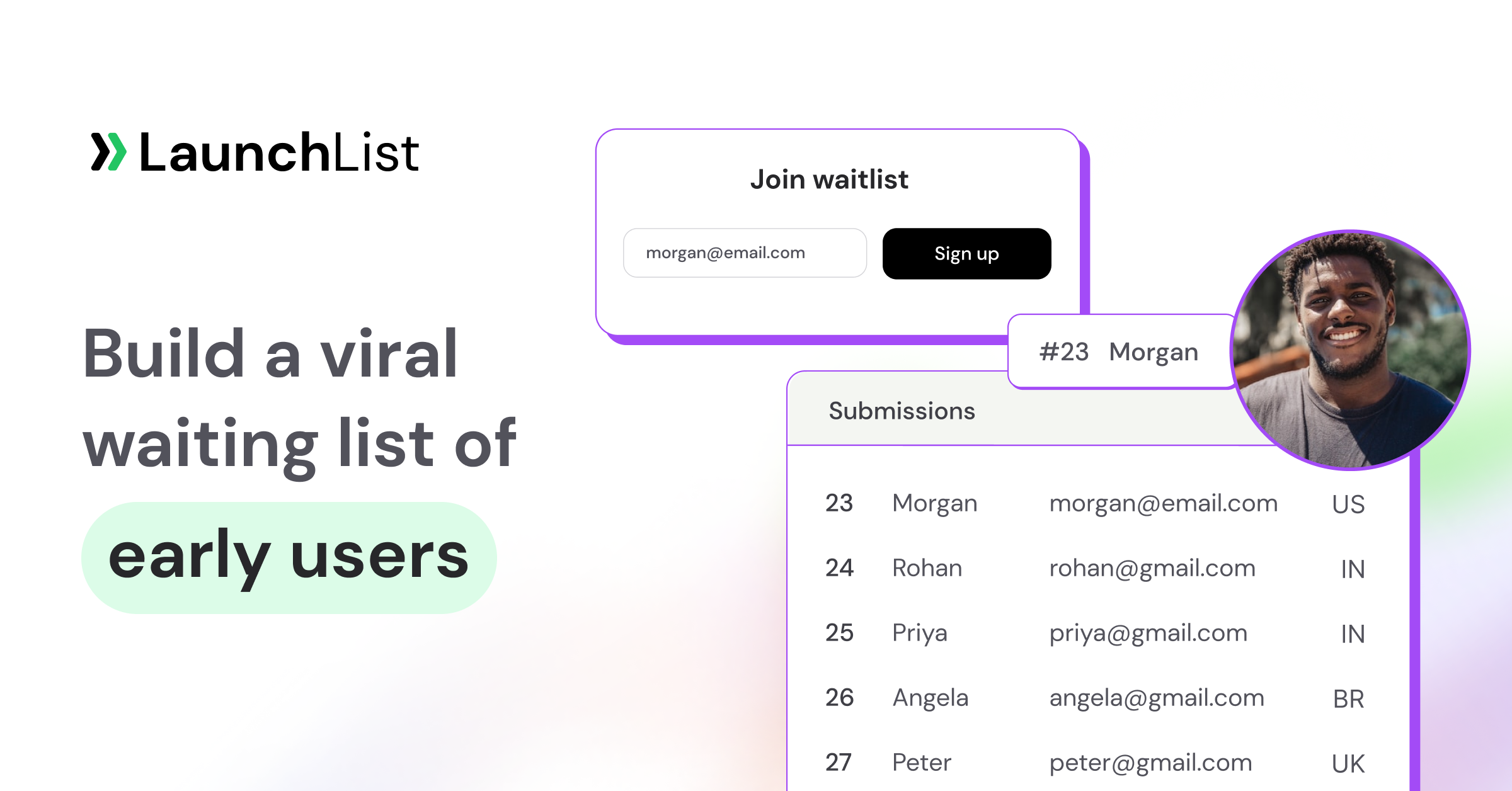
TL;DR: Milestone rewards and position-based perks turn a single signup into a repeat promoter. Morning Brew used a 5-tier swag ladder (sticker at 3 refs, mug at 10, t-shirt at 25, hoodie at 50, branded bookshelf at 100) to drive organic growth to 2.5M+ subscribers. Robinhood used pure position-queue gamification to hit 1M pre-launch users. The mechanic is the same: give signups a reason to refer, then give them progress feedback. This guide covers the six reward patterns that work, how to pick one, the milestones that matter, the mistakes that kill the mechanic, and how to ship a verified reward ladder in LaunchList (the place in line and leaderboard on every plan, reward rungs from the Collect plan up).
Why milestones and rewards work
A pre-launch waitlist landing page captures emails. That's the baseline. What most waitlists miss is the mechanic that turns each signup into a referrer. Without it, your list grows linearly: you pay for every new signup, one by one. With milestones and rewards, each signup can produce multiple new signups, and the list compounds.
The psychology is straightforward. A reward gives users a reason to refer once. A milestone, a visible progression toward something more valuable, gives them a reason to refer repeatedly. Seeing "7 more referrals to your sticker" is more motivating than "refer a friend for a discount" because the progress itself becomes the reward.
For the underlying growth math, see our viral loop guide. For 15 live examples of pages using these mechanics, see waitlist landing page examples that convert.
The 6 reward patterns that actually work
1. Position-queue rewards (free, gamified)
Each signup gets a number (e.g. "You're #4,872 in line"). The number drops as friends they refer also sign up. This is pure gamification: no cash, no swag, no product, just a visible leaderboard position. Robinhood accumulated 1 million pre-launch signups using only this mechanic. It works because the sunk-cost feeling (users who've climbed 10,000 spots won't walk away) and the competitive social layer (friends compare positions) do all the work.
LaunchList runs this mechanic on every plan, the Free plan included: every signup gets a place in line and a personal referral link on their own status page, and you can put a live top-referrer leaderboard on your launch page or embed it on your own site. If you would rather the first person not see "#1" on day one, a "Start numbering at" setting offsets the displayed position (display only, nobody's real order changes).
2. Tiered swag ladder (Morning Brew model)
A series of tangible rewards gated at milestone counts. The classic Morning Brew ladder:
- 3 referrals → sticker (the easy first win)
- 10 referrals → branded mug
- 25 referrals → t-shirt
- 50 referrals → hoodie
- 100 referrals → branded bookshelf (the aspirational prize)
The first tier is critical. It needs to be achievable with minimal effort (3 to 5 referrals, max) so users get an early win that builds momentum. Without an early win, most users give up before earning anything.
3. Early access tiers (feature-unlock)
Good for SaaS products with natural feature gating. Signups unlock access to increasingly valuable features as they refer more people. Example tier structure:
- 0 referrals → free tier, core features
- 3 referrals → beta access to paid feature X
- 10 referrals → a year of paid feature Y
- 25 referrals → full Pro plan for 12 months
The economics work when the features have high marginal cost of paid acquisition but low marginal cost of fulfillment: giving away a Pro plan costs you nothing if the user wasn't going to convert anyway.
4. Exclusive content and community access
Works for creators, newsletters, and communities. Signups earn access to gated content (private podcast episodes, Discord servers, interview recordings) at referral milestones. Cost to ship: low. The key is that the content is genuinely valuable and only accessible through the referral ladder. If the content leaks to the general audience, the mechanic collapses.
5. Discount and credit rewards (two-sided)
Best for products with a clear monetary value. Both the inviter and invitee get a credit or discount: Dropbox did this with 500MB of storage for each side, PayPal did it with $10 each. This is the most effective for paid products because the reward is directly usable. Ship it as "Get $X off. Give $X to a friend." The two-sided language doubles perceived fairness and improves acceptance rates on the invitee side.
6. Recognition and status (leaderboards, badges)
For communities where status matters more than stuff. Featured top referrers on your homepage, public leaderboard, "Founding Member" badge, custom profile flairs. Cheap to ship, powerful when your audience is status-driven (dev tools, design tools, creator communities).
How to pick the right reward for your product
- Consumer, pre-launch, no budget → position queue (free, proven).
- Newsletter or content product → tiered swag ladder + exclusive content.
- SaaS with paid tiers → feature unlock ladder.
- Paid product with high margin → two-sided credit/discount.
- Community or creator audience → recognition + exclusive content.
Mix works too. In LaunchList, the position queue and leaderboard are on every plan, and from the Collect plan up you can layer a reward ladder of up to 20 rungs on top, shown to each signup on their status page with what they have unlocked and how many more friends the next rung takes.
The 3 milestones that matter most
If you're building a tiered system, the three critical thresholds are:
- First milestone (3 to 5 refs): the easy win. Without this, most users give up before earning anything. Make it achievable in a single share burst across 3 to 5 friends.
- Mid milestone (20 to 30 refs): the commitment signal. Users who reach this are demonstrating real intent. Reward them with something memorable and brag-worthy (a physical item or gated access).
- Aspirational milestone (100+ refs): the top-tier signal. The reward should feel disproportionate to the ask, because only a tiny fraction of users will reach it, but those who do become your strongest evangelists.
Points, rewards and position: how they fit together
People mix these up, and the difference matters when you design a ladder that cannot be gamed.
| Lever | What moves it | What it changes | LaunchList plan |
|---|---|---|---|
| Position in line | Credited referrals and points | Where someone sits in the queue and on the leaderboard | Every plan |
| Points | Signing up, each credited referral (10 points per friend by default, configurable), bonus points from a reward, points tasks | Position only | Points per signup and referral on every plan; points tasks from the Collect plan |
| Points tasks | Claiming a task such as "Follow us on X, +50 points" on the status page, once per person per task | Position only, never unlocks a reward | Collect plan and up |
| Reward rungs | The number of credited referrals | Unlocks a reward and sends an unlock email | Collect plan and up |
The design choice behind this: rewards unlock only from friends who actually joined and were verified, so nobody can buy a hoodie by clicking follow buttons. Points tasks are a cheap way to give people something to do between referrals (follow, join the Discord, star the repo) without devaluing the ladder. Tasks run on the honor system, so keep their points small relative to a referral.
Common mistakes that kill the mechanic
- First milestone set too high. Anything above 10 referrals for the entry-level reward kills momentum. Most users won't climb past their first post-signup share; the first tier needs to be earnable from that single attempt.
- Rewards that aren't clearly valuable. "Exclusive content" is vague. "The unreleased episode with [specific guest]" is specific. Be concrete or users won't bother.
- No progress visibility. If users can't see their current referral count and distance to the next milestone, the ladder doesn't drive behavior. Make progress obvious on the page people land on after signing up and in your email updates.
- Manual fulfillment at scale. You can ship the mechanic manually at 100 referrers, not at 10,000. Automate swag fulfillment (Printful, Sticker Mule API) before you push the ladder publicly.
- Rewarding low-quality referrals. If a disposable email counts toward the reward, users will game it. Require email verification before a referral counts, and filter out disposable addresses and repeat signups from one device.
How to ship this on LaunchList
The position-queue mechanic (pattern #1) is on every LaunchList waitlist by default: there is nothing to switch on. To ship a tiered milestone ladder on top:
- Create a free LaunchList account. Signing up gives you a project, a signup form and a hosted launch page; publish the page, or embed the form on your own site.
- Add the leaderboard block to your launch page, or the leaderboard widget to your own site (Embed & API, Your website, Widgets), so people can see who is driving referrals. Every signup already gets a referral link and a place in line on their status page.
- Open Audience, Referrals & rewards, press Edit rewards and add a reward for each rung (up to 20): how many friends it takes, what it unlocks, and the words your signups will see ("Skip the queue and get in on day one" beats "Tier 2 unlocked"). Rewards and milestones are on the Collect, Launch and Grow plans.
- Choose who gives each reward. LaunchList does it can add a tag, give bonus points, or jump the person ahead a set number of places. You send it is the honest setting for swag or anything inside your own product: LaunchList keeps the list of who has unlocked it and is still waiting, and you can grant, mark as fulfilled or void each one.
- Optionally add points tasks under More ways to move up on the same screen (follow on X, join your community), up to 20 of them.
- Show the ladder publicly: the referral rewards block on your launch page, or the milestone widget on your own site, displays the rungs without any personal data.
- Check a signup's status page shows the ladder. When someone unlocks a rung, LaunchList emails them the announcement for you, so you do not need to build that email yourself. Reward announcement emails count toward your monthly campaign email allowance.
Two details that protect the ladder. Rewards unlock from the number of friends who joined, so they cannot be bought with small actions. And referral credit only lands once the friend is verified (with double opt-in on, that means they clicked the confirmation link), after checks for self-referral from the same device, a cap of 3 credited referrals per IP address and 20 per hour by default. A signup later caught as fake, for example as part of a device farm where three or more signups share one device fingerprint, loses its referrer the credit. Skipped referrals record a reason you can see, so you can answer "why didn't my friend count?" honestly.
Automating the ladder
A reward tag is useful beyond the reward itself. Because rewards that add a tag run inside LaunchList, the people who reached a rung become a segment you can email or invite. A few setups founders use:
- Invite your best referrers first. In Audience, Invites, invite a batch: it picks the people with the most referrals first, then the earliest signups, up to 1,000 per batch. Invites for your first 100 beta users are on the Free plan; paid plans are unlimited.
- Nudge people one friend away. On the Launch and Grow plans, an automation triggered by "referral credited" can branch on "referred at least N" and send a nudge, add a tag, or invite them automatically. (A reward unlock itself is not an automation trigger; it already sends its own email.)
- Fulfil in your own systems. Signed webhooks fire on
reward.granted,reward.fulfilledandreward.voided, alongsidereferral.madeandreferral.skipped. Catch them in your backend to provision the unlocked feature, or in Zapier, Make or n8n to create a Printful order. Webhooks are signed with HMAC-SHA256 and retried 7 times over about two and a half days. - Ask an agent. With the LaunchList MCP server connected, you can ask Claude or another MCP client "who is one referral away from the mug?" and have it look up contacts, their position and how many referrals they need to move up, then tag them for a nudge broadcast. Agents cannot delete contacts, and sending a broadcast needs a separate confirmation.
Measuring whether the ladder works
Analytics, Referrals shows referred signups, how many people referred anyone, referrals per referrer, a referred vs organic chart, a signup-to-reward funnel, how many people reached each reward and how many are one away, each against the previous period. That last number is the one to act on: a big "one away" group is your next email. LaunchList compares your numbers with your own previous period rather than with industry benchmarks, because your audience is the only baseline that tells you something. History runs 28 days on the Free plan, 90 days on the Collect plan, 12 months on the Launch plan and all time on the Grow plan.
See everything LaunchList does, or the plans and prices: the Collect plan, which adds rewards, starts at $9 a month for 500 contacts.
Related reading
- Viral loop ultimate guide: the math and mechanics behind every great referral program.
- Waitlist referral program guide: setting up the referral loop end to end.
- 15 waitlist landing page examples that convert: teardowns of pages using these mechanics.
- 5 ways to boost waitlist engagement before launch: what to do between signup and launch-day.
- 12 waitlist email templates: milestone-trigger emails that keep signups active.
- Best free waitlist software (2026): which tools ship position-queue and leaderboard mechanics.
Frequently asked questions
What are waitlist milestones and rewards?
They are prizes that unlock when a person on your waitlist refers a set number of friends, such as early access at 3 referrals and swag at 10. The visible progress toward the next rung is what keeps people sharing after their first referral.
How many referrals should the first reward need?
Three to five. The first reward has to be reachable from the single share burst most people make right after signing up; anything above 10 for the entry rung kills momentum.
Can I add referral rewards to a waitlist for free?
On LaunchList's Free plan every signup gets a referral link, a live place in line and a leaderboard, but reward rungs and points tasks need the Collect plan or higher, which starts at $9 a month for 500 contacts.
How do I stop people faking referrals to win rewards?
Count a referral only after the friend verifies their email, and cap how many can come from one IP address or device. LaunchList does this by default (3 per IP, 20 per hour) and takes the credit back if a referred signup later turns out to be fake.
Do rewards in LaunchList send an email automatically?
Yes. When someone unlocks a reward, LaunchList sends them an announcement email on its own, and those emails count toward your monthly campaign email allowance.
What is the difference between points and rewards in LaunchList?
Points move a person's position in line and come from signing up, referrals and points tasks. Rewards unlock only from the number of verified friends who joined, so points tasks can never buy a reward.
Can I fulfil waitlist rewards in my own app?
Yes. Choose "You send it" for the reward and LaunchList tracks who is owed it, or listen for the signed reward.granted webhook and provision the reward in your backend, Zapier, Make or n8n.